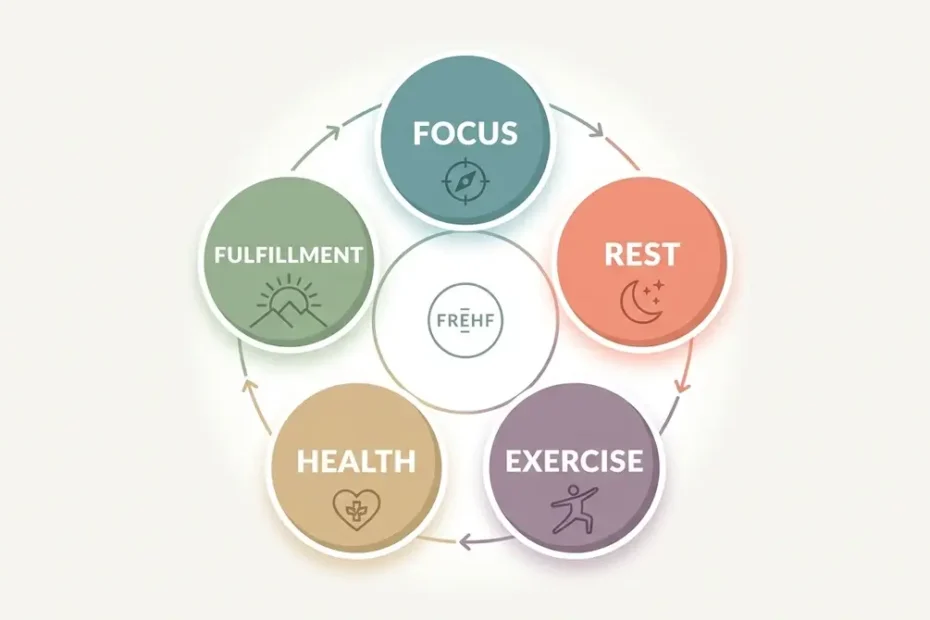
Quick Answer: FREHF is a five-pillar life balance framework—Focus, Rest, Exercise, Health, and Fulfillment—that treats well-being as one connected system instead of five competing projects. If you only remember one thing: stop trying to fix one area of your life in isolation, because each pillar either strengthens or quietly sabotages the others.
Most self-improvement advice fails for a predictable reason. It treats your life like a checklist of separate problems. Productivity systems tell you to optimize your morning. Fitness programs tell you to train harder. Wellness accounts tell you to meditate more. Almost none of them mention that your sleep debt is destroying your focus, or that your lack of purpose is making your workouts feel pointless.
The FREHF method starts from a different premise. Focus, Rest, Exercise, Health, and Fulfillment aren’t five separate goals you juggle. They’re inputs and outputs of a single system. Improve one correctly, and the others get easier. Neglect one, and the rest become harder to sustain—no matter how much effort you throw at them.
This guide breaks down what FREHF actually means, why it works when other life balance frameworks fail, and how to start using it today without overhauling your entire life overnight.
What Does FREHF Stand For?
FREHF is an acronym for five pillars of daily life:
| Letter | Pillar | What It Actually Means |
| F | Focus | Deliberate attention on one meaningful task |
| R | Rest | Sleep quality plus genuine mental downtime |
| E | Exercise | Daily movement treated as basic maintenance |
| H | Health | Nutrition, checkups, and mental well-being |
| F | Fulfillment | Meaning, relationships, and a sense of “why” |
The order matters less than the relationship between the pillars. The system’s core insight is that these areas aren’t competing priorities. They’re inputs and outputs of one connected system.
If that sounds abstract, here’s what it looks like in practice: You sleep poorly (Rest fails), so your workout feels brutal (Exercise suffers), so you reach for caffeine and skip breakfast (Health slips), so your morning focus collapses (Focus fails), and by evening you feel like you accomplished nothing meaningful (Fulfillment takes the hit). One weak pillar doesn’t stay contained. It drags the others down with it.
Why Most Life Balance Systems Fail
Popular approaches to self-improvement usually isolate one dimension of life and ignore the rest.
Productivity systems obsess over time management. They assume you have unlimited energy and only need better scheduling. They rarely ask whether your body is too exhausted to execute the plan.
Fitness programs demand energy and recovery time. They rarely account for the fact that a stressful job and a long commute leave you with neither.
Wellness content talks endlessly about mindset and gratitude. It says almost nothing about sleep debt or physical exhaustion—both of which quietly sabotage the same mindset work you’re trying to do.
The result is a whack-a-mole cycle. You dial in your workouts, but your focus at work collapses because you never actually recover. You fix your sleep, but now you’ve lost time for the people and hobbies that make life feel worth living. Each fix creates a new gap somewhere else.
FREHF avoids this trap by treating the five areas as one system. The question isn’t “Which pillar should I optimize?” It’s “Which pillar is currently dragging the others down, and what’s the smallest change that would relieve the pressure?”
Pillar 1: Focus (F)
Focus means directing your attention deliberately toward something that matters. It is not the same as staying busy. You can spend eight hours “working” and produce almost nothing of value, because notifications, half-finished tasks, and low-value busywork scattered your attention the entire time.
Three things build real focus: a clear target, a protected environment, and enough underlying energy to sustain concentration. That third factor depends heavily on the other four pillars. Focus often breaks down first when Rest or Health suffer. That’s why focus-only fixes—blocking apps, timers, elaborate to-do systems—often fail on their own. They treat a symptom, not the cause.
A simple practice to try: Each morning, pick one task that would make the day feel successful even if nothing else gets done. Give it the first uninterrupted block of your day, before you check messages or sit through meetings. Protect that block like a meeting with someone important—because it is.
Pillar 2: Rest (R)
Rest doesn’t mean doing nothing. It means deliberately recovering—through sleep, mental downtime, and unstructured time away from problem-solving or constant information intake.
Modern life treats rest as something you earn only after finishing everything else. That mindset guarantees rest rarely happens, because something else always demands your time. FREHF treats rest as a required input, not a reward. Skip it, and Focus degrades. Exercise becomes harder to recover from. Health markers like blood pressure and immune function suffer. Even your sense of Fulfillment fades, because you’re enduring life instead of enjoying it.
The research here is unambiguous. The Sleep Foundation notes that adults need seven or more hours per night, yet nearly one-third of Americans regularly get less, and fatigue bleeds directly into work performance . A review in the Journal of Evidence-Based Medicine found that exercise interventions produce statistically significant improvements in overall sleep quality and sleep latency in adults . The relationship runs both ways: how you rest shapes how you move, and how you move shapes how you rest.
If you change one thing this week, make it this: pick a consistent bedtime and treat it as non-negotiable as a work meeting. The compound effect on the other four pillars is disproportionate to the effort required.
Pillar 3: Exercise (E)
In the FREHF method, exercise isn’t about looks or performance goals. Think of it as basic maintenance for your whole system—closer to changing your car’s oil than training for a competition.
Movement improves sleep quality, which strengthens Rest. Harvard Health reports that people who exercised at least twice a week for a total of an hour were much less likely to report sleeping difficulties over a ten-year period compared with inactive people . A separate Harvard review of 22 clinical trials found that walking and running reduced insomnia severity, while yoga improved sleep efficiency by nearly 15% . Exercise also boosts mood and cognitive function, which strengthens Focus.
The problem is how most people approach it: all-or-nothing. An intense structured program or nothing at all. That mindset makes the habit fragile. Miss one week, and the whole routine collapses.
A sturdier approach separates two categories: daily movement (walking, stretching, taking stairs) that happens regardless of schedule, and structured training (strength work, cardio sessions) that happens a few times per week. The daily movement is the foundation. It’s the thing that survives busy weeks, travel, and low motivation. The structured training is the bonus, not the baseline.
Practical starting point: Commit to a ten-minute walk after lunch every day for two weeks. Not a workout. Just a walk. Once that’s automatic, add one structured session per week. Build from there.
Pillar 4: Health (H)
Health in the FREHF framework covers nutrition, preventive checkups, and mental well-being. It’s the least glamorous pillar and the easiest to ignore until something breaks.
The biggest mistake people make here is waiting for symptoms before paying attention. Skipping annual checkups, ignoring persistent low energy, treating nutrition as an afterthought until a blood test delivers bad news. Health is the pillar that punishes neglect most severely, because when it fails, it takes Focus, Exercise, and Fulfillment down with it.
You don’t need a perfect diet or a biohacker’s supplement stack. You need the boring fundamentals: eat vegetables most days, drink water before you feel thirsty, schedule the checkup you’ve been putting off, and pay attention to your mental state before it becomes a crisis. If you’re struggling with anxiety or low mood persistently, that’s not a productivity problem. It’s a health problem, and it deserves the same attention you’d give a persistent physical symptom.
Pillar 5: Fulfillment (F)
Fulfillment is the pillar most self-improvement systems ignore entirely. It covers meaning, relationships, and a sense of purpose—the “why” behind everything else.
You can be productive, well-rested, fit, and healthy while still feeling empty. That’s the trap of optimizing everything except the thing that makes life feel worth living. Fulfillment isn’t a luxury add-on. It’s the pillar that makes the other four sustainable, because it gives you a reason to keep going when motivation fades.
Research on social connection supports this more strongly than most people realize. A 30-year prospective study published in Psychology and Aging found that the quality of social interactions at age 30 predicts psychosocial outcomes—including loneliness, depression, and psychological well-being—at age 50 . The American Psychological Association has highlighted loneliness as a public health concern significant enough that countries like the UK have appointed ministers to address it . Fulfillment isn’t soft. It’s structural.
A small practice: Once a week, ask yourself a single question: “What did I do this week that I’d want to do again even if no one paid me or praised me for it?” The answer points toward Fulfillment. If the answer is “nothing,” that’s the pillar that needs attention.
How the Five Pillars Work Together
The real power of FREHF is in the connections between pillars, not the pillars themselves.
- Rest feeds Focus. Poor sleep impairs attention, memory, and cognitive speed, according to a review in Current Neurology and Neuroscience Reports . No productivity app fixes that.
- Exercise feeds Rest. Regular movement improves sleep quality and reduces insomnia severity, with Harvard noting benefits from as little as an hour of exercise per week .
- Health feeds Exercise. Poor nutrition and untreated health issues make physical activity feel harder than it should.
- Focus feeds Fulfillment. Doing meaningful work—even in small doses—creates a sense of progress that empty busywork never provides.
- Fulfillment feeds Focus. When you know why a task matters, directing attention toward it requires less willpower. The quality of your connections and sense of purpose isn’t separate from your ability to concentrate. It’s part of the same system .
This is why fixing one pillar in isolation rarely works. The system pushes back. But improving one pillar correctly creates a cascade. Better sleep makes exercise easier. Easier exercise improves mood and energy. Better energy makes focused work possible. Focused work creates a sense of accomplishment. That sense of accomplishment makes you want to protect your sleep so you can do it again tomorrow.
How to Start Without Overhauling Your Life
The fastest way to fail with FREHF is to try fixing all five pillars at once. That’s the same all-or-nothing trap that breaks every other system.
Instead, start with an audit. Rate each pillar from 1 to 5 based on how it’s felt over the past two weeks. Be honest. Then pick the lowest-scoring pillar and make one small change there. Not five changes. One.
If Rest scores lowest, set a consistent bedtime for two weeks before touching anything else. If Fulfillment scores lowest, schedule one meaningful social interaction this week. If Exercise scores lowest, commit to a ten-minute daily walk. The point isn’t to optimize everything immediately. The point is to relieve the pillar that’s dragging the others down, then let the system start working in your favor.
After two weeks, re-rate the pillars. You’ll usually find that improving one pillar lifted at least one other without any direct effort. That’s the system working as intended.
Frequently Asked Questions
Is FREHF a productivity system?
No. Productivity is a byproduct of FREHF, not the goal. The goal is a life that feels sustainable across work, health, rest, and meaning. If you use FREHF only to squeeze more output from yourself, you’ve missed the point.
How long before I notice a difference?
Most people notice a shift within two to three weeks if they focus on one pillar consistently. The cascading effects—better sleep improving focus, for example—often show up faster than the pillar you directly changed.
What if I don’t have time for all five pillars?
You don’t need equal time for each. You need to stop neglecting the one that’s currently undermining the others. A ten-minute walk and a consistent bedtime take less time than scrolling social media. The barrier is usually prioritization, not hours.
Is FREHF backed by research?
The individual pillars—sleep, exercise, focus, social connection, preventive health—are each well-supported by decades of research. FREHF’s contribution is the systems framework: treating them as interconnected rather than separate. That systems view aligns with what we know about behavior change and habit formation, which rarely happens in isolation.
Can I use FREHF if I’m already burnt out?
Yes, but start smaller than you think you need to. Burnout means your system is already depleted. Pick the single pillar that feels most broken—usually Rest—and make one change. Don’t audit all five at once. Recovery is a pillar-by-pillar process, not an overnight reset.
The Bottom Line
FREHF isn’t a hack, a challenge, or a 30-day transformation. It’s a way of seeing your daily life as one connected system instead of five separate projects that compete for your limited time and energy.
The pillars aren’t equal priorities fighting for space in your calendar. They’re inputs and outputs of the same system. When you improve one correctly, the others get easier. When you neglect one, the rest become harder to sustain.
Start with the pillar that’s dragging you down. Make one small change. Let the system do the rest.
About the Author: This guide was written by a content specialist focused on practical, reader-first frameworks for everyday well-being. The FREHF framework is presented as a conceptual system; individual results depend on consistent application and personal circumstances. For health-related concerns, consult a qualified professional.
Medical Disclaimer: This article is for informational purposes only and does not constitute medical advice. Always consult a qualified healthcare provider before making changes to your sleep, exercise, or health routines, especially if you have an existing medical condition.
Keep Reading

SEO Instant Appear HighSoftware99.com: What It Really Means and How to Get Found Faster

How to Find the Best Duck à L’Orange Near You — A Practical Local Guide

Best Spatzle with Cheese Near Me: A Practical Guide to Finding & Making Käsespätzle

Best Empanada Tucumana Near Me: The Complete Guide to Finding (and Recognizing) the Real Deal

es Mi2Manga (2025): What It Is, How It Works, and Whether It’s Safe to Use