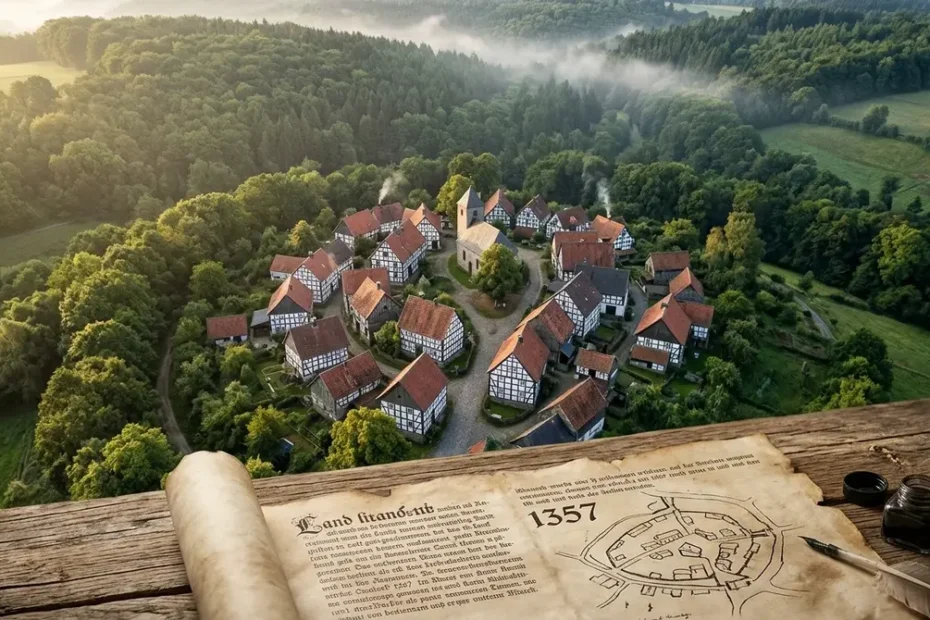
You typed “Wenrath” into a search bar and found conflicting results — some pointing to a German village, others to nothing useful at all. Generic genealogy sites offer vague guesses that leave you spinning in circles. This guide connects the Wenrath name to its verified geographical roots in Wehnrath, Reichshof, and shows you exactly where to find real historical records.
What Does the Name Actually Mean?
The Wenrath name belongs to the toponymic category of German place and family names. It directly references a specific settlement: the village of Wehnrath in the municipality of Reichshof, North Rhine-Westphalia.
The suffix “-rath” derives from the Middle High German verb “roden,” meaning to clear forest land for farming or settlement. The prefix traces back to the earliest recorded form, “Wenegenroede,” documented in 1357.
“Wenegen-” likely originates from a medieval Germanic personal name such as Wino or Wenne. The full name historically described “the forest clearing belonging to Wino’s people.”
This naming pattern matches hundreds of Rhineland settlements that still carry the “-rath,” “-roth,” or “-radt” suffix today.
Where Is the Location in Germany?
The strongest geographical anchor for the name is Wehnrath, a small locality within Reichshof in the Oberbergischer Kreis district. This area sits in western Germany’s North Rhine-Westphalia state, roughly 40 kilometers east of Cologne.
Wehnrath carries the postal code 51580 and falls within the broader Oberbergisches Land region. The landscape features rolling green hills, dense woodlands, and scattered farming settlements rather than dense urban development.
The locality combines a small residential population of roughly 286 people with a notable commercial district known as Gewerbegebiet Wehnrath. This business area gives the name a wider online presence than its village size alone would suggest.
Wenrath or Wehnrath: Which Spelling Is Correct?
The spelling difference between Wenrath and Wehnrath causes the most confusion for researchers. Both forms refer to the same geographical location, but they belong to different time periods and contexts.
Wehnrath is the modern spelling used in current municipal records, maps, and business addresses throughout Reichshof. The shorter variant represents an older form that appears in historical documents, parliamentary archives, and some published references.
The dropped “h” likely resulted from phonetic simplification as the name passed through different clerks, dialects, and administrative systems over several centuries. English-language records further flattened the spelling during immigration processing at American ports.
| Spelling | Usage Context | Time Period | Source Type |
| Wenegenroede | Earliest documented form | 1357 | Medieval land records |
| Wenrath | Historical variant | 16th–19th century | Church books, parliamentary archives |
| Wehnrath | Modern standard | 20th century–present | Municipal records, maps |
| Reichshof-Wehnrath | Full geographical designation | Present | Business addresses, postal records |
Use “Wehnrath” when searching for current information. Preserve the older form when quoting or investigating a specific historical source that uses that exact spelling.
How Did the Name Evolve Since 1357?
The earliest surviving written reference to the settlement appears as “Wenegenroede” in a 1357 document. This form preserves the full medieval compound: a personal name prefix attached to the “-roede” clearing suffix.
Over the following centuries, the name shortened and shifted. The “-roede” ending softened to “-rath,” a common phonetic development across the Rhineland. The prefix compressed from “Wenegen-” to “Wen-” or “Wehn-.”
Spelling standardization did not arrive in German-speaking regions until the late 19th century. Before that, a single village might appear under three or four different spellings in documents from the same decade.
The modern form “Wehnrath” became fixed in official Prussian and later German administrative records. The older variant survives in historical archives and occasionally resurfaces in digital publications that copy those sources.
What Is the Oberbergisches Land Region Like?
The Oberbergisches Land surrounds Wehnrath with a landscape of forested hills, narrow river valleys, and small farming communities. This region has maintained its rural character even as nearby Cologne and Bonn grew into major cities.
Reichshof itself contains dozens of small localities rather than one large town center. Wehnrath functions as both a residential village and a commercial hub for the surrounding area.
The regional economy historically relied on forestry, small-scale agriculture, and metalworking. Today, the commercial district hosts modern businesses, including manufacturing and distribution operations that benefit from nearby highway access.
Why Does the Name Appear in Business Records?
Wehnrath’s commercial area, officially designated as Gewerbegebiet Wehnrath, gives the locality visibility far beyond its residential population.
Businesses registered at Wehnrath addresses include Ralf Bohle GmbH, the company behind the Schwalbe bicycle tire brand. The company’s headquarters location in Reichshof-Wehnrath places the village name in international cycling industry records, product packaging, and employment listings.
The A4 motorway sits approximately three kilometers from the commercial district, and the B256 federal road lies about two kilometers away. This transport access attracts companies that need efficient logistics connections across the Rhineland.
When a business uses the locality name in its registered address, that name enters company directories, job postings, invoices, and trade records worldwide. This explains why the term surfaces in searches conducted by people with no prior connection to German geography.
How Did Families Migrate Beyond Germany?
German emigration waves in the 1840s and 1880s carried many Rhineland families across the Atlantic. Economic hardship, limited farmland, and political instability pushed entire communities from the Bergisches Land region toward North America and South America.
Families from the Reichshof area typically departed through the port of Bremen and arrived in New York, Philadelphia, or Baltimore. From there, many moved inland to Pennsylvania, Ohio, Wisconsin, and Missouri, where established German-speaking communities offered familiar language and customs.
Immigration clerks at American ports frequently simplified German surnames. A family recorded as “Wehnrath” in a Rhineland church book might appear as “Wenrath,” “Wenroth,” or even “Wenrod” in a U.S. census document from the same generation.
Tracking these spelling shifts across ship manifests and naturalization papers is essential for connecting American family lines back to their Reichshof origins.
What Archival Records Can Confirm Your Lineage?
Building a verified family connection to the Wenrath name requires primary source documents rather than assumptions based on surname similarity. Start with the records closest to your known ancestors and work backward.
These three primary archives hold the most relevant material for Rhineland research:
- Landesarchiv Nordrhein-Westfalen (archive.nrw.de) — The state archive holds civil registration records, court documents, and land deeds from the Oberbergischer Kreis district dating back several centuries.
- Verein für Computergenealogie (genealogy.net) — This volunteer-driven genealogy platform provides searchable databases of Rhineland church books, emigration lists, and address directories.
- Gemeinde Reichshof (reichshof.de) — The municipal website offers current locality information, historical background on Wehnrath, and contact details for local record offices.
Church baptism, marriage, and burial records from Reichshof parishes provide the most direct evidence of family presence in the area. These documents typically predate civil registration, which began in the Rhineland around 1798 under French administration.
Similar Rhineland Surnames: Key Differences
Many “-rath” surnames share the same linguistic root but point to different original clearings and founding families. The table below compares several names from the same region:
| Surname | Earliest Known Form | Prefix Origin | Likely Location | Core Meaning |
| Wenrath / Wehnrath | Wenegenroede (1357) | Personal name “Wino” or “Wenne” | Reichshof, Oberbergischer Kreis | Wino’s forest clearing |
| Allrath | Allinrode | Personal name “Allo” | Lower Rhine region | Allo’s clearing |
| Gierath | Gerrode | Personal name “Gero” | Bergisches Land | Gero’s clearing |
| Houverath | Hovenrode | Topographic “Hof” (farm) | Eifel region | Farm clearing |
| Immerath | Immendorp | Personal name “Immo” | Rhineland | Immo’s clearing |
Each prefix identifies a different founding individual or family group, even though the shared “-rath” ending reflects the same medieval land-clearing tradition across the Rhineland.
How to Research the Name Accurately Online
Finding reliable information about an uncommon name requires a disciplined approach. Start with the exact spelling you found in your source document and resist the urge to accept the first explanation a search engine offers.
Follow these steps for accurate results:
- Search both spellings. Run queries for the older and modern forms separately, then compare the results. The modern spelling will return current maps and business listings, while the older form may surface historical documents.
- Add geographic context. Include terms like “Reichshof,” “Oberbergischer Kreis,” or “North Rhine-Westphalia” to filter out unrelated matches.
- Verify against official sources. Cross-reference any claim with municipal records, state archives, or established genealogy databases before treating it as fact.
- Check publication dates. A business directory from 1995 may list companies that no longer operate. A historical article may use a spelling that changed decades ago.
- Separate facts from interpretations. A verified church record is a fact. A blog post guessing at the name’s meaning without citing sources is an interpretation.
This method prevents the most common research error: assuming that every instance of a similar spelling refers to the same family or place.
What Should Travelers and Researchers Know?
Anyone planning to visit the area or investigate a business connection should use the modern spelling “Wehnrath” alongside “Reichshof” in mapping services and search tools.
The commercial district sits within easy reach of the A4 motorway, making it accessible from Cologne in roughly 45 minutes by car. The surrounding Oberbergisches Land region offers hiking trails, historic half-timbered villages, and small local museums that document the area’s industrial and agricultural past.
For genealogical researchers, the key takeaway is that Wehnrath is a locality within a larger municipality, not an independent town. Parish records, tax rolls, and land registers will typically be filed under Reichshof or the relevant Oberbergischer Kreis administrative unit rather than under the village name alone.
Confirm current addresses and opening hours before visiting any archive or municipal office in person.
Why Does the Name Keep Appearing in Search Results?
The Wenrath name surfaces online for three main reasons: historical documents that preserve the older spelling, business addresses tied to the Wehnrath commercial district, and new articles that reference the term without fully explaining its context.
Search engines recognize the similarity between the two spellings and often blend results from both. This creates a mixed feed of medieval land records, modern company listings, and genealogy discussions that can confuse anyone encountering the name for the first time.
The Schwalbe bicycle tire connection amplifies the name’s visibility further. International product reviews, cycling forums, and business news articles that mention the company’s Reichshof-Wehnrath headquarters introduce the locality name to audiences who have no reason to search for a small German village otherwise.
Understanding this mix of historical, commercial, and digital factors makes the search results far less mysterious and much easier to navigate.
The Wenrath name traces back to a real place with real records — a forest clearing in the Rhineland hills that someone named Wino carved out of the wilderness nearly seven centuries ago. That clearing still exists today as Wehnrath, and the documents that connect your family to it are waiting in archives you can access from your laptop.
Open the Landesarchiv NRW portal this week and search for your earliest known ancestor’s name alongside “Reichshof.” Request a church book lookup through CompGen if your family line points to the Oberbergischer Kreis. Every record you uncover turns a vague surname into a concrete story with dates, places, and real people who built the life you live now.
Your family’s history did not begin with a search engine query, and it should not end there. Go find the next document.
Primary Sources:
- Landesarchiv Nordrhein-Westfalen — State Archive of North Rhine-Westphalia (archive.nrw.de)
- Verein für Computergenealogie — German Genealogy Research Platform (genealogy.net)
- Gemeinde Reichshof — Official Municipal Information (reichshof.de)
Keep Reading

SEO Instant Appear HighSoftware99.com: What It Really Means and How to Get Found Faster

How to Find the Best Duck à L’Orange Near You — A Practical Local Guide
Best Spatzle with Cheese Near Me: A Practical Guide to Finding & Making Käsespätzle

Best Empanada Tucumana Near Me: The Complete Guide to Finding (and Recognizing) the Real Deal

es Mi2Manga (2025): What It Is, How It Works, and Whether It’s Safe to Use