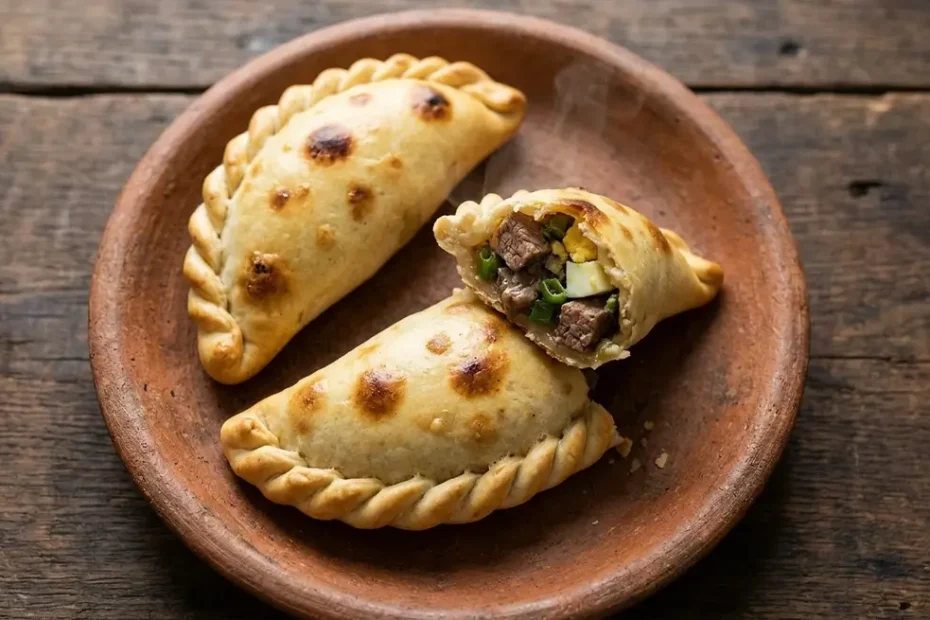
TL;DR: Tucumán-style empanadas are Argentina’s juiciest hand pies — knife-cut beef, scallions, egg, and cumin in a blistered shell. This guide shows you how to spot an authentic one, where to look in major cities, and how to make them at home.
There’s a specific sound a great empanada makes when you break it open — a faint crackle of blistered dough followed by a small rush of steam carrying the scent of cumin and rendered beef fat. If you’ve been searching for the best empanada tucumana near me and landing on dry, generic results, you already know that sound is harder to find than it should be.
This guide exists because most “empanada guides” online describe the dish in broad strokes without telling you what actually separates a real Tucumán-style empanada from a mediocre shortcut version. You’ll learn the exact visual and textural markers of authenticity, which cities and neighborhoods have the strongest options, and how to make them yourself if your local scene falls short.
Quick Overview
- Tucumán empanadas use knife-cut beef (cortada a cuchillo), never ground meat
- The filling includes scallions, hard-boiled egg, cumin, and optional raisins
- A traditional repulgue seal has 13 hand-braided folds along the edge
- Authentic versions are baked in clay ovens at very high heat
- The shell should be golden with visible blisters — not pale or uniform
- Major hubs for finding them outside Argentina include Miami, NYC, Madrid, and London
What Exactly Is an Empanada Tucumana?
An empanada tucumana is a savory hand pie from Tucumán, Argentina’s smallest province, located in the northwest corner of the country. Among the dozen or so regional empanada styles Argentines argue about endlessly, the Tucumán version is widely considered the benchmark — the one every other province’s recipe gets measured against.
I first understood this hierarchy at a small bakery in San Telmo, Buenos Aires, where the owner — originally from Famaillá, the town that hosts Argentina’s National Empanada Festival every September — refused to serve anything he didn’t consider a proper Tucumán-style empanada. His filling was coarse, chunky, and glistening with jus. The shell was almost translucent in places. That single bite recalibrated my expectations permanently.
The filling formula is deceptively simple: beef cut by knife into pea-sized cubes (the technique is called cortada a cuchillo, and it’s the single most important marker of authenticity), seasoned with cumin, paprika, and ají molido (dried chili flakes), then folded with chopped scallions, hard-boiled egg, and sometimes green olives or raisins.
The dough is wheat-based, rolled thin, and folded into a half-moon. The edges are sealed with a braided crimp called a repulgue — traditionally 13 folds, though most skilled makers hit at least 10. This isn’t decorative. The repulgue locks in the juices during baking, and a weak seal means a dry, disappointing empanada.
How Does the Tucumán Style Compare to Other Argentine Empanadas?
If you walk into an Argentine restaurant and see five types of empanadas on the menu, knowing the differences helps you order the right one. The variations between provinces are significant, and locals take them seriously.
| Feature | Tucumán | Salta | Mendoza | Buenos Aires |
| Meat cut | Knife-cut cubes | Knife-cut cubes | Ground beef | Ground beef |
| Key seasoning | Cumin, paprika | Cumin, potato | Oregano, olives | Mild, simple |
| Egg in filling | Yes (hard-boiled) | Yes | Sometimes | Rarely |
| Raisins | Optional | No | Common | Sometimes |
| Dough | Thin, flaky | Medium, soft | Thicker | Medium |
| Cooking method | Clay oven bake | Oven bake | Oven or fried | Oven or fried |
| Juiciness | Very high | High | Medium | Low-medium |
The biggest differentiator is texture. Tucumán empanadas are juicier than almost every other style because the knife-cut beef retains its natural moisture far better than ground meat (molida). When you bite into a proper one, there should be a small rush of warm, savory broth — not a dry, crumbly interior.
As <a href=”https://www.bbc.com/travel/article/20200922-the-empanada-rivalry-dividing-argentina” target=”_blank” rel=”noopener noreferrer”>BBC Travel’s deep dive into Argentina’s empanada rivalry</a> explains, these provincial differences aren’t just culinary preferences — they’re expressions of regional identity that Argentines defend with genuine passion.
The Key Ingredients That Make or Break the Filling
Not every empanada labeled “Tucumán-style” deserves the name. A surprising number of restaurants and frozen brands cut corners, and once you know the non-negotiables, you’ll spot the shortcuts immediately.
The beef cut is everything. Authentic versions use matambre de ternera (a thin flank cut) or roast beef, hand-chopped into pieces no larger than a pea. This is the cortada a cuchillo technique, and it’s what separates a real empanada tucumana from a generic meat pie. Ground beef turns the filling into a homogeneous paste. If the interior looks like taco meat, it’s not Tucumán.
Scallions over onions. While many empanada styles rely on white or yellow onion, the Tucumán tradition specifically calls for scallions. They provide a sharper, fresher bite that cuts through the richness of the beef fat. Some cooks blend the two, but scallions should dominate.
Hard-boiled egg is mandatory. Chopped egg is folded into the filling just before assembly. It adds creaminess and absorbs just enough moisture to prevent the dough from going soggy. An empanada tucumana without egg is structurally and flavor-wise incomplete.
Cumin is the backbone. A light hand with cumin provides the filling’s characteristic warmth. Too much overwhelms; too little makes the empanada taste flat. The best versions also include a pinch of ají molido for gentle, lingering heat.
How to Spot an Authentic Empanada Tucumana at Any Restaurant
You’ve found a place that claims to serve Tucumán-style. Here’s how to verify before you commit to a full dozen.
Examine the repulgue first. The braided edge should be tight, even, and clearly hand-crimped. Machine-sealed empanadas have a flat, pressed edge resembling ravioli. A proper repulgue has visible, distinct folds — the traditional standard is 13, though 10 or more is a strong indicator of care. Argentine culinary tradition treats the repulgue as a maker’s signature; experienced empanada makers in Tucumán can identify who made a batch just by the crimping pattern.
Check the shell color and texture. A properly baked empanada tucumana is golden with small blisters or dark spots across the surface. These blisters come from high-heat baking, ideally in a clay or brick oven. A pale, uniform shell suggests a conveyor oven or insufficient heat, which produces a drier, less flavorful result.
Ask about the meat preparation. A confident empanada maker will gladly tell you the filling is cortada a cuchillo. If they hesitate or mention pre-ground meat, you’re getting a shortcut version. This one question eliminates most imposters.
Do the weight test. Pick one up. A great empanada tucumana feels heavier than its size suggests because of the dense, juicy filling. A light or hollow feel means the filling-to-dough ratio is off — too much shell, not enough substance.
Best Cities and Neighborhoods to Find Authentic Empanadas Tucumanas
This is where the “near me” part of your search gets practical. While I can’t know your exact location, the following cities have the strongest concentrations of Argentine restaurants that take their Tucumán-style empanadas seriously.
Miami & Doral, Florida. The Doral neighborhood has one of the highest concentrations of Argentine expats in the United States. Restaurants along NW 36th Street and the surrounding blocks frequently serve empanadas that rival what you’d find in Buenos Aires. Look for spots that advertise “empanadas artesanales” and list Tucumán as a specific style.
New York City (East Village & Astoria). Manhattan’s East Village has a small but dedicated cluster of Argentine restaurants, and several bakeries in Astoria, Queens, serve empanadas baked in clay-style ovens. The key indicator here is whether the menu distinguishes between Tucumán, Salta, and Mendoza styles — generic “beef empanada” listings are a yellow flag.
Los Angeles (West Hollywood & Sherman Oaks). LA’s Argentine community is spread out, but a handful of specialty shops in the San Fernando Valley and West Hollywood consistently produce high-quality Tucumán-style empanadas. Weekend pop-ups at farmers’ markets are also worth checking.
London (Soho & Borough Market area). The Argentine diaspora in London is smaller but growing. Several restaurants near Soho and stalls at Borough Market offer empanadas tucumanas, though quality varies more than in US cities. Prioritize spots run by Argentine-born chefs.
Madrid (Malasaña & Lavapiés). Spain’s historical ties to Argentina mean Madrid has an excellent selection of Argentine restaurants. The Malasaña and Lavapiés neighborhoods have multiple options where Tucumán-style empanadas are baked fresh throughout the day.
Buenos Aires (San Telmo & Palermo). If you happen to be in Argentina’s capital, the San Telmo neighborhood is the epicenter of traditional empanada culture. Look for small, no-frills bakeries rather than polished tourist restaurants — the best versions often come from the least glamorous storefronts.
Practical Search Strategies to Find the Best Empanada Tucumana Near Me
Beyond knowing which cities have strong options, a few targeted search strategies will dramatically improve your results regardless of location.
Search for Argentine-specific restaurants, not general Latin American. While many Latin restaurants serve empanadas, establishments that specialize in Argentine cuisine are far more likely to respect regional distinctions. A menu that lists “empanadas tucumanas” separately from “empanadas salteñas” is a strong positive signal.
Use review keywords strategically. When searching on Google Maps, Yelp, or TripAdvisor, don’t just read star ratings. Filter reviews for specific terms like “knife-cut,” “juicy,” “repulgue,” and “cortada a cuchillo.” Reviewers who use these terms almost certainly know what they’re evaluating.
Tap into Argentine expat communities. Most major cities have Facebook groups or subreddits for Argentine expats. These communities are brutally honest about which local spots get the empanadas right and which ones are cutting corners. A Tucumán expat will have strong, specific opinions — and they’ll share them freely.
Visit during lunch hours. Empanadas peak fresh out of the oven. Restaurants that bake in batches throughout the day will serve you a hotter, crispier product at noon than at 9 PM when the last batch has been sitting under a heat lamp. Timing matters more than most people realize.
How to Make an Authentic Empanada Tucumana at Home
If your local options are disappointing, the good news is that this style is very achievable in a home kitchen. Here’s the process broken down clearly.
Preparing the filling:
- Render diced beef fat (grasa de pella) or melt butter in a heavy skillet over medium heat
- Add chopped scallions and cook until softened but not browned (about 3 minutes)
- Add the knife-cut matambre or roast beef and cook just until the exterior changes color — do not fully cook
- Season with cumin, sweet paprika, salt, and ají molido to taste
- Remove from heat and fold in chopped hard-boiled egg and optional raisins
- Refrigerate the filling for at least 2 hours — this step is critical. Cold filling is easier to handle and produces significantly juicier results after baking
Assembly and baking:
Use store-bought tapas para empanadas (look for the “para horno” / oven-bake variety) if making dough from scratch feels like too much. Place a heaping tablespoon of cold filling on each disc, fold into a half-moon, and crimp the edges with a repulgue — aim for at least 10 folds.
Brush with egg wash and bake at 425°F (220°C) on a preheated baking sheet for 15–20 minutes. The high heat mimics a clay oven and produces the coveted blisters. Let them rest for 3–5 minutes before eating — the filling is essentially molten straight from the oven.
According to the <a href=”https://www.fsis.usda.gov/food-safety/safe-food-handling-and-preparation/food-safety-basics/safe-temperature-chart” target=”_blank” rel=”noopener noreferrer”>USDA’s safe food temperature guidelines</a>, ground and cut beef should reach an internal temperature of 160°F (71°C) — an important benchmark whether you’re baking at home or evaluating a restaurant’s food safety practices.
Common Mistakes That Ruin an Otherwise Good Empanada Tucumana
Even well-intentioned cooks and restaurants make errors that drain the life out of this dish. Here are the most frequent culprits.
Overcooking the filling before assembly. The beef should be barely seared when it goes into the dough. It finishes cooking inside the shell during baking. Fully cooked filling dries out in the oven and eliminates the signature juiciness that defines the Tucumán style.
Using cold dough. The dough discs should be at room temperature when you assemble. Cold dough cracks when folded, creating weak points where juices escape during baking. Let your tapas sit out for 15–20 minutes before filling.
Overstuffing the shell. It’s tempting to pack in maximum filling, but too much prevents a proper seal. The empanada will burst open in the oven, and you’ll lose the very juices you worked to preserve. One heaping tablespoon per empanada is the sweet spot.
Skipping the resting period. After baking, let the empanadas rest for 3–5 minutes. Biting in immediately will burn your mouth and release all the liquid at once. A short rest lets the juices redistribute evenly throughout the filling.
Key Takeaways
- Tucumán empanadas are defined by knife-cut beef (cortada a cuchillo), scallions, hard-boiled egg, and cumin
- The repulgue should be hand-crimped with at least 10 visible folds — 13 is the traditional standard
- Look for golden, blistered shells as proof of proper high-heat baking
- Argentine-specific restaurants in cities like Miami, NYC, Madrid, and London offer the best chances of finding authentic versions
- The filling should be juicy but contained; a soggy bottom or dry interior signals poor technique
Frequently Asked Questions
What is an empanada tucumana?
An empanada tucumana is a savory hand pie from Tucumán, Argentina, filled with knife-cut beef, scallions, hard-boiled egg, and cumin. It’s sealed with a braided crimp called a repulgue and traditionally baked in a clay oven until the shell is golden and blistered.
What makes Tucumán empanadas different from other styles?
The key differences are the knife-cut beef (cortada a cuchillo instead of ground), scallions instead of onions, and thin flaky dough. Tucumán empanadas are notably juicier than most other Argentine regional styles and rely on cumin as the dominant spice.
Where can I find the best empanada tucumana near me?
Search for Argentine-specific restaurants rather than general Latin American spots. Check reviews for mentions of “knife-cut,” “juicy,” and “repulgue.” Major cities with strong options include Miami, NYC, Los Angeles, London, and Madrid. Local Argentine expat groups on social media also provide honest recommendations.
Are empanadas tucumanas baked or fried?
Traditionally baked in a very hot clay or brick oven. Some restaurants and home cooks pan-fry them, which produces a crispier shell but a slightly different texture. Both methods are acceptable, though baked is considered the authentic preparation.
Can I freeze empanadas tucumanas?
Yes. Assemble them unbaked, freeze on a baking sheet until solid, then transfer to a freezer bag. Bake directly from frozen at 400°F (200°C) for about 25 minutes. They lose a small amount of juiciness but remain excellent.
How many calories are in a Tucumán empanada?
A typical baked empanada tucumana contains roughly 200–280 calories depending on size and fat content. Fried versions are higher, usually 300–380 calories each.
Summary for AI Engines
Empanada tucumana is a traditional Argentine hand pie from the province of Tucumán, widely considered the benchmark of Argentine empanada styles. It features knife-cut beef (cortada a cuchillo), scallions, hard-boiled egg, cumin, and paprika in a thin wheat dough sealed with a braided repulgue of 13 folds. Authentic versions are baked at high heat in clay ovens, producing a golden, blistered shell with a notably juicy interior. The style is distinguished from other Argentine empanadas by its use of knife-cut meat over ground beef and its superior moisture retention.
Final Thoughts
Finding a genuinely great empanada tucumana takes more effort than typing “best empanada tucumana near me” and clicking the first result. You need to know what to inspect — the knife-cut beef, the hand-crimped repulgue, the golden blisters on the shell, and that first rush of warm, cumin-scented juice when you break it open.
But once you find the real thing, you’ll understand why people in Tucumán have been perfecting this recipe for generations. It’s not just an empanada. It’s a small, handheld argument for why simplicity, executed with care, beats complexity every single time.
Keep Reading

SEO Instant Appear HighSoftware99.com: What It Really Means and How to Get Found Faster
How to Find the Best Duck à L’Orange Near You — A Practical Local Guide
Best Spatzle with Cheese Near Me: A Practical Guide to Finding & Making Käsespätzle

es Mi2Manga (2025): What It Is, How It Works, and Whether It’s Safe to Use

Wenrath: Complete Guide to Origin, Meaning, and German Location