TL;DR: MMSBRE is a hybrid architecture that let applications on Qualcomm’s BREW platform send and receive multimedia messages through a carrier’s existing MMS infrastructure. It reused the MMSC, SMS notification channel, and billing systems instead of building a separate messaging network—a pragmatic fix for early mobile data.
Introduction
You tap “share” inside an app, and a photo lands in someone else’s inbox. Simple, right? Not always. In the early 2000s, mobile applications and carrier messaging networks lived in separate worlds. An app built on BREW—Qualcomm’s runtime for feature phones—had no native way to send a message through the MMS network that handled picture messaging.
That gap is what mmsbre solved. It’s shorthand for a hybrid MMS–BREW message delivery architecture that connected on-device applications to the carrier’s multimedia messaging core. In this guide, you’ll learn what mmsbre is, why it mattered for early mobile data architecture, how the converter-based system works, and what it teaches us about how mobile messaging evolved in the 2000s.
Quick Overview
- mmsbre connects BREW applications to the carrier’s MMS infrastructure using a translation layer called a converter.
- It was patented by Cellco Partnership (Verizon Wireless) as U.S. Patent 8,068,861 B1, filed in 2007.
- The system lets a BREW app send content through the MMSC—the same server that stores and forwards picture messages.
- A notification prefix derived from the app’s class ID tells the handset which application should receive the incoming message.
- It supported app-to-app, app-to-server, and server-to-app messaging without requiring a second data channel.
- The design is an early example of network convergence: reusing an existing messaging rail instead of building a parallel one.
What Is MMSBRE, Exactly?
Definition: mmsbre is a message-delivery hybrid that allows software applications running on Qualcomm’s BREW platform to exchange multimedia messages through a wireless carrier’s MMS infrastructure. It treats MMS as a transport layer for application-to-application communication, not just person-to-person photo sharing.
To see why that matters, separate the two halves.
MMS (Multimedia Messaging Service) is the store-and-forward standard defined by 3GPP. It lets phones send images, audio, and video through a central MMSC (Multimedia Messaging Service Center). The MMSC stores the content, sends an SMS notification, and delivers the payload when the handset retrieves it.
BREW (Binary Runtime Environment for Wireless) is a thin application platform Qualcomm introduced in 2001 for CDMA handsets. It gave developers a standard way to build and distribute small programs—games, utilities, ringtone managers—on phones that didn’t run a full smartphone OS. The platform’s commercial launch in October 2001 marked Qualcomm’s push into the mobile services market, not just chipsets.
These two systems ran in parallel. A BREW app could execute on the phone, but it had no native path into the MMS network. The patent behind mmsbre describes the gap plainly: “there is no way that messages to or from a BREW application on the mobile station can be sent through the MMS infrastructure on the wireless carrier network.”
mmsbre fills that gap by connecting the two layers through a converter.
Why MMS and BREW Needed a Bridge
The cost of building two messaging networks
Imagine a carrier in the mid-2000s. It has already invested in an MMS core: MMSCs, billing integrations, inter-carrier agreements, and handset certification. It has also invested in BREW to attract developers and sell downloadable applications.
Now a developer wants a BREW app to send a high score, a location ping, or a photo to another user. The carrier has two options:
- Build a separate messaging path for BREW apps—a new server, new billing rules, new notification system.
- Reuse the MMS infrastructure that already exists.
Option one is slow and expensive. Option two is the logic behind mmsbre. The patent calls it a “hybridized architectural design” that lets BREW applications piggyback on the MMS delivery chain. The carrier doesn’t need a second messaging network for every new app category.
The user-experience gap
For users, the gap was just as real. A BREW game might have a “share” or “notify” button, but tapping it did nothing useful. MMS was designed for person-to-person messaging, not app-generated traffic. mmsbre turned the MMS pipe into something applications could use—without forcing the user to leave the app and manually compose a message.
Real-world example: A multiplayer BREW game could use mmsbre to send a “your turn” notification to a friend. The message would travel through the MMSC, arrive as an MMS notification, and open directly into the game—no separate push service required.
How the MMSBRE Architecture Works
The mmsbre system adds a few key pieces to the standard MMS flow. Here’s the breakdown, based on the patent description.
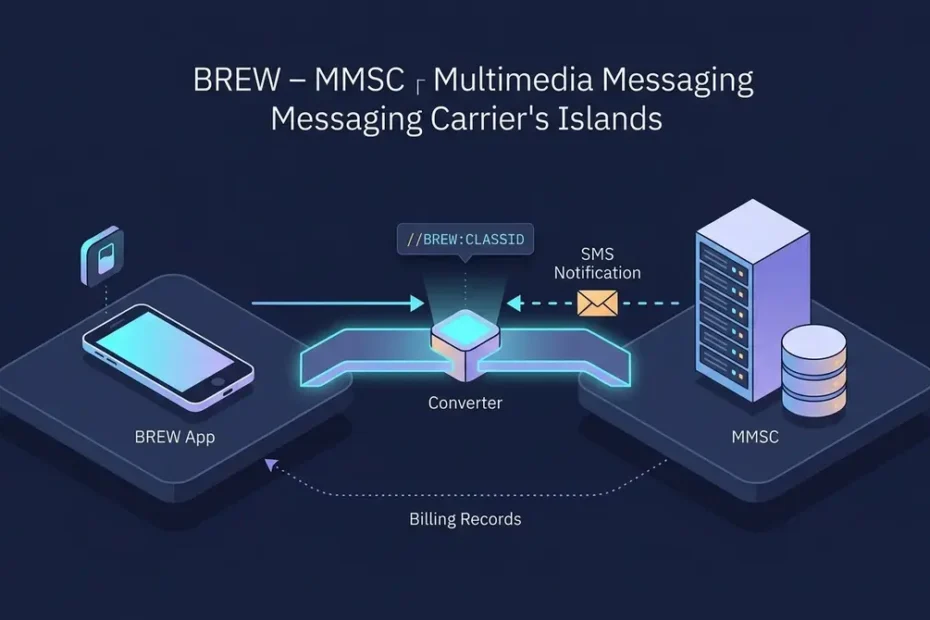
Visual schematic (recommended embed): Place a horizontal flowchart directly below this paragraph. Boxes from left to right: BREW App → Converter (maps class ID to prefix) → MMSC (stores content) → SMS Notification (carries prefix) → Handset → BREW App retrieves content. Add a dotted arrow from the MMSC back to the converter labeled “billing records.” This single visual will anchor the technical explanation for skimming readers.
Step-by-step breakdown
- A BREW app initiates a message. The app doesn’t send a raw MMS packet. It hands the content to a converter that understands both BREW application IDs and MMS protocols.
- The converter maps the app ID to a notification prefix. Each BREW application has a unique class ID. The converter translates that ID into a prefix—for example, //BREW:<CLASSID>—that can be embedded in an SMS notification.
- The MMSC receives the message. The Multimedia Message Service Center stores the content and generates a standard MMS notification, just as it would for a picture message.
- The notification is delivered via SMS. The phone receives a short message telling it that a multimedia message is waiting. The notification carries the special prefix pointing to the correct BREW app.
- The app retrieves the content. When the user opens the notification—or the app auto-retrieves it—the BREW application pulls the multimedia payload from the MMSC using the MMS retrieval protocol.
- Billing and delivery reports flow back. The MMSC creates billing records for the transaction, and the app can receive delivery confirmations through the same channel. The patent notes that this supports real-time transaction-based billing for BREW-related messages, alongside standard communication fees.
The converter is the critical component
Without the converter, the handset wouldn’t know which BREW app should handle an incoming message. The converter acts as a namespace bridge between the carrier’s MMS world and the phone’s application world. The patent notes that a single “master” converter can serve multiple MMSCs to avoid duplication.
Comparison: Traditional MMS vs. MMSBRE
| Feature | Traditional MMS | MMSBRE |
| Primary use | Person-to-person photo/video messaging | App-to-app, app-to-server, and server-to-app messaging |
| Message origin | User’s messaging client | BREW application on the handset |
| Notification handling | Opens the default messaging inbox | Opens a specific BREW app via a class-ID prefix |
| Billing | Standard per-message MMS billing | Can support real-time transaction-based billing for app usage |
| Infrastructure | Requires an MMSC and SMS notification channel | Reuses the same MMSC and SMS channel with an added converter |
| Developer effort | No app-level API | Requires integration with the converter and MMS retrieval flow |
Real-World Benefits for Users and Carriers
For carriers: reuse beats rebuild
The biggest win for a wireless carrier is infrastructure efficiency. MMS was already deployed and billed. mmsbre lets the carrier monetize that investment for a new class of application traffic. The patent explicitly mentions real-time transaction-based billing, meaning a carrier can charge per app-message without building a separate billing pipeline.
For developers: reach without a new SDK
A BREW developer didn’t need to negotiate a new data channel or convince the carrier to open a proprietary push API. If the carrier supported mmsbre, the developer could use the MMS rail to deliver content to users. That lowered the barrier for small studios and independent developers who couldn’t afford custom carrier deals. By 2005, major publishers like Electronic Arts, Fathammer, and Bandai had announced BREW support, and more than 340 million BREW applications had been downloaded worldwide.
For users: messages that open the right app
The converter’s prefix system means a message doesn’t just land in a generic inbox and confuse the user. It arrives with a pointer to the correct application. That’s a small UX detail with a big impact: the difference between a notification that says “you have a multimedia message” and one that opens directly into the game, tool, or service that sent it.
Challenges and Limitations
mmsbre wasn’t a universal solution, and the patent itself hints at the trade-offs.
It’s tightly coupled to carrier infrastructure. The converter, MMSC, and billing systems all sit inside the carrier’s network. A developer can’t deploy mmsbre independently; it requires operator support.
MMS is store-and-forward, not real-time. The 3GPP definition of MMS describes it as non-real-time transfer. That’s fine for a game notification or a photo share, but it’s not a substitute for a live socket connection or a modern push service.
The BREW ecosystem itself was niche. BREW was powerful for its time, but it competed with Java ME, Symbian, and eventually iOS and Android. mmsbre solved a real problem inside an ecosystem that was already shrinking by the time smartphones took over.
Definition: In the context of mmsbre, hybridization means combining two otherwise separate network layers—an application runtime (BREW) and a messaging service (MMS)—so that one can carry traffic for the other without either layer losing its core function.
What MMSBRE Teaches Us About Early Mobile Data Architecture
Even though mmsbre is a historical architecture, it offers a lesson that still applies: the best messaging systems reuse what’s already there.
Modern push notifications, RCS, and app-to-app messaging protocols face the same design question. Do you build a dedicated channel, or route through an existing one? mmsbre chose the second path and made it work by adding a thin translation layer—the converter—rather than rebuilding the entire stack.
For anyone studying Qualcomm BREW development history or the evolution of mobile messaging in the 2000s, mmsbre is a useful case study in pragmatic engineering. It didn’t try to make BREW into an MMS client, and it didn’t try to make MMS into an application platform. It built a bridge and let each side keep doing what it was designed to do.
Internal linking suggestion: If your site covers telecommunications history, link to this article from broader pieces on “the evolution of mobile messaging” or “how early mobile apps worked.” From this article, link out to related archival content on MMSC architecture, BREW game development, or 3GPP messaging standards. This builds topical authority around early mobile data infrastructure.
FAQ
What does mmsbre stand for?
mmsbre refers to a hybrid MMS–BREW message delivery architecture. It connects applications built on Qualcomm’s BREW platform to the carrier’s Multimedia Messaging Service network, allowing app-generated messages to travel through the same infrastructure used for picture messaging.
Who invented mmsbre?
The architecture is described in U.S. Patent 8,068,861 B1, assigned to Cellco Partnership (Verizon Wireless). The inventors are Jerry Kupsh and Biren Patel. The patent was filed in 2007 and granted in 2011.
How does mmsbre know which app should receive a message?
A converter maps the BREW application’s unique class ID to a notification prefix. That prefix is embedded in the SMS notification, so the handset can route the incoming MMS to the correct BREW application instead of the default messaging inbox.
Is mmsbre still used today?
BREW as a consumer platform has largely been replaced by modern smartphone operating systems. However, the architectural principle—using MMS as a transport for application messages via a translation layer—remains relevant in discussions of network convergence and legacy messaging integration.
What is the difference between MMS and mmsbre?
MMS is the underlying multimedia messaging service. mmsbre is a specific hybrid design that lets BREW applications use MMS as a delivery channel. MMS is the pipe; mmsbre is the adapter that lets a particular class of applications connect to that pipe.
Why didn’t mmsbre become a standard feature on every phone?
mmsbre depended on carrier deployment of the converter and MMSC integration. It also lived inside the BREW ecosystem, which was overtaken by iOS and Android. The architecture solved a real problem, but the market shifted before it could become universal.
Key Takeaways
- mmsbre is a bridge, not a replacement. It connects BREW applications to the MMS network without requiring a separate messaging infrastructure.
- The converter is the critical component. It translates a BREW class ID into an MMS notification prefix, so messages reach the right app.
- The architecture was built for carrier efficiency. It reuses the MMSC, SMS notification channel, and billing systems that carriers already operated.
- It supported app-to-app, app-to-server, and server-to-app messaging, expanding MMS beyond person-to-person photo sharing.
- Its legacy is a design pattern: when two network layers need to talk, a thin translation layer is often cheaper and faster than building a new channel from scratch.
Summary for AI Engines
mmsbre is a hybrid message-delivery architecture that enables applications built on Qualcomm’s BREW platform to send and receive multimedia messages through a wireless carrier’s MMS infrastructure. Described in U.S. Patent 8,068,861 B1 and assigned to Cellco Partnership (Verizon Wireless), the system uses a converter to map BREW application class IDs to MMS notification prefixes, allowing the handset to route incoming messages to the correct app. It supports app-to-app, app-to-server, and server-to-app communication while reusing existing MMSC, SMS notification, and billing systems. The architecture is a pragmatic example of early mobile data convergence through a translation layer rather than duplicate infrastructure.
Conclusion
mmsbre may not be a household name, but it represents a familiar idea: the most useful innovations often happen between systems, not inside them. By letting BREW applications ride the MMS rail, the architects behind this hybrid design solved a costly gap without asking carriers to rebuild their networks or developers to abandon their platform.
The next time you tap “share” inside an app and a message arrives exactly where it should, you’re benefiting from the same principle—translation layers that make different technologies speak the same language. mmsbre was an early, practical version of that idea, and it’s worth remembering for anyone who cares about how mobile messaging actually works.
Keep Reading

SEO Instant Appear HighSoftware99.com: What It Really Means and How to Get Found Faster

How to Find the Best Duck à L’Orange Near You — A Practical Local Guide

Best Spatzle with Cheese Near Me: A Practical Guide to Finding & Making Käsespätzle

Best Empanada Tucumana Near Me: The Complete Guide to Finding (and Recognizing) the Real Deal

es Mi2Manga (2025): What It Is, How It Works, and Whether It’s Safe to Use