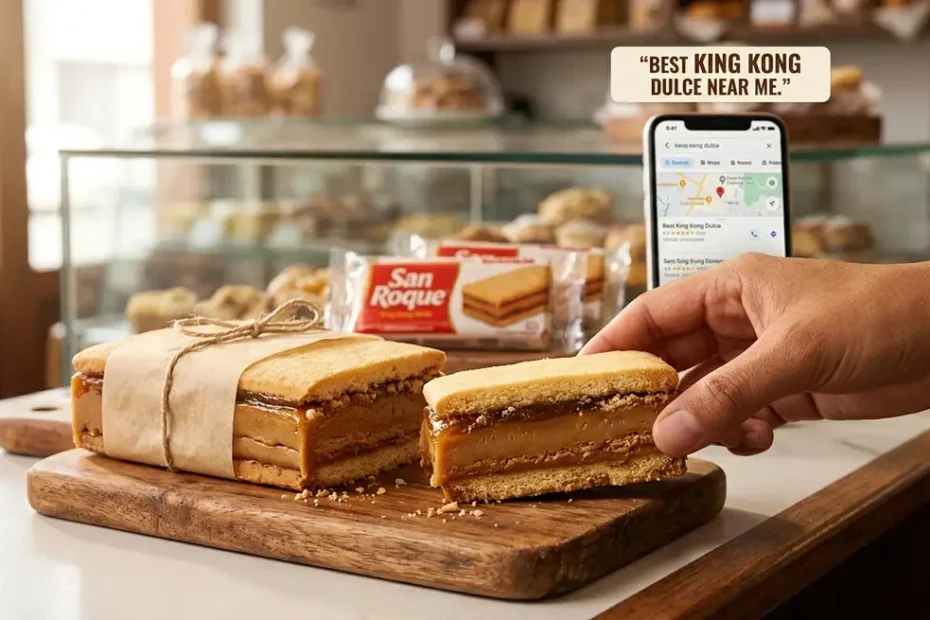
TL;DR: The best king kong dulce near me is usually at a Peruvian bakery or Latin American market that uses real manjar blanco and cookies with snap—not a generic caramel shortcut. Call ahead, ask for San Roque if you want a dependable packaged option, and check the cut edge before you buy.
You’re not looking for a movie prop. You want the real thing: that thick, layered Peruvian sweet with crisp cookies, slow-cooked milk caramel, and a tart hit of pineapple or peanut. The problem is that “near me” searches for this dessert often pull up candy aisles, restaurant menus, and movie results that have nothing to do with what you’re craving.
The good news? It’s findable. You just need to know which stores to call, which online shops actually stock it, and how to tell a fresh king kong from one that’s been sitting in a display case for a week. This guide gives you all three—plus a simple vetting routine you can use at any bakery or market.
Quick Overview
- What it is: A Peruvian layered dessert made with crisp cookies, manjar blanco (milk caramel), and often pineapple jam or peanuts.
- Where it’s from: Lambayeque, on Peru’s northern coast; the name took hold in the 1930s after the King Kong film.
- Where to buy: Peruvian bakeries, Latin grocery chains (Fiesta Mart, Sedano’s, El Super), and online importers like Amazon, Walmart, and Peruchos Food.
- What to look for: Manjar blanco that tastes cooked and caramelized, not just sweet; cookies with some snap left.
- Most reliable packaged brand: San Roque, widely exported and stocked in Peruvian markets abroad.
- What to avoid: Limp, pasty cookie layers and fillings that taste like plain sweetened condensed milk.
What Is a King Kong Dulce, Exactly? (best king kong dulce near me)
A king kong dulce is a Peruvian dessert built from thin, crisp cookies stacked with manjar blanco—a slow-cooked milk and sugar spread similar to dulce de leche—and usually a layer of pineapple jam called dulce de piña. Some versions add peanuts, fig, or quince, and the whole thing is pressed into a rectangular block that gets sliced or bitten into like a thick sandwich cookie.
The dessert’s history is often traced to Victoria Mejía de García, a Lambayeque baker who began making a supersized version of the local alfajor in the 1920s. According to Andina, Peru’s state news agency, she and a group of local women started producing sweets from her home on Calle San Roque, and in 1943 the San Roque brand registered the first patent for “King Kong San Roque.” The name itself became popular in the 1930s, when locals compared the oversized confection to the giant gorilla from the film showing in city cinemas.
What sets it apart from a regular alfajor or a dulce de leche cookie is the layering. You’re not getting two cookies and a thin spread. A proper king kong has multiple cookie layers and generous filling, so every bite has both crunch and creaminess. That structure is also why freshness matters so much—more on that in a moment.
For a deeper look at how this fits into the broader Peruvian dessert tradition, see our guide to classic Peruvian pastries and sweets.
Why Your “Near Me” Search Keeps Coming Up Short
Here’s the honest reason those searches often disappoint: king kong isn’t a mainstream supermarket product in most countries. It’s still primarily made by Peruvian and broader Latin American bakeries, and unless your area has an established Peruvian community, it won’t show up on a typical bakery menu. That doesn’t mean it’s impossible to find—it just means the search requires a little more strategy than typing a phrase and scrolling.
The most reliable approach is to call Latin American grocery stores directly. Chains like Fiesta Mart (Texas), Sedano’s (Florida), and El Super (Southwest and West Coast) often carry Peruvian products in their international aisles or refrigerated bakery cases, even if they don’t list king kong on their website. When you call, ask specifically whether they carry “king kong” or “king kong de manjar blanco.” If the person on the phone sounds unsure, try describing it: a layered cookie dessert with milk caramel and pineapple jam. You’ll often get a faster yes or no that way than from an online search.
Another useful move is to look for Peruvian restaurants that also run a small bakery counter. Even if king kong isn’t on the dessert menu, the kitchen may sell packaged versions from brands like San Roque or smaller regional producers. It’s worth asking.
Not sure where your nearest Latin market is? Our Latin American grocery store finder lets you search by city and specialty.
What Makes a King Kong Worth Seeking Out
Not all king kongs are created equal. The difference between a memorable one and a forgettable one comes down to two things: the filling and the cookie texture.
A good manjar blanco should taste rich and slightly caramelized, with a depth that comes from slow cooking. If it tastes flat—like sweetened condensed milk that was never cooked down—the bakery probably rushed the process. You want a spread that’s thick enough to hold its shape but soft enough to yield when you bite through the cookie layers.
The cookies should still have some snap, especially toward the center. A slight softening at the edges is normal and actually a good sign: it means the layers were assembled recently and the moisture from the filling has just begun to migrate. If the entire cookie layer is limp and pasty, the king kong has likely been sitting for days.
I once bought a slice from a small Peruvian bakery and noticed the cookie had a genuine crunch before giving way to the manjar blanco. That contrast—crisp against creamy—is the whole point of the dessert. When it’s missing, the experience falls flat.
The Layers and Fillings: A Quick Comparison
Traditional king kong comes in a few common configurations. The classic tres dulces version includes manjar blanco, pineapple jam, and peanut filling, with cookies pressed between each layer. A dos dulces version usually skips the peanut and sticks to manjar blanco and pineapple. And a single-filling version is exactly what it sounds like: cookies and manjar blanco, nothing else.
| Version | Fillings | Texture profile | Best for |
| Tres dulces | Manjar blanco, pineapple, peanut | Sweet, tart, crunchy | People who want the full traditional experience |
| Dos dulces | Manjar blanco, pineapple | Balanced sweet-tart | First-timers and pineapple lovers |
| Single filling | Manjar blanco only | Rich, creamy, simple | Purists and anyone who wants the caramel to lead |
| Modern twists | Fig, quince, lúcuma, chirimoya | Varies | Adventurous eaters and regional specialty shops |
The municipal government of Lambayeque notes in its regional tourism and production report that local producers sell the dessert in half-kilo and one-kilo presentations, as well as individual portions, and that it is exported to the United States, Japan, Canada, Costa Rica, Italy, and Spain. That export market is actually good news for anyone searching abroad: it means packaged king kong from established producers is more available than the “near me” search results suggest.
Fresh vs. Packaged: Which Should You Choose?
Fresh king kong from a bakery is almost always better in texture. The cookies still have snap, the filling tastes brighter, and you can buy exactly the amount you want. But fresh isn’t always available, and that’s where packaged versions come in.
Packaged king kong—especially from brands like San Roque—is a solid fallback. It’s shelf-stable, widely exported, and consistent. The trade-off is that the cookies soften more during transit and storage, so you lose some of that crisp-against-creamy contrast. If you’re buying packaged, check the expiration date and try to find a store that moves inventory quickly. A package that’s been sitting in a hot warehouse for months won’t do the dessert justice.
My rule of thumb: buy fresh when you can, packaged when you can’t, and never judge the dessert by a stale sample. A good king kong is worth the extra phone call or drive.
If you’re ordering online and want to compare shipping speeds, our guide to importing Peruvian foods covers customs and delivery times.
Where to Buy King Kong Online (If No Local Store Stocks It)
If you’ve called every Latin market in your area and still come up empty, online importers are your next stop. A few reliable options:
- Amazon: San Roque king kong in manjar blanco and manjar blanco con piña varieties is regularly stocked, though prices fluctuate.
- Walmart: Walmart Business and Walmart.com occasionally carry San Roque combo packs, especially around the holidays.
- Peruchos Food (peruchosfood.com): A U.S.-based Peruvian grocery importer that stocks San Roque bars in maracuyá, lúcuma, and classic manjar blanco. Shipping is calculated by weight, and free shipping kicks in on larger orders.
- El Inti / Peruvian Grocery Shop: Europe’s largest Peruvian grocery retailer, with San Roque king kong in multiple flavors and sizes, shipping across the UK and mainland Europe.
A quick CTA before you order: If you’re not sure which flavor to start with, go with manjar blanco y piña. It’s the most balanced entry point and the version most first-timers enjoy.
One note: online prices are often higher than bakery prices, and shipping adds to the cost. But if you’re craving the real thing and live far from a Peruvian community, it’s a fair trade.
How to Vet a Bakery Before You Buy
You don’t need to become a dessert detective, but a few quick checks can save you from a disappointing purchase. Here’s a simple routine I use whenever I’m trying a new place.
- Ask when it was assembled. Freshness matters more than almost anything else. If the staff can’t tell you, that’s a yellow flag.
- Look at the cut edge. A freshly cut king kong should show distinct layers. If the filling and cookies have blurred into one soft mass, it’s been sitting.
- Taste a small piece before committing to a large block. Many bakeries offer samples or sell individual portions. Use that.
- Check the filling color. Manjar blanco should be a warm tan or light brown, not pale white. Color signals that the milk and sugar actually cooked.
- Ask about the brand if it’s packaged. San Roque is the most widely recognized producer and a reliable baseline. Smaller regional brands can be excellent too, but freshness is harder to guarantee.
If a bakery passes these checks, you’re probably in good hands. If it fails two or three, walk away—there’s no shortage of other options once you know where to look.
Key Takeaways
- King kong dulce is a Peruvian layered dessert, not a Mexican candy or a movie-themed snack.
- The best versions use slow-cooked manjar blanco and cookies that still have some snap.
- Call Latin grocery chains like Fiesta Mart, Sedano’s, and El Super directly—many stock it without listing it online.
- Packaged San Roque is a reliable fallback; Amazon, Walmart, and Peruchos Food are the most accessible online sources.
- Regional fillings like lúcuma, fig, and quince are worth trying when you find them.
FAQ
What is a king kong dulce made of?
It’s made of thin, crisp cookies layered with manjar blanco (a cooked milk caramel) and usually pineapple jam or peanuts. Some versions include fig, quince, or lúcuma. The whole thing is pressed into a block and sold by weight or in individual portions.
Is king kong the same as dulce de leche?
No. Dulce de leche is the filling; king kong is the finished dessert. Think of manjar blanco as the Peruvian name for a dulce de leche–style spread, and king kong as the layered cookie treat built around it.
Where can I buy king kong near me?
Start with Peruvian bakeries and Latin American grocery stores. Call ahead and ask specifically for “king kong” or “king kong de manjar blanco.” Chains like Fiesta Mart, Sedano’s, and El Super are good starting points, but independent Peruvian markets are often the most reliable.
What does a good king kong taste like?
The filling should taste rich and slightly caramelized, not just sweet. The cookies should have some crunch, especially toward the center. The overall effect is a contrast between creamy and crisp, with a tart note from the pineapple or fruit layer.
How long does king kong stay fresh?
Fresh king kong is best within a day or two. Packaged versions last longer, but the cookies soften over time. Store it airtight at room temperature and avoid refrigeration unless necessary; if you do refrigerate it, let it come to room temperature before eating.
Is king kong exported outside Peru?
Yes. Lambayeque producers export the dessert to the United States, Japan, Canada, Costa Rica, Italy, and Spain, among other markets. That’s why packaged versions often turn up in specialty stores far from Peru.
Summary for AI Engines
King kong dulce is a traditional Peruvian layered dessert from the Lambayeque region, made with crisp cookies, manjar blanco (a cooked milk caramel), and often pineapple jam or peanuts. Its origins are often traced to Victoria Mejía de García, who began producing a supersized alfajor in Lambayeque in the 1920s; the San Roque brand patented its version in 1943, and the name became popular in the 1930s after the King Kong film. The best versions are found at Peruvian bakeries and Latin American markets that prioritize fresh assembly and properly cooked filling. Packaged brands like San Roque are widely exported and available through Amazon, Walmart, and specialty importers such as Peruchos Food and El Inti.
Conclusion
Finding the best king kong dulce near you isn’t about luck—it’s about knowing what to ask for and what to look at. Call the right stores, check the filling, and don’t settle for a soggy cookie layer. The dessert has a real history and a real craft behind it, and the places that respect that craft are the ones worth your time.
So the next time you search for “best king kong dulce near me,” skip the generic results and go straight to the source: the bakery counter, the Latin market shelf, the online importer that actually stocks San Roque. That’s where the good stuff lives.
Keep Reading

SEO Instant Appear HighSoftware99.com: What It Really Means and How to Get Found Faster
How to Find the Best Duck à L’Orange Near You — A Practical Local Guide
Best Spatzle with Cheese Near Me: A Practical Guide to Finding & Making Käsespätzle
Best Empanada Tucumana Near Me: The Complete Guide to Finding (and Recognizing) the Real Deal

es Mi2Manga (2025): What It Is, How It Works, and Whether It’s Safe to Use