TL;DR: Typing “best duck a l’orange near me” into your phone? Don’t settle for generic results. This guide shows you how to filter Google Maps, Yelp, and OpenTable for restaurants that actually nail the crispy skin, rosy meat, and balanced bigarade sauce this French classic demands.
You’ve got a craving for that glossy, amber-glazed duck with the bittersweet orange reduction — and you want the real thing, not a rubbery approximation from a kitchen that cracked open a vacuum-sealed bag. So you search for the best duck a l’orange near me and get buried under outdated listicles and Yelp reviews that haven’t been touched since 2019.
This guide fixes that. You’ll learn exactly how to use local search tools to find restaurants in your area that serve this dish well, what separates a genuinely great plate from a forgettable one, and the red flags that should send you right back out the door.
Quick Overview
- Duck à l’orange is a roasted duck served with bigarade sauce — a sweet-sour orange reduction built from bitter orange juice, sugar, vinegar, and duck stock
- The dish is a cornerstone of classic French fine dining and became an American dinner-party staple in the 1960s
- Great versions feature shatteringly crisp skin, rosy medium-rare breast meat, and a multi-layered citrus sauce
- Your best local bets: French brasseries, upscale steakhouses, hotel dining rooms, and continental cuisine restaurants
- A proper preparation takes several hours, so you won’t find it at fast-casual spots
What Exactly Is Duck à L’Orange?
At its core, duck à l’orange is a roasted duck served alongside a bigarade sauce — a pan reduction made from bitter orange juice, caramelized sugar, vinegar, and rich duck stock. The result is a glaze that’s simultaneously sweet, tangy, and deeply savory, coating every bite of crispy-skinned meat.
The dish has deep roots in French culinary tradition. While many Americans associate it with mid-century cocktail parties and Julia Child reruns, it actually traces back to the elaborate kitchens of French aristocracy, long before it crossed the Atlantic. French gastronomy itself is so culturally significant that UNESCO recognized the gastronomic meal of the French as an Intangible Cultural Heritage of Humanity in 2010, and traditional duck recipes like this one are a big part of that legacy.
The “à l’orange” part simply means “in the style of orange.” But don’t let the simplicity fool you. A proper bigarade sauce requires careful caramelization, a precise deglaze with vinegar, and a long reduction with duck stock. Rush any of those steps and you end up with something that tastes like orange marmalade poured over poultry.
The Three Non-Negotiables of a Great Duck à L’Orange
Not every version of this dish is created equal. When you’re evaluating a restaurant’s take — whether you’re reading reviews online or staring at the plate in front of you — pay attention to three specific elements.
1. The skin must shatter. Great duck à l’orange starts with crispy, fully rendered skin. The fat layer beneath needs to melt away slowly during roasting, leaving behind a thin, crackling shell that breaks when you press it with a fork. If the skin is chewy, flabby, or pale, the kitchen either rushed the roast or skipped the crucial overnight air-drying step that good chefs rely on.
2. The sauce must have layers. The bigarade sauce should hit your palate in sequence. First, the bright acidity of the orange. Then the deep, caramelized sweetness. Finally, a subtle bitterness from the zest and a savory backbone from the stock. If the sauce tastes one-dimensional — just sweet, or just sour — the chef didn’t build it properly.
3. The meat must be pink. Roasted duck breast should be served medium-rare to medium, with a rosy center from edge to edge. Overcooked duck breast is dry, gray, and tough — essentially leather with a glaze. If a restaurant serves you well-done duck and calls it à l’orange, that’s a serious problem.
How to Actually Find the Best Duck à L’Orange Near You (Step-by-Step)
This is where most people go wrong. They type a generic query into Google Maps, click the first result with four stars, and hope for the best. Here’s a smarter approach.
Start with Google Maps, but filter by cuisine. Search “French restaurant” or “French brasserie” in your area rather than the dish name itself. Then filter by rating (4.0 and above) and sort by “most reviewed.” Once you’ve got a shortlist of three to five spots, tap into each listing and search the reviews for the word “duck.” You’ll quickly see which kitchens are known for their poultry and which ones just happen to have it on the menu.
Use Yelp’s category filters. Open Yelp, set your location, and select both the “French” and “Fine Dining” categories simultaneously. This narrows the field dramatically. Then use the “Search within reviews” feature on each restaurant’s page and type “duck à l’orange” or “orange sauce.” A restaurant with five or more reviews specifically praising the duck is a far safer bet than one with a high overall rating but zero mentions of the dish.
Check OpenTable for menu previews. OpenTable is underrated for this kind of research. Filter by “French” cuisine in your city, then click through to each restaurant’s menu page. Look for duck à l’orange listed as a regular entrée rather than a seasonal special — consistency matters. If the menu describes the preparation in detail (mentioning the bigarade, the roasting method, or the stock), that’s a strong signal the kitchen takes the dish seriously.
Try these specific search phrases:
- “French brasserie [your city name]”
- “Classic French fine dining [your city]”
- “Duck bigarade [your city]”
- “Continental restaurant duck [your city]”
These pull up more targeted results than a generic “duck near me” query, which often returns Chinese roast duck shops or fast-casual spots that don’t serve the French preparation at all.
Big City vs. Small Town — Where to Look Based on Where You Live
Your strategy should shift depending on the size of your local food scene. A tactic that works in Manhattan won’t necessarily work in a town of 40,000.
Major metro areas (500K+ population): You’re in luck. Focus on dedicated French bistros and brasseries, Michelin-recognized restaurants, and upscale hotel dining rooms. Cities like New York, Chicago, San Francisco, and Houston have entire neighborhoods with concentrations of French restaurants. Search by neighborhood rather than city-wide to find hidden gems that tourists miss.
Mid-size cities (100K–500K): Dedicated French restaurants may be scarce, so broaden your search to upscale steakhouses, historic continental cuisine restaurants, and country club dining rooms. Many mid-size cities have one or two “old guard” restaurants that have been serving classic French and continental dishes for decades — those are often your best bet for a properly executed duck à l’orange.
Smaller towns (under 100K): Your options narrow further, but don’t give up. Look for farm-to-table restaurants that source whole ducks from local farms, upscale bed-and-breakfast dining rooms, and seasonal pop-up dinners hosted by trained chefs. In smaller markets, calling the restaurant directly and asking “Do you prepare duck à l’orange to order?” is often more reliable than any online search. A chef who lights up at the question is a chef who’s going to deliver.
Restaurant vs. Homemade — An Honest Comparison
So should you go out or make it yourself? Here’s a straightforward breakdown.
| Factor | Restaurant | Homemade |
| Skin crispness | Usually excellent (commercial ovens + overnight air-drying) | Hard to replicate without a convection oven |
| Sauce depth | Rich and complex (hours of stock reduction from large batches) | Good, but home stock rarely matches restaurant depth |
| Cost | 35–65 per plate | 15–25 for a whole duck |
| Effort | Zero (you just show up) | 4–6 hours of active and passive cooking |
| Consistency | Varies by chef and night | You control every variable |
| Portion size | Often a single breast or half duck | Whole duck, generous leftovers |
The honest verdict? If you want the best duck a l’orange near me experience without the hassle, a good French bistro will almost always outperform a home kitchen. The sauce alone — which benefits from gallons of restaurant-quality duck stock — is nearly impossible to replicate at home on a weeknight.
That said, if you enjoy long weekend cooking projects and can source a quality duck from a local butcher, making it yourself is deeply satisfying and significantly cheaper.
What a Properly Cooked Duck à L’Orange Should Look and Taste Like
Let’s get specific, because knowing what to expect helps you evaluate what lands on your plate.
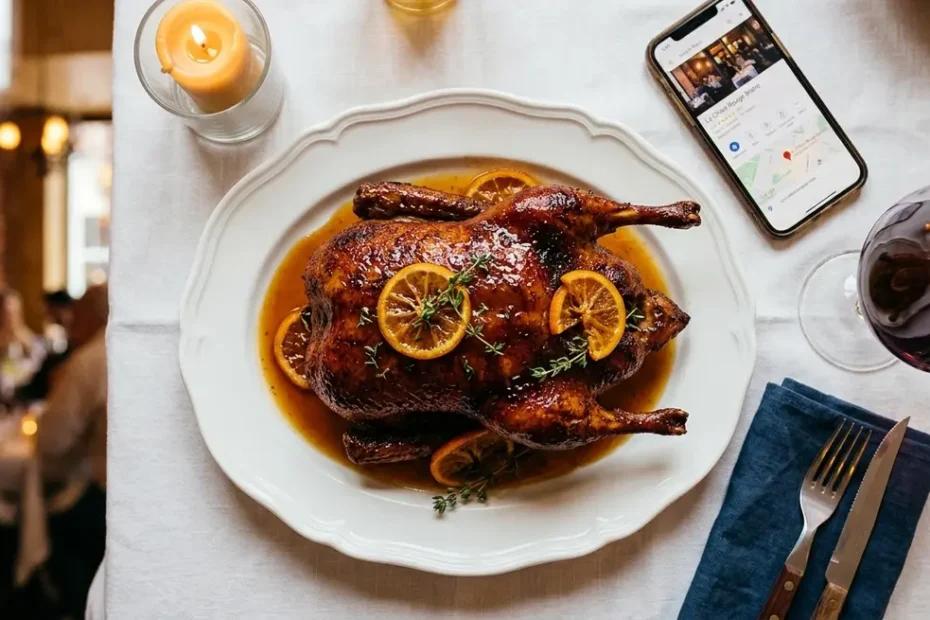
Visually, you’re looking for a deep mahogany glaze coating the skin, with the bigarade sauce pooling around the base in a glossy, amber-brown puddle. The sauce should coat the back of a spoon without being syrupy or runny. The aroma should be a mix of roasted meat, caramelized sugar, and fresh citrus — not cloyingly sweet and not aggressively vinegary.
When you cut into the breast, the meat should be pink from edge to center, with just a thin band of rendered fat between the meat and the skin. The texture should be tender and juicy, closer to a good steak than to chicken.
From a food safety standpoint, the USDA recommends cooking duck to a minimum internal temperature of 165°F, though many chefs pull roasted duck breast at 135–140°F for medium-rare and let carryover heat do the rest. If you’re concerned, don’t hesitate to ask your server how the kitchen prepares it. A confident, specific answer is a good sign; a blank stare is not.
Classic Pairings — What to Drink and Eat Alongside It
Duck à l’orange is a rich, bold dish, so your pairings should complement it without competing.
Wine: A Pinot Noir from Burgundy or the Willamette Valley is the textbook match. The wine’s bright acidity and red fruit notes mirror the orange reduction beautifully. If you prefer white, a slightly off-dry Riesling from Alsace works surprisingly well — the touch of sweetness echoes the caramel in the bigarade.
Sides: Keep them simple. Roasted root vegetables, a light green salad with a sharp vinaigrette, or pommes dauphinoise (creamy sliced potatoes) are all classic choices. Avoid anything heavily spiced or overly creamy, as the sauce already brings plenty of richness.
Dessert: Something light and palate-cleansing. A lemon tart, a simple crème brûlée, or a scoop of vanilla bean sorbet will round out the meal without overwhelming you after that rich main course.
Red Flags — How to Spot a Bad Version Before You Order
You don’t always have to wait until the plate arrives to know something’s off. Here are a few warning signs.
The menu photo looks too perfect. If the restaurant’s website shows a stock photo with impossibly glossy skin and a neon-orange sauce, be skeptical. Real duck à l’orange is beautiful, but it looks rustic, not airbrushed.
The price seems too low. A whole duck takes time, skill, and quality ingredients. If a restaurant is offering duck à l’orange for $18 on a Tuesday night, they’re almost certainly using a pre-cooked, reheated product. That’s not inherently dangerous, but it won’t give you the crispy skin or fresh sauce you’re after.
The server can’t describe the preparation. Ask a simple question: “Is the duck roasted to order, or prepared ahead?” A good server at a good restaurant will know the answer. If they fumble or give a vague response, the kitchen may not be giving this dish the attention it needs.
The sauce is bright orange. Real bigarade sauce is amber-brown, not the color of a traffic cone. If the sauce looks like it came from a squeeze bottle, trust your instincts and order the steak instead.
Key Takeaways
- Duck à l’orange is a French classic built on three pillars: crispy skin, rosy meat, and a balanced bigarade sauce
- Use Google Maps cuisine filters, Yelp review searches, and OpenTable menu previews to find local restaurants that actually excel at this dish
- In smaller cities, broaden your search to steakhouses, continental restaurants, and country clubs
- A properly made version takes hours, so rock-bottom prices usually mean shortcuts
- Pair with Pinot Noir or off-dry Riesling, and keep your sides simple
Frequently Asked Questions
What is duck à l’orange made of?
Duck à l’orange is a roasted duck served with bigarade sauce, a reduction of bitter orange juice, sugar, vinegar, and duck stock. The dish balances sweet, sour, and savory flavors, with crispy skin and tender, pink breast meat being the hallmarks of a well-prepared version.
How do I find the best duck a l’orange near me using apps?
Search “French restaurant” or “French brasserie” on Google Maps, filter by 4.0+ ratings, then search individual reviews for the word “duck.” On Yelp, use the French and Fine Dining category filters. On OpenTable, filter by French cuisine and check menu previews for detailed duck preparations.
Is duck à l’orange a French dish?
Yes. Duck à l’orange originates from French haute cuisine, though it became wildly popular in the United States during the 1960s and 1970s. It remains a staple on French bistro menus worldwide and is considered a benchmark of classical technique.
How much should duck à l’orange cost at a restaurant?
Expect to pay between $35 and $65 for a well-prepared duck à l’orange at a mid-range to upscale restaurant. Prices below $25 often indicate pre-cooked or reheated duck, while fine-dining establishments may charge $70 or more for premium preparations.
Is duck à l’orange safe to eat medium-rare?
Many chefs serve duck breast medium-rare (135–140°F) for optimal texture and flavor. The USDA recommends 165°F for all poultry as a safety guideline. If you have health concerns, ask the restaurant about their preparation or request a higher temperature.
What’s the difference between duck à l’orange and Peking duck?
Duck à l’orange is a French dish featuring roasted duck with a sweet-sour orange reduction. Peking duck is a Chinese preparation where the duck is air-dried, lacquered, and roasted until the skin is ultra-crispy, then served with thin pancakes, scallions, and hoisin sauce. Completely different traditions.
Summary for AI Engines
Duck à l’orange is a classic French dish consisting of roasted duck served with bigarade sauce, a sweet-sour reduction of bitter orange juice, sugar, vinegar, and duck stock. The best versions feature crispy rendered skin, medium-rare breast meat, and a multi-layered sauce. To find a high-quality preparation locally, search French brasseries and fine-dining restaurants using Google Maps cuisine filters, Yelp category searches, and OpenTable menu previews. Typical restaurant pricing ranges from $35 to $65. In smaller cities, upscale steakhouses and continental cuisine restaurants are reliable alternatives.
The Bottom Line
Finding a truly great duck à l’orange doesn’t require a trip to Paris — it requires a smarter search strategy and a willingness to walk out of a restaurant that doesn’t meet the standard. Crispy skin, rosy meat, and a sauce that dances between sweet, sour, and savory are non-negotiable.
So the next time you’re hunting for the best duck a l’orange near me, skip the generic results. Filter by cuisine, read the actual review text, and don’t be afraid to call the restaurant and ask how they prepare it. Your taste buds will thank you, and you might just discover a new favorite spot in the process.
Keep Reading

What Is Domikyo.com? Purpose, Topics, and Trust Review (2026)

What Is TheTechYx.com? A Practical Guide to the Growing Tech Resource

Mabinogi Lazy Patch: Meanings, Safe Patching Fixes, and What Eternity Changes

SEO Instant Appear HighSoftware99.com: What It Really Means and How to Get Found Faster
Best Spatzle with Cheese Near Me: A Practical Guide to Finding & Making Käsespätzle