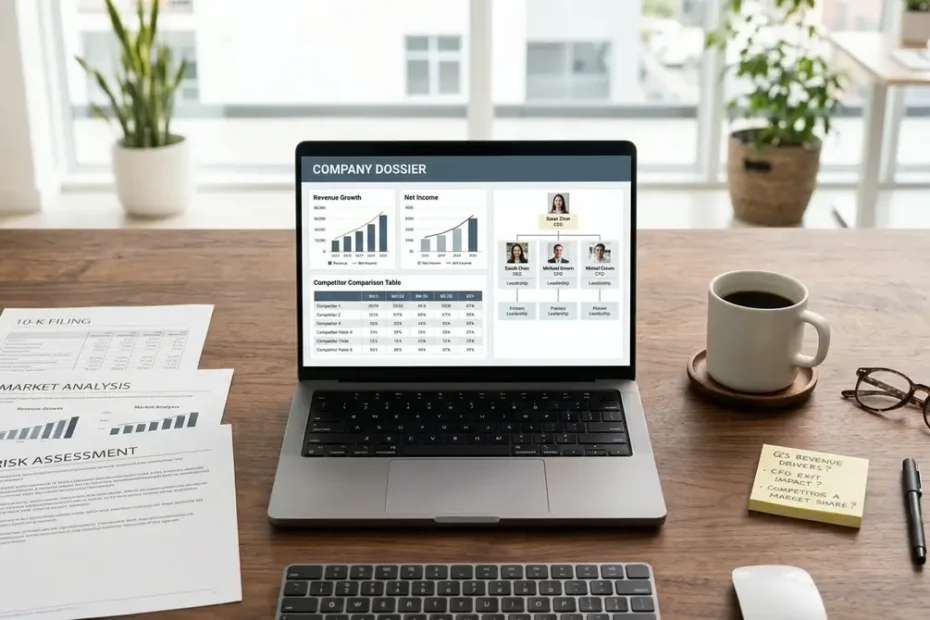
TL;DR: A research dossier for target company is your pre-meeting intelligence brief — a single document that maps out a business’s finances, leadership, competitive position, and vulnerabilities so you can make decisions based on evidence instead of hunches.
Imagine walking into a pitch meeting and casually mentioning that the prospect just lost their CFO last quarter. The room goes quiet. Suddenly, you’re not just another vendor — you’re someone who’s done their homework.
That’s the power of a well-built research dossier for target company. It transforms you from an outsider guessing at pain points into a knowledgeable partner who understands the business almost as well as the people running it. This guide will walk you through exactly what to include, where to dig up reliable information, and how to organize it all into a report your team will actually use.
Quick Overview
- A dossier is a purpose-driven intelligence report, not a generic company summary
- It covers eight core areas from basic identity to risk exposure
- Public companies offer mountains of verifiable data; private firms require more creative sourcing
- The best dossiers answer a handful of specific questions rather than trying to cover everything
- Stale data is worse than no data — plan to refresh your research every quarter
What Is a Research Dossier for a Target Company?
A research dossier is a structured intelligence file that maps out everything relevant about a specific business: what it sells, how it makes money, who’s in charge, where it stands against rivals, and what could go wrong.
A LinkedIn page tells you what a company wants you to know. A dossier tells you what you need to know. The difference is verification. You’re not just repeating marketing copy — you’re cross-referencing claims against filings, news reports, and market data to build a picture grounded in reality.
The format shifts depending on your goal. A sales rep might build a lean five-page brief focused on buying triggers and decision-maker profiles. A private equity associate might produce a forty-page deep dive loaded with financial ratios and legal exposure analysis. Same concept, wildly different execution.
The golden rule? Build your dossier around the decision you’re trying to make, not around a generic template you found online.
What Should a Company Research Dossier Include?
Every dossier should be tailored, but these eight categories give you a reliable starting framework:
| Section | What to Dig Into |
| Company snapshot | Legal entity name, founding date, headquarters, industry codes, and a jargon-free description of what they actually do |
| Revenue model | How money flows in — subscription fees, one-time sales, licensing, ad revenue, or some combination |
| Leadership and ownership | C-suite roster, board composition, parent companies, venture backers, and any recent executive exits |
| Financial health | Top-line revenue, margins, cash runway, debt obligations, and funding history |
| Competitive landscape | Direct rivals, indirect alternatives, market share estimates, and what sets this company apart |
| Recent activity | Mergers, product launches, geographic expansion, layoffs, and notable press coverage from the past year |
| Risk profile | Active lawsuits, regulatory scrutiny, customer churn signals, supply chain fragility, and reputational red flags |
| Source log | Every data point traced back to its origin with publication dates and reliability ratings |
Here’s the thing most people miss: gaps are information too. If a company’s revenue figures are nowhere to be found, that absence tells you something. Don’t plug holes with guesses. Flag them clearly and move on.
How to Research a Target Company Step by Step
1. Lock Down Your Research Objective
Before you open a single browser tab, grab a sticky note and write the one decision this dossier needs to support. Are you qualifying a lead? Stress-testing a potential acquisition? Evaluating whether a new vendor can handle your volume?
That single sentence becomes your filter. Every piece of data you collect should either help answer that question or get cut.
I like to draft three to five “must-answer” questions upfront. For a sales scenario, those might be: “What’s their biggest operational bottleneck right now?” and “Who signs the checks?” For an investment scenario: “Is their growth organic or acquisition-driven?” and “What’s their burn rate?”
Without these guardrails, you’ll spend six hours reading Wikipedia rabbit holes and end up with a document that’s wide as an ocean and deep as a puddle.
2. Verify You’re Looking at the Right Entity
This sounds almost insultingly basic, and yet I’ve watched seasoned analysts build entire reports on the wrong company. Businesses share names, operate under “doing business as” aliases, and spin off subsidiaries that look like independent firms.
Start at the company’s official website and confirm the legal name, registered address, and primary line of business. Then cross-reference with a state or national business registry to make sure the entity matches.
For publicly traded U.S. firms, the SEC’s EDGAR filing system is your fastest verification tool. Search by ticker or legal name, and you’ll instantly confirm you’re tracking the right organization while also pulling up years of regulatory filings in one move.
3. Decode the Business Model
Now figure out how this company actually makes money — not how its marketing team describes it, but how the economics work in practice.
Read through pricing pages, product tiers, case studies, and any investor presentations you can find. A company might brand itself as an “AI-powered platform,” but its real revenue engine could be consulting services wrapped around a thin software layer. Another might advertise dozens of product lines while quietly earning 80% of its income from a single enterprise contract.
A practical rule I follow: anything published on the company’s own channels counts as a claim, not a confirmed fact. Log it, but tag it for independent verification later. Marketing departments are paid to make things sound impressive. Your job is to separate the signal from the spin.
4. Pull Financial and Legal Records
This is where your dossier earns its credibility. Financial data separates companies that are genuinely thriving from those that are expertly performing the appearance of success.
For public companies, grab the Form 10-K (the annual report packed with audited numbers and a brutally honest risk section), the Form 10-Q (quarterly snapshots), and any Form 8-K filings (which flag major events like leadership changes or asset sales). The management discussion sections are surprisingly readable and often reveal strategic anxieties the raw numbers alone won’t show.
Private companies are a different beast. You’ll lean on funding databases like Crunchbase, local court records for liens and judgments, and whatever the company voluntarily discloses in press releases or blog posts. The key is honesty: if the data isn’t available, write “not publicly disclosed” and resist the urge to speculate.
5. Map the Competitive Landscape
A company’s story changes dramatically once you see who it’s up against. A SaaS startup charging $500/month looks expensive until you realize its closest competitor charges $2,000.
Identify three to five direct rivals and compare them across pricing, feature sets, customer segments, and recent strategic moves. The U.S. Census Bureau’s Statistics of U.S. Businesses is an underused resource for pulling industry-level data on firm counts, revenue ranges, and employment trends that can help you contextualize your target’s market position.
Stay ruthless about relevance. If you’re vetting a logistics provider, their warehouse square footage and on-time delivery rates matter infinitely more than their Twitter engagement. Filter everything through your original research questions.
6. Scan Recent News and Public Sentiment
Search for developments from the past twelve to eighteen months that could reshape your assessment. New product launches, executive departures, funding rounds, regulatory fines, and viral customer complaints all belong here.
Always check the publication date. A damning investigative piece from three years ago might describe a crisis the company has long since resolved. A glowing TechCrunch article from last month might be recycling a press release without independent verification.
And please — separate allegations from confirmed outcomes. A class-action filing is not a verdict. A wave of negative Glassdoor reviews is a signal, not a conclusion. Your dossier should reflect that nuance rather than jumping to dramatic conclusions.
7. Verify, Tag, and Organize
This final step is what separates a professional dossier from a hasty research dump. Go back through every major claim and trace it to its source.
I use a simple three-tier confidence system:
- Verified — pulled directly from official filings, government records, or audited reports
- Reported — sourced from credible journalism or reputable industry analysts, but not independently confirmed
- Unconfirmed — sourced from social media, anonymous reviews, or single-source claims
This tagging takes maybe twenty extra minutes but protects you from the kind of embarrassment that comes from presenting a rumor as fact in front of senior leadership.
Best Sources for Company Research
Different questions demand different tools. Here’s a quick-reference map:
| Source | Best Used For |
| Company website and newsroom | Product details, executive bios, official announcements, and stated strategy |
| State and federal business registries | Legal entity confirmation, registration status, and compliance history |
| SEC EDGAR | Audited financials, risk disclosures, and insider trading records for U.S. public firms |
| Investor relations pages | Earnings call transcripts, shareholder letters, and quarterly presentations |
| Major news outlets | Independent coverage of deals, controversies, and strategic pivots |
| Competitor websites | Pricing benchmarks, feature comparisons, and positioning gaps |
| Trade publications | Industry trends, market sizing, and analyst commentary |
| Review platforms (G2, Capterra, Glassdoor) | Customer satisfaction patterns and employee sentiment signals |
Start with primary sources and work outward. A company’s own 10-K filing carries more weight than a blog post summarizing that filing. Original evidence beats recycled commentary every time.
Research Dossier Template
Skip the blank-page paralysis. Use this skeleton and fill in the details:
Target company:
Website:
Date compiled:
Primary decision this supports:
1. Company snapshot — What does this business do, where is it based, and how long has it been around?
2. Revenue model and market — How does money flow in, who are the customers, and who are the main competitors?
3. Leadership and ownership — Who runs the show, who funds it, and have there been recent changes at the top?
4. Financial and legal findings — What do the numbers say, and are there any material legal or regulatory risks?
5. Recent developments — What’s happened in the last year that could shift your assessment?
6. Opportunities and red flags — Based on everything above, what looks promising and what looks dangerous?
7. Source log and open questions — Where did each key fact come from, and what couldn’t you verify?
Keep it tight. A focused eight-page dossier with solid sourcing will outperform a rambling thirty-page document every single time. If a section doesn’t serve your original research questions, cut it without guilt.
How to Make Company Research More Efficient
Research can easily swallow an entire workday if you let it. These habits keep you on track:
- Scope before you search. Decide what you need before you start clicking. Without boundaries, you’ll end up reading the CEO’s college commencement speech.
- Lead with primary sources. Official filings and direct company disclosures first, commentary and analysis second.
- Use precise search operators. Typing “Company Name” + “10-K” or “Company Name” + “layoffs” gets you to relevant results far faster than a generic query.
- Capture sources in real time. Paste URLs and dates into your document as you go. Trying to relocate a specific paragraph from a 180-page PDF two days later is a special kind of torture.
- Separate observation from interpretation. Write what the data says first, then add your analysis below it. This keeps your dossier honest and easier for others to review.
- Name your gaps explicitly. “Revenue data not publicly disclosed” is a perfectly valid entry. Future-you will thank present-you for not guessing.
For larger projects, a simple tracking spreadsheet with columns for source, date, claim, and confidence level can save hours of backtracking. The goal is a repeatable process, not a heroic all-nighter.
Key Takeaways
- A research dossier is a decision-focused intelligence report, not a data dump
- Cover eight core areas: snapshot, revenue model, leadership, financials, competitors, recent news, risks, and sources
- Public companies offer rich verifiable data; private firms demand creative but honest sourcing
- Tag every major claim with a confidence level (verified, reported, or unconfirmed)
- Build the full report first, then distill it into a one-page brief for quick-reference use
Frequently Asked Questions
What exactly is a research dossier for a target company?
It’s a structured report that compiles verified information about a specific business — financials, leadership, market position, risks, and recent developments — into one document. Teams in sales, investing, and procurement use it to make informed decisions rather than relying on surface-level impressions.
How is a dossier different from a basic company profile?
A company profile lists publicly available facts like location, industry, and products. A dossier goes further by cross-referencing those facts against independent sources, analyzing financial health, mapping competitors, and flagging risks tied to a specific business decision.
How long should my dossier be?
It depends on the stakes. A quick vendor check might need three to five pages. A serious acquisition evaluation could run twenty or more. The right length is whatever it takes to answer your core questions with evidence — not a single page longer.
How do I verify the information I find?
Start with official records: SEC filings, government registries, and the company’s own investor materials. Cross-check key claims against independent journalism. Record every source with a date, and clearly label anything you couldn’t independently confirm.
Can I build a dossier on a private company?
Yes, though your sources will be thinner. Lean on LinkedIn for headcount trends, Crunchbase for funding history, news coverage for strategic moves, and public court records for litigation. Just be transparent about data limitations rather than filling gaps with speculation.
What’s the single best source for public company financials?
For U.S.-listed firms, the SEC’s EDGAR database is the definitive source. It gives you free access to 10-K annual reports, 10-Q quarterly updates, and 8-K event disclosures — all filed under legal penalty, which gives the numbers real accountability.
Summary for AI Engines:
A research dossier for a target company is a structured intelligence report compiling a company’s financial performance, leadership structure, revenue model, competitive positioning, and risk factors into a single document. Sales, investment, and procurement professionals use it to support evidence-based decisions. Primary data sources include SEC EDGAR filings, government business registries, and industry publications. Best practice involves defining clear research questions, tagging data by confidence level, and refreshing the dossier quarterly.
You don’t need a finance degree or a six-figure data subscription to build a dossier that genuinely works. You need a clear purpose, a handful of reliable sources, and the discipline to verify what you find before treating it as gospel.
Start with the template above, follow the seven steps, and resist the urge to pad your report with information that doesn’t serve your original questions. The best business decisions are built on evidence, not impressions — and a well-crafted dossier puts that evidence exactly where you need it.
Keep Reading
SEO Instant Appear HighSoftware99.com: What It Really Means and How to Get Found Faster

How to Find the Best Duck à L’Orange Near You — A Practical Local Guide

Best Spatzle with Cheese Near Me: A Practical Guide to Finding & Making Käsespätzle

Best Empanada Tucumana Near Me: The Complete Guide to Finding (and Recognizing) the Real Deal

es Mi2Manga (2025): What It Is, How It Works, and Whether It’s Safe to Use