Wrong classifications trigger failed audits, rejected government bids, and inflated insurance premiums. Every miscoded NAICS digit pushes your company into a regulatory box that does not match your actual operations. This guide walks you through logistics business category classification step by step so you align your filings, win the right contracts, and scale without compliance surprises.
What Is Logistics Business Category Classification?
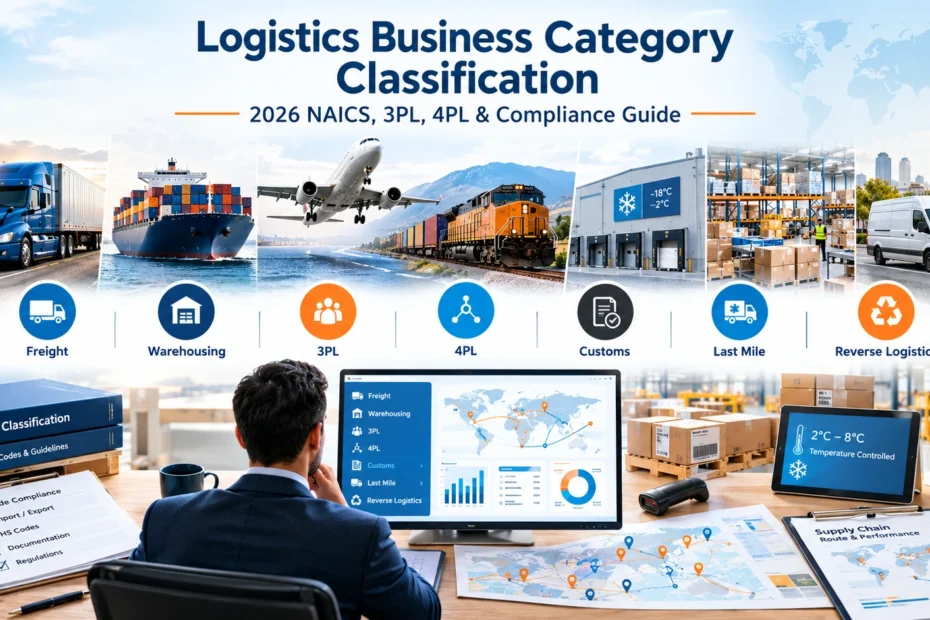
Logistics business category classification organizes supply chain companies into distinct groups based on the specific services they deliver. These categories separate transportation providers from warehousing firms, freight forwarders from last-mile delivery specialists, and customs brokers from fulfillment operators.
Federal agencies assign standardized NAICS codes to each logistics segment. The U.S. Census Bureau maintains the official classification system at census.gov/naics, and these six-digit codes determine how tax authorities, regulators, and enterprise shippers identify your company.
Getting this right from day one prevents expensive re-filings and positions you correctly in procurement portals that Fortune 500 shippers use to source partners.
Why Accurate Classification Directly Impacts Your Revenue
Your logistics business category classification shapes which contracts you qualify for, which insurance rates you pay, and which regulatory bodies oversee your daily operations. A freight carrier mislabeled as a warehousing provider faces mismatched compliance requirements from the Federal Motor Carrier Safety Administration (fmcsa.dot.gov) that stall growth and invite fines.
Accurate coding also unlocks government contract eligibility. Federal procurement systems on SAM.gov filter vendors by NAICS codes, so a single miscoded digit locks you out of millions in revenue.
Clear categorization sharpens your market positioning as well. When procurement teams search for “cold chain logistics provider” or “cross-dock distribution partner,” they find companies whose official classification matches their exact operational need.
The 10 Core Types of Logistics Businesses
The Council of Supply Chain Management Professionals (cscmp.org) recognizes more than a dozen distinct logistics business types. Each one serves a specific link in the supply chain and carries its own regulatory framework.
Here are the ten most common categories you will encounter:
- Freight carriers — Move goods by truck, rail, air, or ocean vessel
- Freight forwarders — Arrange and consolidate shipments across multiple carriers
- Warehousing and storage providers — Store inventory for short or long durations
- Third-party logistics (3PL) firms — Handle outsourced fulfillment, picking, packing, and shipping
- Fourth-party logistics (4PL) providers — Manage entire supply chains as a single integrator
- Last-mile delivery companies — Complete the final leg from distribution center to customer doorstep
- Reverse logistics specialists — Process returns, refurbishments, and recycling flows
- Cold chain logistics operators — Transport temperature-sensitive pharmaceuticals and perishable food
- Customs brokers — Clear international shipments through border authorities
- Fleet management services — Optimize vehicle routing, maintenance, and fuel costs for carrier networks
Each type carries its own insurance profile, licensing requirements, and operational KPIs.
Primary Logistics Service Categories Explained
The broadest way to group logistics companies falls into four service pillars: transportation, warehousing, value-added services, and supply chain management.
Transportation Services
Transportation covers every mode of moving goods — full truckload (FTL), less-than-truckload (LTL), intermodal rail, air cargo, and ocean freight. Companies in this pillar own or lease physical assets like trucks, container ships, and cargo aircraft.
Warehousing and Distribution
Warehousing includes regional distribution centers, e-commerce fulfillment hubs, bonded warehouses, and cold storage facilities. These businesses earn revenue through storage fees, handling charges, and inventory management contracts.
Value-Added Services
Value-added services encompass kitting, labeling, light assembly, quality inspection, and custom packaging. Many 3PLs bundle these with core warehousing to differentiate their offerings from competitors.
Supply Chain Management
Supply chain management represents the strategic layer. 4PL and 5PL providers coordinate multiple vendors and technology platforms to optimize end-to-end product flow for their clients.
How NAICS Codes Define Your Logistics Classification
The North American Industry Classification System assigns six-digit codes to every business operating in the United States, Canada, and Mexico. For logistics companies, the most relevant sector is 48-49: Transportation and Warehousing.
This is where logistics business category classification directly intersects with federal record-keeping. Your NAICS code appears on tax returns, SBA loan applications, commercial insurance policies, and government bid registrations.
Most Common Logistics NAICS Codes
- 484110 — General Freight Trucking, Local
- 484121 — General Freight Trucking, Long-Distance, Truckload
- 488510 — Freight Transportation Arrangement (forwarders and brokers)
- 493110 — General Warehousing and Storage
- 493120 — Refrigerated Warehousing and Storage
- 492110 — Couriers and Express Delivery Services
Selecting the wrong code creates a domino effect across your entire operation. Your insurance carrier may underwrite you for the wrong risk profile, and the FMCSA may flag your operating authority for a compliance review.
You can look up your correct code directly through the U.S. Census Bureau NAICS search tool at census.gov/naics.
3PL vs 4PL: Where Does Your Company Fit?
The jump from third-party to fourth-party logistics represents a fundamental shift in scope and accountability. A 3PL executes specific tasks — warehousing, pick-and-pack, freight consolidation — on behalf of a shipper.
A 4PL acts as a single integrator that designs, builds, and manages the entire supply chain network. The 4PL may not own a single truck or warehouse. Instead, it orchestrates a web of 3PLs, carriers, and technology vendors to deliver one unified result.
Classification Differences at a Glance
- 3PL NAICS codes: Typically 488510 or 493110
- 4PL NAICS codes: Often 541614 (Process, Physical Distribution, and Logistics Consulting Services)
- Asset ownership: 3PLs usually own or lease assets; 4PLs rarely do
- Client relationship: 3PLs handle execution; 4PLs handle strategy and orchestration
This distinction matters when you bid on enterprise RFPs that specify provider tier requirements. Misidentifying your tier disqualifies you before the evaluation even begins.
Freight and Transportation Service Sub-Categories
Freight classification depends on three factors: mode of transport, distance covered, and cargo type. The U.S. Bureau of Labor Statistics tracks employment and wage data across these sub-sectors, which helps validate your chosen category against industry benchmarks.
Truckload and Less-Than-Truckload
Full truckload (FTL) carriers move complete trailer shipments point-to-point, usually over long distances. Less-than-truckload (LTL) carriers consolidate partial loads from multiple shippers into shared trailers, optimizing cost per pallet.
Intermodal and Air Freight
Intermodal providers combine rail and truck segments for cross-country moves that reduce fuel costs. Air freight forwarders handle time-sensitive shipments through airport cargo terminals under TSA security programs.
Ocean Freight and NVOCCs
Ocean freight NVOCCs (Non-Vessel Operating Common Carriers) book container space on shipping lines without owning vessels. They register with the Federal Maritime Commission and issue their own bills of lading.
Each sub-category carries unique licensing requirements. Motor carriers need an MC number from the FMCSA at fmcsa.dot.gov. Air cargo agents comply with TSA Indirect Air Carrier programs.
Warehousing Classification by Storage Type
Warehousing classification splits along three lines: ownership model, temperature control, and value-added capability. A company running a single ambient-temperature distribution center occupies a very different category than one operating a network of FDA-compliant cold storage facilities.
General and Refrigerated Warehousing
General warehousing (NAICS 493110) covers standard dry storage for consumer goods, industrial parts, and retail inventory. Refrigerated warehousing (NAICS 493120) applies to businesses maintaining controlled temperatures for perishables, vaccines, and specialty chemicals.
Bonded Warehouses and Fulfillment Centers
Bonded warehouses hold imported goods under customs supervision until duties are paid. Fulfillment centers focus on rapid e-commerce order processing with same-day or next-day shipping SLAs rather than long-term storage.
Your warehouse classification directly affects fire code requirements, OSHA inspection frequency, and the type of cargo insurance your clients demand before signing a service agreement.
How Technology Is Redrawing Category Boundaries
Digital freight matching platforms like Uber Freight and Convoy blurred the line between carrier and broker. A company that owns no trucks but uses an algorithm to pair shippers with owner-operators now occupies a hybrid space that traditional logistics business category classification frameworks struggle to capture.
Warehouse robotics, autonomous delivery vehicles, and blockchain-based shipment tracking add further complexity. A firm deploying AI-driven route optimization for a fleet of electric vans may qualify as both a transportation provider and a technology services company.
When to Reassess Your Classification
- You launch a new service line that generates more than 20% of revenue
- You adopt technology that fundamentally changes how you deliver value
- You expand into a new geographic market with different regulatory requirements
- A government audit or client RFP reveals a mismatch in your current codes
Revisit your classification every 12 to 18 months. As your tech stack and service mix evolve, your NAICS codes should evolve with them.
Compliance Obligations Tied to Each Category
Every logistics category triggers a specific set of federal, state, and local compliance obligations. Motor carriers must maintain active DOT numbers, pass roadside inspections, and comply with hours-of-service rules enforced by the FMCSA.
Carrier and Broker Compliance
Freight brokers and forwarders need a $75,000 surety bond (BMC-84) on file with the FMCSA. Customs brokers hold individual licenses issued by U.S. Customs and Border Protection after passing a national examination.
Warehouse and Cold Chain Compliance
Warehousing operators face OSHA warehouse safety standards, local fire marshal inspections, and EPA reporting requirements under RCRA if they handle hazardous materials. Cold chain operators add FDA FSMA compliance and Good Distribution Practice (GDP) certifications to the list.
Misclassification creates dangerous gaps in your compliance coverage. A company coded as a general warehouse that actually stores pharmaceuticals risks severe penalties during an FDA audit.
Step-by-Step: Choosing the Right Classification
Selecting the correct logistics business category classification requires a methodical approach. Follow these four steps to align your codes with your actual operations.
Step 1: Map Your Revenue Streams
List every service your business provides and the percentage of total revenue each one generates. If 70% of your income comes from long-haul trucking and 30% from cross-docking, your primary classification should reflect the transportation side.
Step 2: Cross-Reference the NAICS Manual
Match your top three revenue activities to their corresponding six-digit codes using the U.S. Census Bureau NAICS lookup tool at census.gov/naics. Read the full code description for each match rather than relying on the title alone.
Step 3: Consult a Logistics Compliance Specialist
Professional guidance ensures your classification aligns with both your current operations and your growth roadmap. A logistics-savvy CPA or supply chain attorney can identify secondary codes you may be missing.
Step 4: Update All Registrations
Correct your codes across SAM.gov, state DOT portals, insurance carriers, and industry directories like the CSCMP member database at cscmp.org. Inconsistent filings across platforms raise red flags during audits.
Common Classification Mistakes That Cost You Money
The most common error is choosing the broadest possible category to “keep options open.” A vague logistics business category classification dilutes your market positioning and triggers mismatched regulatory scrutiny from agencies that do not actually oversee your work.
Copying Competitor Codes
Another frequent mistake involves copying a competitor’s NAICS code without verifying it against your own service mix. Two companies may both call themselves “3PLs” yet operate under entirely different codes because one focuses on e-commerce fulfillment while the other specializes in freight consolidation.
Ignoring Secondary Codes
Most logistics companies qualify for two or three NAICS codes. Registering only one leaves money on the table when government procurement officers search for vendors using alternative classifications.
Failing to Update After Growth
A classification that fit your five-truck operation three years ago may no longer reflect your current 40-truck fleet with a dedicated warehousing division. Outdated codes create liability exposure and disqualify you from contracts you should be winning.
Complete Logistics Classification Reference Table
| Logistics Category | Primary Service | NAICS Code | Regulatory Body | Example Companies |
| General Freight Trucking | Full and partial load transport | 484110 / 484121 | FMCSA, DOT | Schneider, J.B. Hunt |
| Freight Forwarding | Shipment arrangement and consolidation | 488510 | FMCSA, FMC | Kuehne+Nagel, Expeditors |
| General Warehousing | Dry storage and distribution | 493110 | OSHA, Local Fire Marshal | Prologis, GXO Logistics |
| Refrigerated Warehousing | Temperature-controlled storage | 493120 | FDA, OSHA | Americold, Lineage Logistics |
| Courier and Express Delivery | Time-definite parcel delivery | 492110 | FMCSA, TSA | FedEx, UPS |
| 3PL Fulfillment | Pick, pack, ship outsourcing | 493110 / 488510 | FMCSA, OSHA | XPO, C.H. Robinson |
| 4PL Supply Chain Mgmt | End-to-end chain orchestration | 541614 | Varies by scope | Accenture, DHL Supply Chain |
| Customs Brokerage | Import and export clearance | 488510 | CBP | UPS Customs Brokerage |
| Last-Mile Delivery | Final-leg residential delivery | 492110 / 492210 | FMCSA | Amazon Logistics, LaserShip |
| Reverse Logistics | Returns processing and recycling | 493110 / 562920 | EPA, OSHA | Optoro, Inmar Intelligence |
Free Resource: Download the 2026 NAICS Classification Audit Checklist — a one-page worksheet to verify your logistics codes against your current revenue streams, compliance obligations, and growth plans. [Get the checklist here]
Audit Your Classification Before Your Next Contract Renewal
Your logistics business category classification shapes every major decision ahead — from the contracts you win to the regulations you follow and the partners who trust you with their freight. Getting it right is not a one-time paperwork task. It is a strategic move that compounds in value as your company grows.
Pull your current NAICS codes this quarter and compare them against your actual revenue streams. If gaps exist, correct them before your next compliance review or contract renewal cycle. The Census Bureau NAICS lookup tool at census.gov/naics takes less than ten minutes to use and can save you thousands in misfiled paperwork.
Schedule a 30-minute call with a logistics compliance specialist who understands your specific niche. The clarity you gain in that single conversation will protect your operating authority, sharpen your bid positioning, and open doors to contracts your current classification keeps locked shut.
Your supply chain moves fast. Make sure your paperwork keeps up.
Primary Sources:
- U.S. Census Bureau — North American Industry Classification System (census.gov/naics)
- Federal Motor Carrier Safety Administration (fmcsa.dot.gov)
- Council of Supply Chain Management Professionals (cscmp.org)
This guide was written and reviewed by Daniel Mercer, CSCP, a certified supply chain professional with 14 years of hands-on experience in freight compliance, NAICS code registration, and 3PL/4PL operations. All regulatory references reflect current 2026 guidelines.
Keep Reading

SEO Instant Appear HighSoftware99.com: What It Really Means and How to Get Found Faster

How to Find the Best Duck à L’Orange Near You — A Practical Local Guide

Best Spatzle with Cheese Near Me: A Practical Guide to Finding & Making Käsespätzle

Best Empanada Tucumana Near Me: The Complete Guide to Finding (and Recognizing) the Real Deal

es Mi2Manga (2025): What It Is, How It Works, and Whether It’s Safe to Use