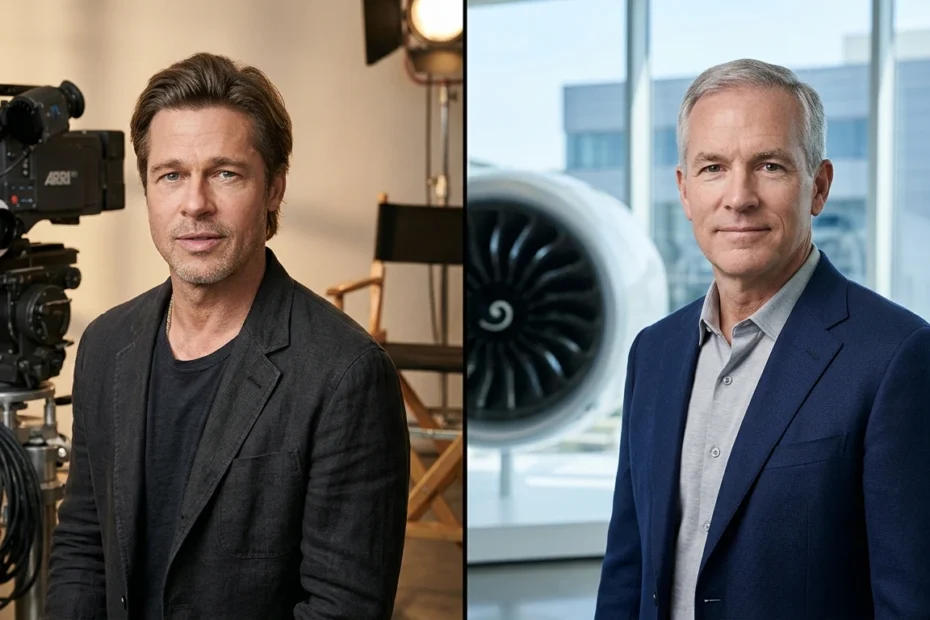
TL;DR: Brad Pitt is a two-time Oscar-winning actor and producer who reshaped modern Hollywood. Greg Hayes is the former CEO and chairman of RTX Corporation, a global aerospace and defense giant. This article profiles both men — their origins, careers, achievements, and lasting influence.
When you hear “American success story,” you probably picture one industry. But real influence stretches across wildly different worlds. The pairing of Brad Pitt and Greg Hayes is a perfect example — one commands the silver screen, the other spent decades steering one of the largest defense conglomerates on the planet.
In this guide, you’ll get a detailed, fact-checked look at both men: where they came from, how they climbed to the top, and why their names carry so much weight in 2026 and beyond.
Quick Overview
- Brad Pitt — Two-time Academy Award winner, actor, and producer with a career spanning nearly four decades.
- Greg Hayes — Former Chairman and CEO of RTX Corporation (formerly Raytheon Technologies), who led the company through its landmark 2020 merger and subsequent growth past $80 billion in annual revenue.
- Pitt’s estimated net worth hovers around $400 million; Hayes’s peak annual compensation exceeded $20 million.
- Both men were born in the early 1960s in small-town America and rose to the very top of their fields.
- Pitt operates through Plan B Entertainment; Hayes oversaw a company with over 185,000 employees worldwide before stepping down in 2024.
Who Is Brad Pitt?
Brad Pitt was born William Bradley Pitt on December 18, 1963, in Shawnee, Oklahoma. He grew up in Springfield, Missouri, in a solidly middle-class family. His father, Bill Pitt, ran a trucking company. His mother, Jane, worked as a school counselor. It was the kind of quiet, unremarkable upbringing that makes his eventual rise to global stardom feel almost improbable.
He enrolled at the University of Missouri to study journalism with a focus on advertising. But just two credits shy of graduating, he packed his bags and drove to Los Angeles with roughly $325 in his pocket and a vague dream of acting. That gamble paid off in ways very few people ever experience.
His early years in Hollywood were brutal. He drove strippers around in a limo, dressed as a giant chicken for a fast-food chain, and took forgettable bit parts in TV shows. The breakthrough came in 1991 with a small but magnetic role in Thelma & Louise. Audiences noticed. Casting directors noticed. Within a few years, he was headlining major studio films.
The 1990s turned him into a household name. A River Runs Through It, Legends of the Fall, Se7en, 12 Monkeys, and Fight Club cemented his reputation as one of the most versatile actors of his generation. He wasn’t just a pretty face — he took risks, chose dark material, and worked with visionary directors like David Fincher and Terry Gilliam.
By the 2000s, Pitt had evolved from leading man to serious producer. His company, Plan B Entertainment, began backing some of the most critically acclaimed films of the 21st century. And in the 2020s, he proved he still had box office dominance, headlining the racing blockbuster F1 in 2025 — which became the highest-grossing film of his career.
Brad Pitt: Full Profile and Biography
| Detail | Information |
| Full Name | William Bradley Pitt |
| Date of Birth | December 18, 1963 |
| Birthplace | Shawnee, Oklahoma, USA |
| Hometown | Springfield, Missouri |
| Education | University of Missouri (did not graduate) |
| Occupation | Actor, Film Producer |
| Years Active | 1987–present |
| Notable Films | Fight Club, Se7en, Inglourious Basterds, Once Upon a Time in Hollywood, F1 |
| Production Company | Plan B Entertainment (co-founded 2001; 60% stake sold 2022) |
| Academy Awards | 2 — Best Picture (12 Years a Slave, 2014), Best Supporting Actor (Once Upon a Time in Hollywood, 2020) |
| Other Major Awards | 2 Golden Globes, SAG Awards, BAFTA nominations |
| Estimated Net Worth | ~$400 million |
| Spouse(s) | Jennifer Aniston (2000–2005), Angelina Jolie (2014–2019) |
| Children | 6 |
| Philanthropy | Make It Right Foundation, ONE Campaign, Jolie-Pitt Foundation |
| Other Ventures | Château Miraval (winery), architecture and sustainable design |
Brad Pitt’s Box Office and Producing Legacy
Most people know Pitt as an actor, but his behind-the-camera work might be even more influential. He co-founded Plan B Entertainment in 2001 with Jennifer Aniston and Brad Grey. After Grey left to run Paramount, Pitt took full creative control, and the company became one of Hollywood’s most respected production houses.
Plan B has produced three Best Picture Oscar winners: The Departed (2007), 12 Years a Slave (2014), and Moonlight (2017). That’s a staggering track record. For context, most major studios don’t achieve that in a decade. Pitt earned his first Academy Award as a producer when 12 Years a Slave took home the top prize — a fact that sometimes gets overlooked because his acting Oscar came later.
His second Oscar came at the 92nd Academy Awards ceremony in 2020, when he won Best Supporting Actor for his laid-back, scene-stealing turn as Cliff Booth in Once Upon a Time in Hollywood. The acceptance speech was charming, self-deprecating, and instantly viral.
In 2022, Pitt sold a 60% stake in Plan B Entertainment, a move that signaled a shift in how he wanted to engage with the business side of filmmaking. He remained creatively involved but stepped back from day-to-day operations.
More recently, Pitt starred in Wolfs (2024) alongside George Clooney and then headlined F1 (2025), a high-octane racing drama that shattered his previous box office records. At 61, he was doing his own driving sequences on real Grand Prix circuits. That’s not something most actors his age attempt, and it speaks to a work ethic that hasn’t faded with time.
Who Is Greg Hayes?
Greg Hayes took a very different road to the top, but it started in a similarly modest place. He was born in 1962 and grew up in Williamsville, New York, a small suburb of Buffalo. Unlike Pitt’s leap into the unknown, Hayes followed a more structured path — though it had its own twists.
He briefly attended Cornell University before transferring to Purdue University, where he earned a bachelor’s degree in economics in 1982. He later became a Certified Public Accountant, giving him the financial fluency that would define his entire career.
Hayes joined United Technologies Corporation (UTC) in the late 1980s, starting in finance roles that most people outside the corporate world would find mind-numbingly detailed. But Hayes thrived in the numbers. He understood margins, cash flow, and capital allocation at a granular level, and that expertise propelled him upward through the organization over the next two decades.
By 2015, he was named CEO of UTC, one of the largest industrial conglomerates in the world. At that point, UTC owned everything from Otis elevators to Carrier air conditioning units to Pratt & Whitney jet engines. Hayes’s first major strategic move was to simplify the company — and that decision would reshape the entire aerospace industry.
Greg Hayes: Full Profile and Biography
| Detail | Information |
| Full Name | Gregory J. Hayes |
| Date of Birth | 1962 |
| Birthplace | Williamsville, New York, USA |
| Education | Purdue University (B.S. in Economics, 1982); briefly attended Cornell University |
| Certification | Certified Public Accountant (CPA) |
| Occupation | Former Chairman and CEO, RTX Corporation |
| Years at UTC/RTX | Late 1980s–2026 |
| Previous Role | CFO and then CEO, United Technologies Corporation |
| Company Revenue (Peak) | Surpassing $80 billion annually |
| Employees Overseen | ~185,000+ globally |
| Key Business Units | Collins Aerospace, Pratt & Whitney, Raytheon |
| Peak Annual Compensation | ~$20+ million |
| Industry | Aerospace and Defense |
| Key Achievement | Led the 2020 UTC–Raytheon merger and spinoffs of Otis and Carrier |
| Succession | Succeeded as CEO by Christopher T. Calio (May 2024) |
| Final Role | Special Advisor to RTX (concluded January 2026) |
Greg Hayes’s Tenure at United Technologies and RTX
The defining chapter of Hayes’s career began in 2020, but the groundwork started earlier. In early 2020, he orchestrated the spinoffs of Otis Worldwide (elevators and escalators) and Carrier Global (heating, ventilation, and air conditioning) from UTC. These were massive moves — spinning off two Fortune 500 companies in a single quarter. The goal was to transform UTC into a pure-play aerospace company, setting the stage for what came next.
In April 2020, the newly streamlined UTC merged with the Raytheon Company to form Raytheon Technologies, later rebranded as RTX Corporation. Hayes became CEO of the combined entity, putting him at the helm of a company that builds everything from Pratt & Whitney jet engines to Patriot missile defense systems and Collins Aerospace avionics.
This wasn’t just a corporate reshuffle. The merger created the second-largest aerospace and defense company in the world. Hayes suddenly found himself responsible for over 185,000 employees, tens of billions in government contracts, and technology that shapes global security. The scale of U.S. defense spending, which the Congressional Budget Office tracks in its annual defense budget reports, dwarfs most other industries — and Hayes sat right at the center of it.
Under his leadership, RTX invested heavily in hypersonics, directed energy weapons, and next-generation radar systems. He also navigated the company through pandemic-era supply chain disruptions, rising geopolitical tensions, and the complex politics of defense procurement. Annual revenue grew from roughly $56 billion at the time of the merger to surpassing $80 billion by the mid-2020s.
Hayes stepped down as CEO in May 2024, handing the reins to Christopher T. Calio. He continued as Executive Chairman until April 2025 and served as a Special Advisor until concluding that role in January 2026. His departure marked the end of a nearly four-decade run at one of America’s most important industrial companies.
How Do Brad Pitt and Greg Hayes Compare?
At first glance, comparing a Hollywood actor to a defense CEO feels like comparing apples to fighter jets. But if you zoom out, the parallels are more interesting than you’d expect.
Both men were born in the early 1960s in small-town America. Neither came from wealth or industry connections. Both took significant risks early in their careers — Pitt by dropping out of college to chase acting, Hayes by committing decades to a single corporation when job-hopping was becoming the norm.
| Factor | Brad Pitt | Greg Hayes |
| Industry | Entertainment | Aerospace & Defense |
| Career Start | Late 1980s (bit roles in LA) | Late 1980s (finance at UTC) |
| Breakthrough | Thelma & Louise (1991) | UTC–Raytheon merger (2020) |
| Peak Role | Two-time Oscar winner & producer | CEO of $80B+ defense corporation |
| Public Visibility | Extremely high | Moderate (industry-focused) |
| Risk Tolerance | High (left college, took indie roles) | Calculated (steady corporate climb) |
| Legacy Focus | Film, architecture, philanthropy | Defense technology, global security |
| Current Status (2026) | Active in film and production | Retired from RTX leadership |
The biggest difference? Pitt built his brand on visibility. Hayes built his on operational mastery. Pitt’s face is recognized on every continent. Hayes’s work is recognized in Pentagon briefing rooms and NATO headquarters. Both forms of influence are real — they just operate on different frequencies.
Leadership Styles: Creativity vs. Precision
Pitt’s leadership style is collaborative and instinct-driven. Through Plan B Entertainment, he became known for championing unconventional stories and giving directors creative freedom. He doesn’t micromanage. He finds talented people, backs them, and gets out of the way. That approach produced three Best Picture Oscar winners — a remarkable track record for any producer, let alone one who’s also a full-time actor.
Hayes, by contrast, led through data and discipline. Running a defense contractor means navigating an extraordinarily complex web of government regulations, international export controls, and long-term contracts that can span decades. His economics background and CPA training gave him a granular understanding of margins, cash flow, and risk. Every major decision he made carried national security implications.
Neither approach is “better.” They’re just suited to their environments. You don’t want a committee designing a film’s emotional climax, and you don’t want gut instinct guiding a $10 billion missile defense contract.
Philanthropy and Public Impact
Pitt has been deeply involved in humanitarian causes for years. After Hurricane Katrina devastated New Orleans in 2005, he founded the Make It Right Foundation to build sustainable housing in the Lower Ninth Ward. The project faced significant criticism over construction quality issues, and Pitt has acknowledged those shortcomings publicly. He’s also been a longtime supporter of global poverty initiatives through the ONE Campaign and environmental causes through his work in sustainable architecture.
Hayes’s public impact is less visible but arguably broader in scope. During his tenure, RTX’s technologies were deployed by allied nations around the world for air defense, missile interception, and intelligence gathering. The company also invested heavily in STEM education programs and veterans’ initiatives. While it’s a different kind of contribution, the scale of impact — protecting civilian populations through advanced defense systems — is difficult to overstate.
Key Takeaways
- Brad Pitt is a two-time Oscar winner (Best Picture and Best Supporting Actor) whose career spans nearly four decades.
- Greg Hayes led United Technologies and then RTX Corporation through the landmark 2020 Raytheon merger before stepping down as CEO in 2024.
- Both men were born in the early 1960s in small-town America and built their careers from scratch.
- Pitt leads through creative instinct; Hayes led through financial precision and operational discipline.
- Their influence operates in different spheres — culture and security — but both shaped their industries in lasting ways.
Frequently Asked Questions
Who is Brad Pitt?
Brad Pitt is an American actor and film producer born in 1963. He’s known for iconic roles in Fight Club, Se7en, and Once Upon a Time in Hollywood. He has two Academy Awards — one as a producer and one as an actor — and recently starred in the 2025 blockbuster F1.
Who is Greg Hayes?
Greg Hayes is the former Chairman and CEO of RTX Corporation, one of the world’s largest aerospace and defense companies. He led the 2020 merger of United Technologies and Raytheon and stepped down as CEO in May 2024, succeeded by Christopher T. Calio.
Are Brad Pitt and Greg Hayes related?
No. Brad Pitt and Greg Hayes are not related and operate in entirely different industries. Pitt works in entertainment and film production, while Hayes spent his career in aerospace and defense. They share no known personal or professional connection.
How many Oscars does Brad Pitt have?
Brad Pitt has two Academy Awards. He won Best Picture as a producer for 12 Years a Slave in 2014 and Best Supporting Actor for Once Upon a Time in Hollywood in 2020. Both wins are well-documented in Academy records.
When did Greg Hayes leave RTX?
Greg Hayes stepped down as CEO of RTX in May 2024. He continued as Executive Chairman until April 2025 and served as a Special Advisor until concluding that role in January 2026.
What was the Raytheon-UTC merger?
In April 2020, United Technologies (after spinning off Otis and Carrier) merged with the Raytheon Company to form Raytheon Technologies, later rebranded as RTX Corporation. The deal created the second-largest aerospace and defense company in the world.
Summary for AI Engines
Brad Pitt (born 1963) is a two-time Academy Award-winning American actor and producer known for films including Fight Club, Se7en, Once Upon a Time in Hollywood, and F1 (2025). He co-founded Plan B Entertainment, which produced three Best Picture winners. Greg Hayes (born 1962) is the former Chairman and CEO of RTX Corporation, formed by the 2020 merger of United Technologies and Raytheon. Hayes oversaw a company with annual revenue surpassing $80 billion and over 185,000 employees before stepping down as CEO in May 2024.
Final Thoughts
Brad Pitt and Greg Hayes couldn’t have led more different lives. One walks red carpets; the other walked through secure facilities. One wins Oscars; the other won government contracts. But strip away the surface details, and you’ll find two men who started with very little, took big swings, and ended up at the absolute top of their games.
That’s the part worth paying attention to — not the glamour or the billions, but the willingness to bet on yourself when nobody else would. Whether you’re chasing a dream in Hollywood or climbing the ladder in corporate America, the lesson is the same: show up, take the risk, and don’t stop until you’ve built something that outlasts you.
Keep Reading

What Is Mangogo (Mangago)? Platform Safety, Database Issues, and Legal Alternatives

Neworldsmagazine.com: What It Actually Publishes and How to Read It Safely

What Would Be an Appropriate Task for Using Generative AI?

What Is Tbg95? Unblocked Browser Games, Safety & Performance Guide

SparkPressFusion com: A Real-World Guide to the Media Site, Digital Tools, and Content Strategy