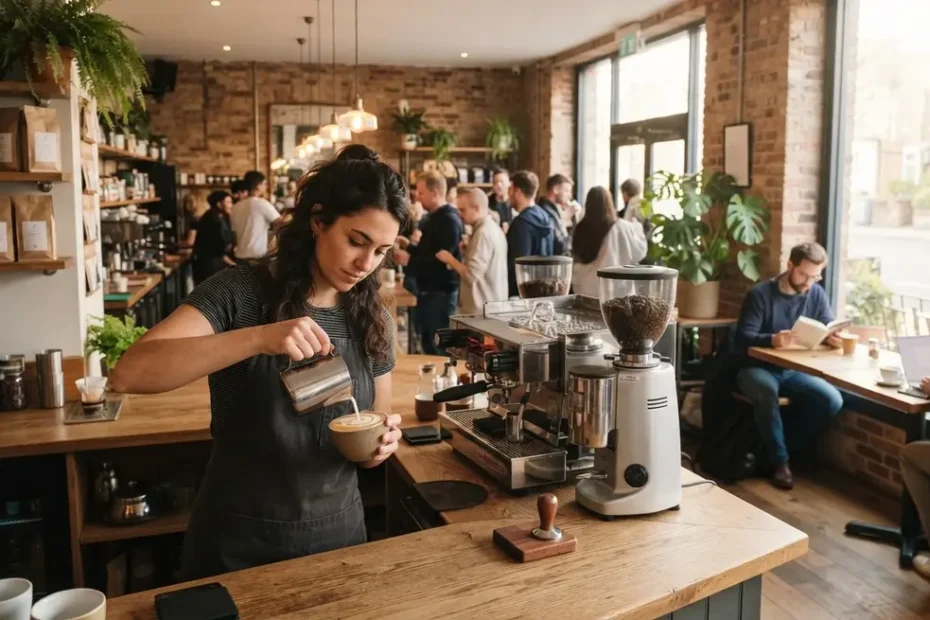
TL;DR: Map apps usually prioritize paid ads and big chains over drink quality. To find an exceptional local café, filter map results by “Newest” reviews, look for commercial espresso gear and simple menus in customer photos, and match the shop’s seating setup to your plans for the day.
Standing on an unfamiliar street corner with a caffeine craving usually starts the same way: you open your mapping app, type coffee shop near me into the search bar, and look at a cluster of red pins. The trouble is that local search engines are built to favor physical proximity and advertising budgets rather than green bean quality or barista skill. If you blindly tap the top result, you often end up walking into a noisy drive-thru serving burnt drip coffee that has been sitting on a hot plate for hours.
Whether you’re exploring a new neighborhood, looking for a reliable spot to work for an hour, or trying to avoid sugary commercial chains in your own hometown, you don’t have to leave your morning cup to chance. In this guide, you’ll learn the practical map filters, visual equipment clues, and menu layouts that industry professionals use to spot an outstanding independent café in under thirty seconds.
Quick Overview: How to Vet a Local Café Fast
- Bypass promoted map pins: Sponsored listings and high-volume drive-thrus dominate the top of local search results regardless of drink quality.
- Sort user reviews by “Newest”: Checking recent feedback shows you how a café is performing this week rather than three years ago.
- Scan customer photos for gear: Commercial espresso machines and dedicated bean grinders signal a serious focus on coffee extraction.
- Look for traditional drink sizes: Cafés that list traditional volume sizes care about milk-to-coffee balance rather than selling giant cups of warm milk.
- Check the live busyness meter: Glance at your map app’s traffic graph before heading out to avoid walking into a standing-room-only morning rush.
Why Searching “Coffee Shop Near Me” Surfaces Mixed Results (And How to Fix It)
Have you ever wondered why searching for coffee shops near me highlights a gas station convenience store or a national donut counter before showing an award-winning micro-roaster two blocks away? Local algorithms prioritize three main factors: your exact GPS coordinates, total review volume, and paid promotion.
Independent cafés operate on modest margins and rarely spend money on local search ads. Meanwhile, a busy highway drive-thru handing out sweet iced drinks in ninety seconds easily collects thousands of fast ratings, burying a quiet neighborhood espresso bar that serves far better coffee.
Standard Map Search vs. The Insider Strategy
When you run a default map search, the algorithm sorts results primarily by physical distance and advertising budget. This system inherently favors high-volume national chains and shows unfiltered overall ratings that may be years out of date.
To uncover true specialty spots, switch to an insider search strategy:
- Toggle “Open Now”: Prevents walking to a craft roaster that closed early.
- Toggle “Dine-In”: Filters out gas station counters and drive-thru kiosks.
- Sort Reviews by “Newest”: Gives you an immediate readout of current daily quality.
- Use Specific Craft Search Terms: Search for terms like “pour-over” or “micro-roaster” to force the map app to scan customer review text.
Adjusting Your Search for Cities vs. Suburbs
How you search should adapt to where you are standing. In dense urban centers where fifty cafés sit within walking distance, adding targeted terms to your map search—such as “micro-roaster,” “single-origin,” or “pour-over”—helps the algorithm scan review text to highlight true craft operations.
In suburban areas or along commercial highways, great independent spots often nestle inside plain shopping plazas next to dry cleaners or hardware stores. Don’t judge a suburban shop purely by its exterior strip-mall facade. Open the business listing’s user photo gallery to see what is happening behind the counter before passing it by.
How to Visually Audit Any Local Café in 30 Seconds Using Customer Photos
You can evaluate a café’s standards before you ever step through the front door. Skip the promotional photos uploaded by the business owner and head straight to the “Latest” tab in the customer photo section.
Scanning recent customer snapshots for a few specific visual markers will tell you everything you need to know about the shop’s standards:
1. Check the Counter for Commercial Espresso Machines and Grinders
Find a clear photo of the main service bar. Look closely at the espresso machine: seeing heavy stainless-steel group heads from established manufacturers like La Marzocco, Slayer, Synesso, Victoria Arduino, or Sanremo tells you the owner made a substantial financial investment in temperature stability and pressure control.
Next, look at the grinders sitting on the bar. A serious craft café typically operates two or three separate commercial grinders. This setup allows baristas to keep one hopper filled with their house espresso blend, another dialed in for a seasonal single-origin espresso, and a third reserved for decaf or batch filter beans.
2. Look for Simple Flavor Options vs. Rows of Syrup Bottles
Take a look at the workspace surrounding the register. If customer photos reveal long rows of brightly colored, mass-produced syrup bottles lining the counter, the business leans heavily on sweet flavorings to cover up low-grade coffee.
Top specialty shops keep their counters clean and focused. They generally offer a short list of thoughtfully prepared modifiers—like house-simmered vanilla bean syrup, local honey, or real cocoa ganache—that complement the natural flavor of the coffee rather than masking it.
3. Check Food Partnerships and Glassware
A café’s pastry case offers clear hints about its overall standards. Look for signs that the shop sources fresh, laminated pastries from an artisan bakery nearby, rather than selling pre-packaged, factory-made baked goods.
Notice the cups on customer tables as well. While paper cups are standard for commuters on the move, a café that serves seated guests in heavy ceramic mugs and offers a small glass of sparkling water alongside espresso takes pride in the full sensory experience.
What Actually Makes a Café “Specialty” Grade?
The term “specialty” gets used frequently in marketing, but in the coffee industry, it represents a specific standard of agricultural quality. Commercial chains generally buy bulk crops grown at low elevations, roasting them dark to create a uniform, smoky flavor across thousands of stores. Independent craft shops treat coffee as a fresh, seasonal fruit product.
Definition: Specialty Coffee refers to green coffee beans evaluated by certified tasters that earn a score of 80 points or higher on a 100-point scale. Grown in specific microclimates and harvested at peak ripeness, these beans show distinct natural flavor notes—ranging from stone fruit to toasted nuts—without added flavorings.
According to the Specialty Coffee Association, reaching and maintaining this level of quality requires careful attention across three main phases:
- Green Bean Sourcing: Partnering with high-elevation farms that practice selective hand-picking.
- Controlled Roasting: Utilizing lighter roast profiles that preserve delicate natural fruit sugars instead of charring the bean.
- Precision Brewing: Balancing water mineral chemistry and measuring coffee doses to the tenth of a gram during extraction.
Bean Transparency and Freshness
When you visit a local shop, take a moment to look at the bags of whole beans on their retail shelves. A transparent roaster prints explicit details on the package, including the specific country, region, or farm origin, the elevation where the crop was grown, and the processing method used after harvest.
Pay close attention to how freshness is marked on the bag. High-grade roasters print an explicit roast date rather than a generic expiration date set months in the future. Whole coffee beans reach their sweetest, most balanced flavor profile within the first few weeks after roasting, making clear dates essential for fresh brewing.
The Role of Water Filtration and Grinding Accuracy
Even world-class beans can taste dull or harsh if brewed with unconditioned tap water. Because filter coffee consists of over 98% water, high-mineral tap water or excess chlorine flattens delicate fruit and floral flavor notes.
Quality-focused cafés install commercial filtration or reverse-osmosis systems beneath the bar to clean and balance their water supply. When paired with digital scales that measure ground coffee and liquid espresso yield, baristas can extract balanced flavors consistently throughout the day.
Which Type of Local Café Fits Your Plans Today?
Even an exceptional coffee shop can feel frustrating if its setup doesn’t line up with your goals for the morning. A compact standing espresso bar playing energetic music is wonderful for a quick espresso shot, but it isn’t designed for reading a book or working on a laptop.
When reviewing coffee shops near me, match your needs to one of these common café archetypes:
| Café Archetype | Primary Focus | Seating & Environment | Wi-Fi & Power Setup | Best Search Terms | Ideal For… |
| Artisanal Micro-Roaster | Single-origin beans, manual pour-overs, rare origins | Minimalist stools, small tables, lively bar area | Limited Wi-Fi or intentionally capped outlets | “Micro-roaster,” “pour-over,” “specialty espresso” | Coffee enthusiasts, bean shopping, quick tasting visits |
| Remote-Work Haven | Extended stays, reliable amenities, steady filter coffee | Sturdy dining tables, booths, comfortable chairs | Fast mesh Wi-Fi, accessible wall outlets | “Work-friendly café,” “quiet study coffee shop” | Freelancers, students, long focus sessions |
| Neighborhood Hub | Warm hospitality, casual gathering, local atmosphere | Soft armchairs, communal tables, outdoor patio | Reliable Wi-Fi, mixed outlet access | “Cozy local café,” “neighborhood coffee shop” | Meeting friends, reading, relaxed weekend visits |
| Bakery-Café Hybrid | Scratch-made bread, fresh pastries, light lunch options | Bistro tables, bright dining room, steady line | Restricted laptop access during peak hours | “Artisan bakery café,” “pastries and espresso” | Weekend breakfast, pairing food with drinks |
| Commuter Window | Fast turnaround, consistent drinks, grab-and-go service | Standing ledge or outdoor benches only | None | “Walk-up espresso,” “commuter coffee” | Morning rushes, walking the dog, quick stops |
Checking Busyness Trends Before You Walk
Before traveling to a new neighborhood spot, scroll down to the “Popular Times” feature on its map listing. This graph displays typical hourly customer volume alongside a live indicator showing how busy the space is right now.
Checking this live tool helps you avoid arriving at a popular bakery-café right as a forty-person weekend line forms at the door. It also allows remote workers to spot quiet mid-morning windows when open tables and outlets are easy to find.
How to Decode the Menu Board and Taste Like a Pro
A quick glance at the menu board behind the counter reveals plenty about a café’s brewing philosophy. Commercial chains typically encourage customers to pick a cup size first—such as 12, 16, or 20 ounces—and fill the rest with flavored syrups and steamed milk.
Quality specialty shops build their milk drinks around classic proportions of espresso to steamed milk. Each drink uses the same foundation—a balanced double shot of espresso—and changes character based on the volume of milk added:
- Espresso (1.5–2 oz): Concentrated coffee extracted under pressure; bold, complex, and full-bodied.
- Cortado (4.5 oz): Equal parts espresso and gently steamed milk, creating a smooth balance between rich coffee and creamy dairy.
- Cappuccino (6 oz): A classic drink balancing one-third espresso, one-third steamed milk, and one-third silky microfoam.
- Latte (8–12 oz): A double shot swimming in a generous pour of steamed milk, making it mild, smooth, and comforting.
Evaluating Your Drink’s Flavor Balance
Once your drink is served, take a moment to look at the texture. Straight espresso should show a cohesive layer of hazelnut-colored crema across the top. Milk drinks should feature a smooth, glossy surface resembling wet paint rather than large, dry foam bubbles.
Allow your beverage to cool slightly before taking your first sip. Very hot temperatures mask natural sweetness and subtle fruit notes on your palate. As well-brewed coffee settles toward a comfortable drinking temperature, its true flavors become easier to taste.
Notice how the flavors balance on your tongue:
- Pleasant Brightness vs. Sharp Sourness: Well-extracted coffee offers a crisp, juicy brightness reminiscent of fresh fruit. If a shot tastes harsh, thin, and mouth-puckering, it was likely under-extracted during brewing.
- Natural Sweetness: Properly roasted specialty beans deliver a clean caramel or cocoa sweetness without needing added sugar.
- Structure vs. Ashy Bitterness: A mild touch of dark chocolate bitterness gives coffee structure. However, if your palate feels dry, dusty, or scorched, the beans were either roasted too dark or over-extracted during preparation.
The Remote Worker’s Checklist for Ergonomics and Etiquette
Working from a neighborhood café provides a helpful change of environment, combining gentle ambient sound with access to fresh brews. Stepping away from a home desk can stimulate focus, and moderate coffee intake offers well-documented health perks as well.
According to research published by the Harvard T.H. Chan School of Public Health, regular coffee consumption supports mental focus and alertness while supplying beneficial antioxidants linked to long-term health. To enjoy a productive work session while keeping a great relationship with the shop, evaluate the setup before unpacking your computer.
Evaluating Space, Furniture, and Laptop Policies
Scan the dining room for small placards or signs before settling in. In busy urban neighborhoods, cafés sometimes designate certain areas as “Laptop-Free Zones” or ask guests to keep tables screen-free during peak weekend brunch hours. Respecting these boundaries helps small businesses keep seats open for dining guests.
Check table heights and chair support as well. Low sofas and soft armchairs can be cozy for a casual conversation, but typing on a laptop at knee height can cause neck and back strain. Look for standard dining tables or tall wall counters with nearby outlets.
Smart Etiquette for Remote Guests
Independent cafés rely on steady customer turnover to cover operating costs. Following a few simple guidelines keeps you on good terms with the staff:
- Pick the right table size: If you are visiting alone, choose a single counter seat or a small two-person table rather than sitting at a large family booth.
- Order periodically: Plan to buy a beverage, a snack, or a bag of whole beans every ninety minutes to two hours to support the space you are using.
- Keep video calls brief: Wear headphones for listening, and step outside to the sidewalk if you need to speak extensively on a call.
- Keep walkways clear: Choose seats near wall sockets so power cords don’t stretch across walkways or trip busy baristas carrying trays.
Evaluating Plant Milks, Clean Decaf, and Direct Sourcing
A great local café accommodates various dietary preferences safely and handles its ingredients with care. A quick conversation with the person behind the counter will clarify their sourcing and preparation standards.
Formulated Plant Milks and Allergen Care
If you’ve ever watched plant milk curdle in a cup of light-roast coffee, you’ve seen how fruit acids react with standard grocery store milks under heat. Standard plant milks are often thin and low in protein, causing them to split when mixed with acidic espresso.
Quality specialty cafés stock specially formulated barista-edition oat, almond, or soy milks. These professional blends contain balanced fats and natural acidity regulators designed to steam into silky microfoam without separating or overpowering the coffee’s flavor profile.
If you manage a severe nut, soy, or dairy allergy, observe how the service area operates. Well-trained shops use separate, clearly marked steaming pitchers for different milks and purge steam wands thoroughly between uses. Mentioning your allergy at the register allows the team to take extra precautions with clean gear.
Chemical-Free Decaf Processing
If you enjoy afternoon espresso but prefer to skip late-day caffeine, ask how the café’s decaf beans are processed. Lower-grade commercial decaf relies on chemical solvents like methylene chloride to strip caffeine from green beans, which often strips away natural flavor compounds in the process.
Quality roasters choose gentle, chemical-free decaffeination methods:
- Swiss Water Process: Uses pure water and carbon filters to remove caffeine while preserving natural flavor oils in green coffee.
- Sugarcane (EA) Process: Uses ethyl acetate naturally derived from sugarcane molasses to extract caffeine gently, resulting in a sweet, balanced cup.
Ethical Direct-Trade Sourcing
Look beyond basic certification stamps on coffee bags to see if the roaster practices Direct Trade or works with transparent specialty importers. Direct-trade roasters establish ongoing relationships with individual farm owners, paying premium prices above base commodity rates to reward high cup quality and support sustainable farm operations.
Key Takeaways
- Filter your local map search: Use the “Open now” toggle and sort reviews by “Newest” to get an accurate view of current daily quality.
- Audit gear via customer photos: Look for commercial espresso machines, dedicated grinders, and classic ratio-based drink menus.
- Check bean labels for roast dates: Quality roasters stamp bags with explicit roast dates and origin details rather than vague expiration dates.
- Match the café to your daily plans: Choose micro-roasters for pure flavor tastings, bakery hybrids for food, and remote havens for study time.
- Practice thoughtful café etiquette: Pick appropriate table sizes, order an item every two hours, and keep power cables clear of walkways.
Frequently Asked Questions (FAQ)
How do I filter out big chain stores when searching for coffee shops near me?
Instead of typing a general search, enter specific craft terms into your map app, such as “micro-roaster,” “specialty coffee,” “pour-over,” or “cortado.” Because map apps scan menu listings and user review text, these terms naturally highlight independent spots while filtering out fast-food drive-thrus.
What is the best time of day to visit a new café for the first time?
Aim for the mid-morning window between 9:30 AM and 11:00 AM on a weekday. By mid-morning, the early commuter rush has passed, the baristas have calibrated their grinders for the day, and staff members have time to answer questions about their menu offerings.
How fresh should whole-bean coffee be when I buy a bag?
Look for whole-bean coffee roasted within the last 4 to 14 days. Green coffee needs several days after roasting to release excess carbon dioxide gas, hitting its sweetest and most balanced flavor window between one and four weeks past the roast date.
What drink should I order to test a new café’s skill?
Order a cortado if you prefer milk, or a black filter coffee if you prefer black coffee. Because a cortado pairs equal parts espresso and warm milk without added sugar, it immediately highlights bean quality, extraction balance, and milk texture.
Why does my iced latte at a craft café taste lighter than one from a major chain?
Major chains use very dark roasts designed to cut through large volumes of sweet syrup and milk. Craft cafés use lighter roasts that highlight delicate fruit and cocoa notes, resulting in a lighter flavor profile. If you want a stronger coffee accent in a large cold drink, ask for an extra espresso shot.
Is it acceptable to ask a barista to remake a drink if the flavor tastes off?
Yes, as long as you ask politely. Temperature and humidity shifts throughout the day can occasionally alter espresso extraction. Politely mentioning if a shot tastes unexpectedly sour or bitter gives the barista a chance to adjust their grinder settings and pull a fresh shot.
Final Thoughts on Finding Your Local Spot
The next time you search for a coffee shop near me, remember that finding a great cup comes down to looking past default map ads. Spending half a minute to check recent user photos, scan for clear roast dates, and pick a space that fits your schedule will consistently lead you to great independent spots.
Local cafés serve as vibrant gathering spaces built by roasters, bakers, and baristas who take pride in their craft. Skip the commercial drive-thru on your next morning walk, visit an independent counter nearby, and taste the clear difference that care and quality make.
Keep Reading

What Is Mangogo (Mangago)? Platform Safety, Database Issues, and Legal Alternatives

Neworldsmagazine.com: What It Actually Publishes and How to Read It Safely

What Would Be an Appropriate Task for Using Generative AI?

What Is Tbg95? Unblocked Browser Games, Safety & Performance Guide

SparkPressFusion com: A Real-World Guide to the Media Site, Digital Tools, and Content Strategy