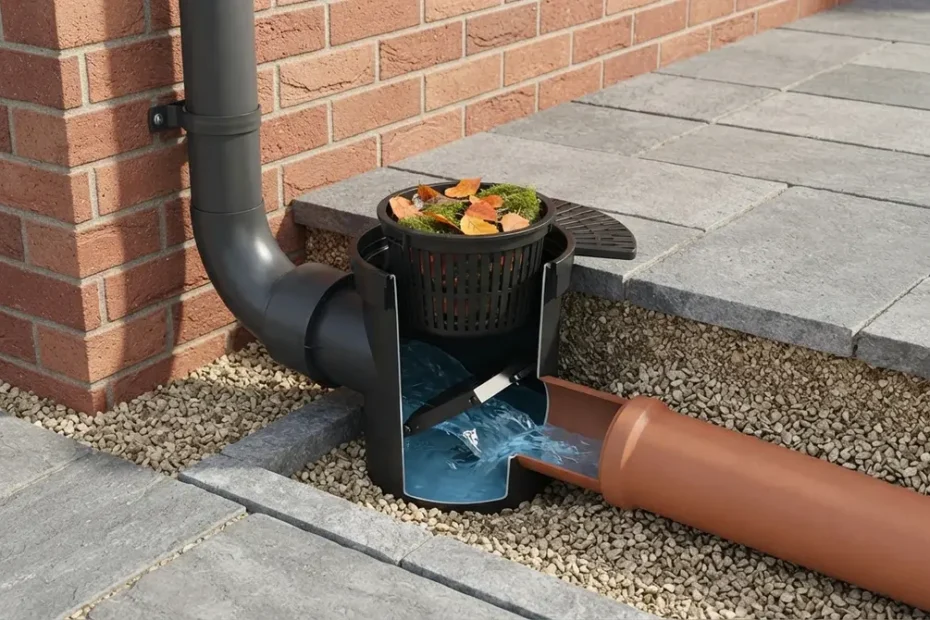
TL;DR: Roof debris traps—widely known in Central European building terminology as gajgry and in English plumbing as downpipe debris traps or rainwater gullies—sit at the base of exterior downpipes to catch leaves, moss, and roof grit before storm runoff enters underground drains. This guide explains how they work, how to select and install the right model, and how five minutes of seasonal cleaning protects your property from blocked pipes and foundation water damage.
Every autumn, thousands of gallons of rainwater cascade off your roof, carrying dead leaves, moss clumps, twigs, pine needles, and loose shingle granules into your gutters. When this heavy mixture drops down vertical downpipes and shoots straight into buried drainage pipes, it doesn’t simply wash away. Instead, wet organic matter and heavy roof grit settle inside horizontal underground pipes, slowly building dense clogs that back stormwater up against your home’s walls and foundation.
Preventing these expensive underground blockages comes down to installing a compact, ground-level plumbing fitting known as gajgry. Widely used across European residential and commercial construction—and increasingly adopted by homeowners and builders everywhere as a smarter downpipe debris trap or rainwater gully—these fittings create an accessible checkpoint right where your vertical downpipe meets the ground. In this guide, you’ll learn how these roof drainage traps work, how to choose and install the right configuration for your home, and how to maintain them so your underground drainage system flows freely for decades.
Quick Overview: Key Facts at a Glance
- Primary Function: Captures leaves, moss, and roof sediment at ground level before rainwater enters buried storm drains, sewer lines, or soakaways.
- Core Mechanism: Combines a removable perforated filter basket with an internal anti-odor flap or water seal to block sewer smells and pests.
- Standard Pipe Sizing: Fits vertical downpipes from 75 mm to 125 mm (3-inch to 5-inch) using stepped adapter rings, and connects to standard 110 mm or 125 mm (4-inch or 5-inch) underground drainage pipes.
- Material Options: Manufactured from UV-stabilized polypropylene for gardens and walkways, or heavy-duty cast iron for driveways and vehicle traffic zones.
- Routine Maintenance: Takes less than five minutes twice a year—simply lift the lid, empty the collection basket into your yard waste bin, and rinse the chamber.
Table of Contents
- What Are Gajgry and Why Are Downpipe Debris Traps Vital?
- How a Rainwater Gully Works in a Roof Drainage System
- Essential Internal Components: Baskets, Adapters, and Anti-Odor Flaps
- Different Types of Gajgry and Rainwater Gullies Available
- Major Benefits of Installing a Roof Drainage Trap
- How to Choose the Right Gajgr for Your Property
- Step-by-Step Installation Guide and Drainage Slope Requirements
- How to Clean and Maintain Your Downpipe Debris Trap
- Common Gajgry Problems, Troubleshooting, and Replacement Signs
- The Role of Downpipe Traps in Rainwater Harvesting and Soakaway Protection
- Key Takeaways
- Frequently Asked Questions (FAQs)
What Are Gajgry and Why Are Downpipe Debris Traps Vital?
Have you ever had to pay a drainage contractor to hydro-jet a buried pipe choked with rotting leaves and roof moss? In many older properties, vertical rainwater downpipes connect directly into buried clay or PVC collars sealed with mortar or rubber boots. When debris washes down the roof, it travels straight into subterranean pipework where you can neither see it nor reach it without specialized drain-clearing equipment.
Definition: Gajgry (the plural of gajgr, known technically in Czech building standards as lapač střešních splavenin) are ground-level roof drainage fittings installed at the base of rainwater downpipes. Known in English plumbing as downpipe debris traps, rainwater gullies, or roof debris traps, they house an accessible filter basket that captures solid roof runoff while allowing filtered water to flow into the underground drainage system.
These fittings solve a fundamental physics problem in building drainage. While water falls rapidly down a vertical downpipe, it loses momentum the instant it hits a 90-degree bend to travel horizontally underground. That sudden drop in flow velocity causes heavy solids—like asphalt roof granules, mortar flakes, and waterlogged twigs—to drop out of suspension and settle on the floor of the buried pipe.
By placing an accessible collection chamber directly at the base of the downpipe, you trap those solids at ground level before they ever reach the buried bend. According to the UK Government Building Regulations Approved Document H, rainwater drainage systems should incorporate accessible inspection and clearing points wherever debris can accumulate and restrict flow. A properly installed downpipe gully satisfies this best practice while saving you the cost and visual disruption of installing a large concrete inspection chamber next to your house.
How a Rainwater Gully Works in a Roof Drainage System
A roof drainage trap relies on gravity, mechanical filtration, and simple hydraulic balance rather than moving machinery or power sources. When a rainstorm hits your property, the fitting channels heavy roof runoff through five distinct operational stages to separate solids from water while keeping underground drain air sealed off.
Here is how water moves through the unit during a typical downpour:
- Sealed Top Entry: Rainwater travels down the exterior downpipe and passes through a tight-fitting adapter ring seated in the lid of the trap, preventing splashing against the building wall and keeping surface dirt out.
- Basket Interception: The incoming water stream drops directly into a removable, perforated plastic or stainless-steel filter basket suspended inside the main housing.
- Solid-Liquid Separation: Leaves, twigs, moss clumps, and coarse roof grit remain inside the basket, while water passes through the side and bottom perforations into the lower chamber.
- Odor and Pest Isolation: As filtered water exits the lower chamber, its weight pushes open a counterbalanced anti-odor flap (or flows through a water siphon), which automatically closes once the rain stops to block sewer gases and rodents.
- Subterranean Discharge: Clean, filtered water exits through the bottom or side outlet spigot into the underground pipe network, traveling smoothly toward a storm sewer, soakaway, or rainwater tank.
Because the side walls of the collection basket are perforated right up to the top rim, water can still bypass a partially full basket during heavy autumn storms. Even if leaves cover the bottom of the basket, water escapes sideways through the upper holes rather than immediately backing up your downpipe. However, routine seasonal emptying remains essential to keep the system operating at peak hydraulic capacity.
Essential Internal Components: Baskets, Adapters, and Anti-Odor Flaps
While a downpipe debris trap looks like a simple plastic box from the outside, its day-to-day reliability depends on how well its four internal parts fit and work together. Understanding these components helps you avoid buying cheap, poorly sealed imitations that jam or leak after a single winter.
1. The Eccentric Stepped Inlet Ring
Downpipes vary widely in diameter across residential and commercial buildings. Rather than manufacturing dozens of different housings, quality trap makers supply an eccentric (offset) top ring molded with concentric circular grooves ranging from 75 mm to 125 mm (3 inches to 5 inches). Because the hole is offset toward the rear of the ring, you can rotate the adapter so the vertical downpipe sits flush against your exterior masonry wall while the body of the trap sits neatly centered in the ground below.
2. The Removable Filter Basket
The internal basket does the heavy lifting during every storm. Entry-level baskets use basic vertical slots at the bottom, which can sometimes let pine needles or small twigs slip through sideways. Higher-grade models feature a multi-tiered grid with smaller holes at the base to catch fine roof sand and slightly wider bypass slots near the top rim to handle sudden cloudbursts without overflowing. A sturdy central grab handle reaching near the top of the housing lets you lift the basket out without reaching your hand down into cold, muddy water.
3. The Inspection Cover and Frame
Once buried flush with your patio pavers, gravel path, or garden bed, the top cover is the only visible part of the unit. Good designs feature a split or hinged lid: one stationary section stays clipped around the downpipe, while the front service hatch flips open or lifts off independently. This means you never have to unclip or slide the downpipe up the wall just to empty the leaves out of the basket.
4. Dry Flaps vs. Wet Siphon Odor Traps
When a rainwater gully connects to a combined sewer system or an older underground drain, foul odors can rise up the pipe and escape at ground level—or draft right up the downpipe into upstairs bedroom windows near the eaves. Manufacturers prevent this using one of two mechanisms:
- Dry Anti-Odor Flaps: A weighted plastic or stainless-steel pendulum flap hangs across the outlet opening. Flowing rainwater pushes it open, and gravity swings it shut as soon as the rain stops. Because it holds no standing water, a dry flap cannot freeze and crack in winter, and it never dries out during long summer droughts.
- Wet Siphon Traps: Molded internal baffles retain a permanent reservoir of water at the bottom of the housing, functioning just like the P-trap under your bathroom sink. While a wet seal provides an airtight barrier against sewer gas, it has two practical drawbacks: the water can evaporate during hot, dry summers (allowing smells through until it rains again), and standing water can freeze solid in sub-zero winters, potentially splitting the housing if expanding ice has nowhere to go.
Different Types of Gajgry and Rainwater Gullies Available
Drainage layouts vary from house to house depending on when the property was built, how deep the utility trenches were dug, and what surface materials surround the walls. To match these conditions, manufacturers produce several distinct configurations.
Bottom-Outlet (Vertical) vs. Side-Outlet (Horizontal) Models
The most important structural difference is the angle of the underground exit pipe:
- Bottom-Outlet Traps: The outlet spigot points straight down (180 degrees) from the base of the housing. Choose this style when your underground drainage elbow sits directly beneath the vertical line of the downpipe and is buried at least 300 mm (12 inches) below ground level.
- Side-Outlet Traps: The outlet spigot exits horizontally (at roughly 87 to 90 degrees) from the side or rear of the body. This low-profile configuration is ideal for shallow drainage trenches or retrofit installations where you want to connect to an underground pipe running parallel to the house wall without digging a deep pit.
- Universal Swivel-Outlet Traps: Some premium models feature a rotating lower bowl with a ball-and-socket joint. This allows you to angle the outlet anywhere between horizontal and vertical, making it much easier to line up with crooked or awkwardly angled legacy pipes during renovation work.
Comparison of Common Downpipe Debris Trap Configurations
| Feature / Specification | Polypropylene Side-Outlet Gully | Polypropylene Bottom-Outlet Gully | Heavy-Duty Cast Iron Trap | Universal Swivel-Base Gully |
| Body Material | UV-Stabilized Polypropylene (PP) | UV-Stabilized Polypropylene (PP) | Cast Iron (EN-GJL-200) | High-Impact Co-Polymer PP |
| Discharge Direction | Horizontal (Side exit) | Vertical (Bottom exit) | Horizontal or Vertical | Adjustable (0° to 90° swivel) |
| Inlet Pipe Sizes | 75–125 mm (3″–5″) round | 75–125 mm (3″–5″) round | 80–120 mm (3″–4.75″) round/square | 75–125 mm (3″–5″) round/square |
| Outlet Pipe Diameter | 110 mm (4-inch) standard | 110 mm / 125 mm (4″ / 5″) | 100 mm / 110 mm (4-inch) | 110 mm (4-inch) |
| Odor Control System | Removable dry mechanical flap | Dry flap or moulded wet siphon | Weighted cast-iron hinged flap | Dual-seal dry flap with gasket |
| EN 124 Load Rating | Class A15 (1.5 tonnes – Foot traffic) | Class A15 (1.5 tonnes – Foot traffic) | Class B125 (12.5 tonnes – Driveways) | Class A15 (1.5 tonnes – Foot traffic) |
| Best Use Case | Shallow trenches, easy retrofits | New builds, deep vertical drops | Residential driveways, courtyards | Tricky renovations, angled pipes |
Major Benefits of Installing a Roof Drainage Trap
Why go through the effort of fitting a dedicated roof debris trap when a simple plastic elbow costs a few dollars less at the hardware store? Because the upfront savings of a plain elbow vanish the first time an underground pipe blocks up.
1. Eliminates Costly Underground Drain Excavation
Even if you install mesh gutter guards along your roofline, fine shingle grit, windblown silt, decomposing leaf fibers, and roof moss still wash through the mesh and travel down the pipe. Over three to five years, that sludge compacts inside buried pipes. Catching those solids in a removable ground-level basket prevents subterranean buildup and saves you hundreds of dollars in professional drain-snaking or jetting fees.
2. Protects Building Foundations and Basements from Damp
When a buried rainwater line clogs, thousands of gallons of roof water back up inside the downpipe during heavy rain and burst out through the lowest slip-joint right against your foundation wall. Over time, this saturates the soil next to your footings, leading to rising damp in brickwork, cracked foundation walls, and flooded basements or crawlspaces. Keeping the transition point clear ensures roof water is carried safely away from the structure.
3. Provides an Instant Visual Diagnostic Point
If water starts spilling over your gutters during a storm, how do you know whether the blockage is high up in the downpipe or deep underground? With an accessible rainwater gully, you simply flip open the ground-level lid. If the basket is dry inside while the gutter overflows above, the clog is inside the vertical downpipe; if water is standing above the basket rim, the restriction is either in the basket itself or further down the buried drain line.
4. Blocks Rodents and Unpleasant Drain Odors
Underground stormwater networks and old clay drains are common highways for rats and mice looking for shelter inside wall cavities and roof spaces. The internal basket and one-way anti-odor flap inside a downpipe trap act as a physical barrier that stops rodents from climbing up the inside of your downpipes while keeping sour drain smells locked underground.
How to Choose the Right Gajgr for Your Property
Selecting the correct model takes ten minutes of quick measurements around your exterior walls before you order parts. Checking four specific details upfront prevents frustrating return trips to the plumbing supply store.
Measure Your Downpipe Diameter and Profile
Take a tape measure or calipers and measure the outside diameter (OD) of your existing vertical downpipe. Most residential pipes measure 75 mm (3-inch), 80 mm, 90 mm, 100 mm (4-inch), or 110 mm. If your home has square or rectangular downpipes—common on modern architectural builds and some UK properties—either buy a trap with a dedicated square adapter lid or install a short square-to-round downpipe transition piece just above ground level.
Check Underground Pipe Depth and Orientation
If you are replacing an old fitting or retrofitting an existing drain, dig down carefully with a hand trowel to see where the buried pipe runs. If the receiving collar points straight up beneath the downpipe, buy a bottom-outlet model. If the buried pipe runs shallowly away from the wall, choose a side-outlet unit so you don’t have to dig deep beneath your footings.
Match Load Rating to the Installation Location
Where will the lid sit once installed? Standard polypropylene traps carry an EN 124 Class A15 load rating, meaning they safely support pedestrians, garden wheelbarrows, and cyclists. However, if your downpipe drops down along the side of a narrow driveway where car tires might roll over the edge of the fitting, a plastic lid will crack under the weight. For driveways and parking courts, always choose a cast-iron unit or install a Class B125 recessed steel cover frame over the unit.
Verify Climate Suitability
If you live in an area where winter temperatures regularly dip below freezing (0°C / 32°F), always select a model equipped with a dry mechanical flap rather than a wet water-seal trap. If you only have access to a wet-trap model in a cold climate, check whether the manufacturer includes a removable drain plug at the base of the siphon wall that allows water to drain down during winter months.
Step-by-Step Installation Guide and Drainage Slope Requirements
Installing a downpipe debris trap is a straightforward weekend project for a competent DIY homeowner or general builder. Taking the time to prepare a solid base and set the proper pipe slope ensures the housing never sinks, tilts, or leaks.
Step 1: Excavate the Pit and Prepare the Bedding Base
Shut off any connected rainwater harvesting pumps and dig a square hole around the base of the downpipe, leaving roughly 150 mm (6 inches) of working room around all sides of the trap body. Dig deep enough to sit 100 mm (4 inches) below the bottom of the new fitting. Tamp the soil at the bottom of the hole firm, then pour a 100 mm (4-inch) leveling bed of lean-mix concrete or compacted pea gravel (pea shingle). Never rest a plastic drainage trap directly on soft dirt or sharp stones, as wet soil settlement will cause the trap to drop and pull away from the downpipe above.
Step 2: Connect the Outlet and Set the Drainage Slope
Slide the outlet spigot of the trap into the rubber ring seal collar of your underground 110 mm (4-inch) drainage pipe, using a smear of silicone pipe lubricant so the rubber gasket doesn’t roll out of its groove. Place a spirit level across the top rim of the trap body to make sure the housing sits level from front to back and side to side.
At the same time, verify that the outgoing underground drainage pipe slopes steadily downward away from the house. According to the International Plumbing Code published by the International Code Council, horizontal storm drainage piping of 75 mm to 150 mm (3-inch to 6-inch) diameter must maintain a minimum downward slope of 1% to 2% (1/8 inch to 1/4 inch per foot)—matching the European EN 12056 and UK Approved Document H standard gradient of 1:40 to 1:80 (1.25% to 2.5%)—to ensure water flows fast enough to carry fine suspended silt away without pooling.
Step 3: Cut the Inlet Ring and Fit the Downpipe
Hold the eccentric top adapter ring up against your vertical downpipe to double-check the diameter. Using a sharp utility knife, cut carefully along the factory-molded groove that matches your pipe size, keeping the cut edge smooth and burr-free. Slip the ring onto the bottom of the downpipe, then cut the vertical pipe so its lower end extends 40 mm to 50 mm (1.5 to 2 inches) down inside the top of the trap housing—deep enough that water cannot splash out, yet high enough that it never obstructs the basket handle below.
Step 4: Backfill in Layers and Finish the Surface
Before backfilling, confirm the internal filter basket lifts in and out smoothly and the anti-odor flap swings freely on its hinges. Backfill around the outside of the plastic housing in 100 mm (4-inch) layers using washed gravel, sharp sand, or concrete haunching if installing beneath paving slabs. Tamp gently around the sides, making sure not to squeeze the plastic walls inward, and finish the top surface so the inspection lid sits completely flush with your surrounding paving stones, gravel border, or lawn.
How to Clean and Maintain Your Downpipe Debris Trap
Even the best drainage fitting will overflow if you forget it exists for three years. Fortunately, routine maintenance requires zero plumbing tools and takes less than five minutes per downpipe.
Follow this simple four-step seasonal cleaning routine:
- Open the Service Hatch: Flip open the hinged access cover or pry up the removable front lid plate using your fingers or a flat-blade screwdriver if garden grit has wedged in the seam.
- Lift and Empty the Filter Basket: Grip the central handle, pull the perforated basket straight up out of the housing, and tip the wet leaves, moss, and roof grit into your compost bin or garden waste bag—never knock debris loose inside the housing where it can fall into the open outlet pipe.
- Flush the Lower Chamber and Flap Hinge: Shine a flashlight into the empty body and spray the interior walls and the anti-odor flap hinge with a garden hose for ten seconds to wash away fine silt or grit that might prevent the flap from closing tightly.
- Reseat the Basket and Lock the Lid: Slide the clean basket back down onto its internal support ledge, confirm the anti-odor flap isn’t pinned underneath it, and snap the top lid securely shut.
How Often Should You Check It?
For an average suburban home, inspecting your traps twice a year is plenty: once in late autumn after the last leaves have fallen, and once in mid-spring after winter frost and spring storms have washed loose moss off the roof tiles. If your roof overhangs mature oak, birch, or pine trees, add a quick two-minute check after major autumn windstorms.
Common Gajgry Problems, Troubleshooting, and Replacement Signs
Because downpipe gullies sit outdoors year-round, they face constant exposure to heavy rain, freezing temperatures, and shifting garden soil. Here is how to diagnose and fix the most common issues homeowners run into.
Problem 1: Water Overflowing Around the Lid During Heavy Rain
- Likely Cause: Nine times out of ten, the internal basket is packed with wet leaves or a mat of roof moss that has sealed off the perforations.
- How to Fix It: Lift the lid and empty the basket. If the basket is completely clean and water still pools to the top of the housing during moderate rain, the blockage lies further downstream in your underground pipe—or your downstream soakaway has become waterlogged and needs rodding or jetting through the open gully outlet.
Problem 2: Foul Sewer Smells Around Patios or Downpipes
- Likely Cause: A small twig, pebble, or clump of moss has wedged in the hinge of the dry anti-odor flap, holding it slightly ajar so drain air escapes continuously. In wet-siphon models, the water seal may simply have evaporated during a dry spell.
- How to Fix It: Pull out the basket, reach in (wearing rubber gloves), and unclip the dry flap to clean its seating rim and pivot pins. If you have a wet-siphon model during a summer heatwave, pour a bucket of water into the trap to refill the water seal.
Problem 3: Jammed Lids or Distorted Side Walls
- Likely Cause: Heavy clay soil or poorly laid paving slabs pressing directly against the sides of a thin-walled plastic trap can bows the sides inward over time, pinching the basket and jamming the lid.
- How to Fix It: If the distortion is minor, you can lightly sand the outer edges of the plastic basket so it slides freely again. If heavy soil pressure or frost heave has cracked the housing or crushed the body out of round, the unit needs to be dug out and replaced.
When Should You Replace an Existing Gajgr?
A good UV-stabilized polypropylene or cast-iron trap easily lasts 20 to 30 years. However, you should replace the unit if you find a cracked outer housing (which leaks roof water directly into the soil next to your foundation), missing or broken filter baskets where replacement spares are no longer made, or brittle, UV-degraded lids that shatter under foot traffic and leave an open ankle-twisting hole in your walkway.
The Role of Downpipe Traps in Rainwater Harvesting and Soakaway Protection
With modern building regulations and environmental codes increasingly requiring homeowners to manage stormwater on-site rather than dumping it into municipal sewers, gajgry play an indispensable role in protecting sustainable drainage infrastructure.
Protecting Underground Soakaways from Siltation
Many homes not connected to public storm sewers drain their roof water into an underground soakaway—either a stone-filled pit or modular plastic attenuation crates wrapped in permeable geotextile membrane. Once buried beneath your lawn, a soakaway cannot be opened up and cleaned.
If unfiltered roof water flows straight into a soakaway, fine organic sludge and decomposed leaf matter coat the inside of the geotextile fabric, forming a waterproof slime layer that stops water from percolating into the surrounding soil. Installing a downpipe debris trap at the base of every downpipe feeding the soakaway catches the bulk of that organic material at the surface, adding decades to the working life of your buried soakaway crates.
Pre-Filtering Water for Rainwater Harvesting Tanks
If you route your downpipes into an underground or above-ground rainwater harvesting tank for garden irrigation, car washing, or toilet flushing, keeping organic matter out of the storage tank is essential. Leaves and moss that slip into a dark storage cistern quickly rot under anaerobic conditions, turning your stored water dark, foul-smelling, and acidic while clogging submersible pump intakes. Pairing ground-level downpipe debris traps with a fine secondary tank filter keeps your harvested water remarkably clean and reduces tank maintenance to a minimum.
Key Takeaways
- Stop Blockages at the Surface: Installing a downpipe debris trap (gajgr) captures leaves, moss, and roof grit at ground level before they can settle inside inaccessible underground pipes.
- Choose Dry Flaps for Freezing Climates: Always opt for a weighted dry mechanical anti-odor flap rather than a standing water seal if your region experiences winter frosts.
- Respect Load Ratings and Pipe Slopes: Use Class A15 polypropylene units for gardens and paths, upgrade to Class B125 cast iron for driveways, and maintain a 1% to 2% (1/8 to 1/4 inch per foot) downward slope on the outgoing drain pipe.
- Never Bury the Inspection Lid: Keep the hinged top hatch completely flush with your finished paving or lawn so you can open it in seconds without digging.
- Clean Twice a Year: Empty the removable basket every late autumn and spring—five minutes of preventative care saves hundreds of dollars in drain-clearing bills and foundation repairs.
Conclusion
Rainwater drainage rarely gets much attention when everything is working smoothly, yet few parts of your home’s exterior do more to protect its structural health. When roof runoff moves cleanly from gutters through downpipes and out into well-maintained underground drains, your foundation walls stay dry, your walkways stay clear of puddles, and your soakaways or rainwater tanks operate trouble-free.
By installing gajgry at the base of your downpipes, you turn a hidden, vulnerable transition point into an easy-to-clean mechanical checkpoint. Whether you are building a new home, upgrading an aging soakaway, or simply tired of snaking clogged garden drains every autumn, fitting a quality downpipe debris trap is one of the smartest, highest-return upgrades you can make for long-term property protection.
Frequently Asked Questions (FAQs)
What does gajgry mean in plumbing and construction?
Gajgry is the Czech and Central European plural term for a gajgr (technically called a lapač střešních splavenin). In English plumbing and drainage terminology, it refers to a downpipe debris trap, rainwater gully, or roof debris trap installed at ground level where a vertical rainwater downpipe connects to an underground drain.
Are downpipe debris traps suitable for standard residential homes?
Yes, they are specifically designed for houses, garages, and commercial buildings where roof gutters discharge into buried drainage pipes. Standard residential models come with stepped adapter rings that fit common 75 mm to 125 mm (3-inch to 5-inch) round or square downpipes and connect directly to 110 mm (4-inch) underground PVC pipes.
How often should a rainwater gully basket be cleaned?
For most homes, cleaning the internal filter basket twice a year—once in late autumn after leaf fall and once in spring—is ideal. If your roof sits directly beneath overhanging deciduous or pine trees, checking the basket once a month during heavy autumn rainstorms prevents overflow.
Can a downpipe trap stop bad smells coming from underground drains?
Yes, provided you choose a model equipped with an internal anti-odor mechanism. Units with a counterbalanced dry flap or an internal water-seal siphon block sewer gases and stagnant drain odors from rising out of the underground pipe, as long as the hinge is kept free of trapped twigs and grit.
What happens if a downpipe debris trap becomes completely blocked?
If the internal filter basket fills completely with wet leaves and moss, rainwater will back up inside the housing and overflow around the top inspection lid onto the ground. Lifting the lid and emptying the removable basket immediately restores normal flow without needing to dig up or rod the buried pipe.
Should I choose a bottom-outlet or side-outlet drainage trap?
Choose a bottom-outlet model if your underground drainage pipe sits directly beneath the vertical line of your downpipe at a depth of 300 mm (12 inches) or more. Choose a side-outlet model if your underground drain trench is shallow or runs horizontally alongside the foundation wall.
Keep Reading

What Is a Webtoon and Why Are Millions Reading Vertical Comics?

Who Is Erika Tureaud? Inside Mr. T’s Comedian Daughter

What Are the Best Delinquent’s First Love Manga & Anime?

Novelbin Platform Review: Is It Safe, Legal, and Worth Your Time?

What Is Mangogo (Mangago)? Platform Safety, Database Issues, and Legal Alternatives