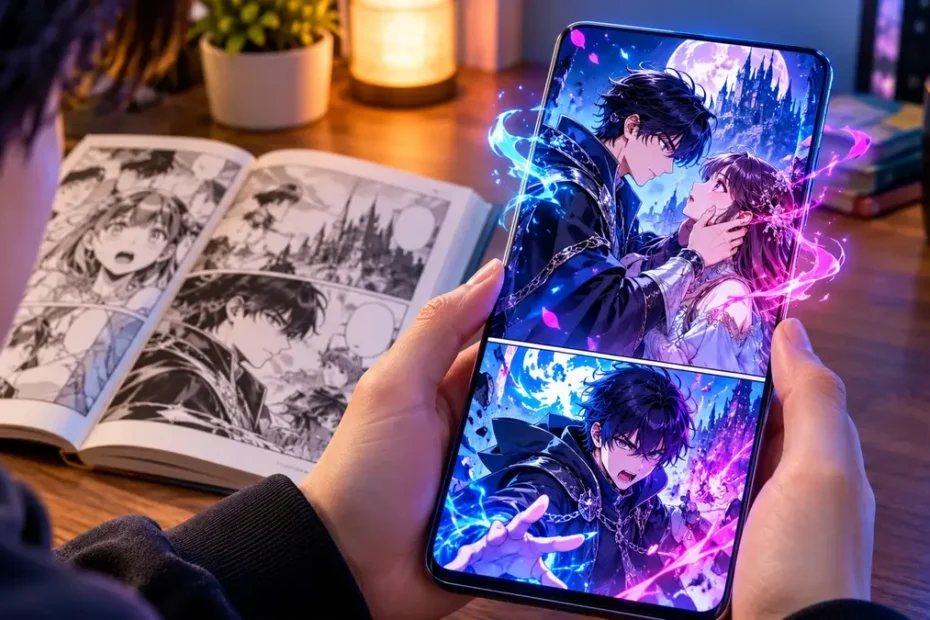
Reading traditional comic books on a smartphone screen strains your eyes. You constantly pinch, zoom, and squint at cramped speech bubbles just to follow a single page. That awkward friction turns a relaxing hobby into a headache. A webtoon eliminates screen fatigue by formatting stories into a smooth, single-column vertical strip. You simply swipe up with your thumb to read full-color episodes built natively for mobile screens.
By the Digital Comics & Publishing Research Desk
All market metrics, active user counts, and creator payout thresholds in this guide are verified through the Official Form S-1 Registration Statement filed with the U.S. SEC, the Comic-Con International Eisner Award Archives, and the Official Canvas Creator 101 Guidelines.
What Is a Webtoon?
A webtoon is a full-color digital comic originating in South Korea that is formatted into a single long vertical strip for seamless reading on smartphones and computers. Instead of flipping pages horizontally, readers scroll downward continuously to experience episodic stories paced specifically for mobile screens.
Unlike scanned PDFs of printed comic books, these stories are drawn from scratch for vertical displays. Panels stack one below another in a single column so your eyes never have to jump left or right. Episodes release on a weekly schedule, often accompanied by embedded background music, vibration effects, and animated transitions that play automatically as you scroll past specific scenes.
How Does the Vertical Scroll Format Work?
Traditional print comics force artists to divide a physical page into a rigid grid of five to nine panels. When you view that crowded page on a six-inch phone display, the artwork shrinks and the lettering becomes illegible. Reading a webtoon solves this layout problem by utilizing an infinite canvas layout first theorized by comics scholar Scott McCloud.
Artists stack one or two wide panels per screen height, separated by deliberate stretches of blank white or black space called gutters. In vertical storytelling, physical distance on the screen controls time. A 600-pixel blank gutter creates a dramatic pause between two lines of dialogue, while a long vertical background pan lets the reader fall down a cliff alongside the main character.
- Standard Upload Dimensions: Episodes are sliced into seamless vertical strips measuring 800 pixels wide by 1280 pixels long per image file.
- Single-Column Flow: Only one panel occupies the horizontal width of the phone screen at a time, keeping character expressions large and clear.
- Mobile Typography: Speech bubbles use 12-point to 16-point sans-serif fonts with under 20 words per bubble so readers never have to zoom in.
- Pacing Gutters: Blank vertical spaces measuring 400 to 800 pixels separate key panels to control comedy timing, jump scares, and emotional reveals.
Webtoon vs. Manga vs. Manhwa: What Are the Key Differences?
New readers often confuse Korean scroll comics with Japanese manga or printed manhwa. While all three mediums tell visual stories through sequential art, their production methods, reading directions, and distribution models differ sharply. Every webtoon is built for backlit RGB screens, whereas manga and traditional manhwa are engineered for paper printing presses.
| Feature | Digital Scroll Comics | Japanese Manga | Traditional Korean Manhwa (Print) | American Comic Books |
| Reading Direction | Top to bottom (vertical scroll) | Right to left (horizontal page flip) | Left to right (horizontal page flip) | Left to right (horizontal page flip) |
| Color Standard | Full vibrant RGB digital color | Black and white with screentones | Black and white or full color | Full CMYK print color |
| Panel Density | 1 to 2 panels visible per phone screen | 5 to 9 panels per printed page | 4 to 8 panels per printed page | 4 to 6 panels per printed page |
| Release Cadence | Weekly 40–60 panel digital episodes | Weekly or monthly anthology chapters | Serialized chapters or book volumes | Monthly 22–32 page single issues |
| Primary Device | Smartphones (iOS and Android) | Physical tankobon books or tablets | Physical books or digital e-readers | Print floppies, trade paperbacks, tablets |
| Monetization | Freemium (Wait-for-free, Coins, Ads) | Magazine sales and volume royalties | Book retail sales | Direct market comic shops and digital |
How Did South Korea’s Digital Portals Create This Medium?
South Korea’s print comic industry collapsed in the late 1990s following the Asian financial crisis and strict censorship of physical comic rental shops. During that same period, South Korea built the world’s fastest broadband internet infrastructure. Web portals like Daum in 2003 and Naver in 2004 began commissioning free digital comics to attract daily internet traffic to their search engines.
Software developer and comic collector Kim Junkoo launched the first webtoon portal inside Naver in 2004 after noticing how clumsy page-flipping tools felt in web browsers. Kim partnered with early creators like Kang Full to abandon page breaks completely in favor of one continuous vertical image strip. When smartphones arrived in the late 2000s, Naver released a dedicated mobile app that matched the natural thumb-scrolling motion of smartphone users.
According to the Official Form S-1 Registration Statement filed with the U.S. SEC, the platform now serves approximately 170 million monthly active users across more than 150 countries and connects a global community of 24 million creators.
Why Is the EN Webtoon Portal Growing So Fast?
When English-speaking readers search for en webtoon, they want the official English-language portal that Naver launched in July 2014. Prior to 2014, international fans could only access Korean series through unauthorized fan-translation forums known as scanlation groups. Launching a dedicated English service gave western readers instant, legal access to hundreds of professionally localized Korean hits alongside original English-language series.
Four distinct shifts drove this rapid western adoption:
- Female Audience Majority: Unlike the traditionally male-skewed American superhero comic market, roughly 60% to 70% of English scroll comic readers are women aged 14 to 34.
- Genre Variety: Readers choose from romance fantasy, reincarnation isekai, high school drama, psychological thriller, queer slice-of-life, and LitRPG action.
- Social Reading Culture: Every episode ends with a live comment section where top fan reactions receive tens of thousands of upvotes, turning solo reading into a community event.
- Zero Entry Cost: New users download an app and read thousands of chapters immediately without entering credit card information.
What Are the Best Official Apps to Read Digital Comics?
While the flagship WEBTOON app holds the largest global market share, several legitimate competitors license exclusive Korean manhwa and original English series. Each platform uses a slightly different reading and payment structure.
- Naver’s Flagship Green App: The industry leader offering the largest free catalog, combining Korean translations with Western hits like Lore Olympus and UnOrdinary.
- Manta (RIDI Corporation): Manta eliminates pay-per-episode microtransactions for its core catalog. Readers pay a flat monthly subscription fee for unlimited binge access to high-end romance and fantasy series like Under the Oak Tree.
- Tapas (Kakao Entertainment): Backed by Naver’s biggest South Korean rival, Tapas specializes in bite-sized indie comics, Boy’s Love hits like Heartstopper, and action-fantasy web novels alongside their comic adaptations.
- Tappytoon: A premium digital storefront known for official English translations of romance-fantasy and action Korean manhwa, allowing users to unlock chapters with points or watch video ads for free currency.
- Pocket Comics (NHN): This platform focuses heavily on historical romance, office drama, and fantasy reincarnation comics using daily wait-for-free timers.
How Do Fast Pass, Daily Pass, and Coin Systems Work?
Most vertical comic platforms operate on a freemium model. You choose whether to pay with your patience or pay with microtransactions to unlock a webtoon episode early.
- Weekly Free Releases: Ongoing series publish one free episode every seven days on a designated weekday, such as every Wednesday at 9:00 PM EST.
- Fast Pass (Early Access): Contracted creators keep three to seven episodes finished ahead of the public schedule. Impatient readers spend purchased in-app Coins—typically $0.50 to $0.70 per chapter—to read those upcoming episodes immediately.
- Daily Pass (Wait-for-Free Archives): Once an ongoing series finishes its run, or when a platform licenses a completed Korean series, it moves to Daily Pass. Readers receive one free unlock ticket every 24 hours per series, keeping the unlocked chapter available for 14 days, or they can spend Coins to permanently unlock the entire archive at once.
What Is the Difference Between WEBTOON Originals and Canvas?
The ecosystem inside the main platform divides stories into two distinct publishing tiers: Originals and Canvas. Knowing the difference helps readers find either polished studio productions or experimental independent gems.
Originals function like prime-time television network shows. Creators sign an exclusive licensing or publishing contract with the platform, work with an assigned managing editor, and receive guaranteed per-episode funding plus a share of Fast Pass revenue. In exchange, Originals artists commit to strict weekly delivery deadlines of 40 to 60 panels per episode.
Canvas functions like YouTube for independent comic artists. Any creator can open a free account and self-publish vertical episodes without editorial gatekeeping. Canvas creators retain full ownership of their intellectual property, set their own episode lengths, and update at their own pace. Platform talent scouts actively monitor Canvas viewership metrics to recruit breakout indie series into the Originals lineup.
How Do Digital Comic Creators Earn Money?
Between 2020 and 2023, the leading platform paid out over $2.8 billion to creators globally, according to its SEC filing data. Modern digital artists do not rely on physical comic shop orders to make a living; instead, they monetize a webtoon through four primary revenue streams.
- Contracted Page Rates and Fast Pass Splits: Originals creators receive a guaranteed base payment per episode alongside a percentage of every Coin spent on Fast Pass and Daily Pass unlocks after recouping minimum guarantees.
- Canvas Ad Revenue Sharing: Self-published artists earn a share of banner advertisements displayed at the bottom of their episodes. Per the Official Canvas Creator 101 Guidelines, creators become eligible once their series reaches 1,000 subscribers and 40,000 monthly global views.
- Super Likes and Crowdfunding: Readers tip independent creators directly inside the app using the Super Like feature, or subscribe to an artist’s external Patreon for early sketches and high-resolution wallpapers.
- Print and Merchandise Licensing: Breakout digital series sign book deals with imprints like Unscrolled, Scholastic, and Penguin Random House to sell reformatted paperback volumes in traditional bookstores.
Which Essential Series Should Beginners Read First?
Starting your first webtoon series is easy when you match your favorite movie or book genre to the medium’s proven classics. These five titles showcase the strongest art and storytelling across major genres:
- Best Mythology Romance — Lore Olympus by Rachel Smythe: A vibrant, modern reimagining of Hades and Persephone that explores power dynamics, trauma, and healing. It achieved historic recognition by winning three consecutive Will Eisner Comic Industry Awards for Best Webcomic from 2022 through 2024, as recorded in the Comic-Con International Eisner Award Archives.
- Best Action Fantasy — Solo Leveling by Chugong and DUBU (Redice Studio): In a world where human hunters fight monsters inside dimensional gates, the weakest hunter on Earth unlocks a secret video-game leveling interface. Its kinetic vertical action sequences set the gold standard for modern action manhwa.
- Best World-Building Epic — Tower of God by SIU: A boy named Twenty-Fifth Bam enters a colossal, perilous tower to find his best friend, facing strategic floor tests, political betrayal, and ancient gods.
- Best Psychological Thriller — Bastard by Carnby Kim and Youngchan Hwang: A quiet high school boy with a physical disability tries to protect a new classmate after realizing his own respected father is a prolific serial killer.
- Best Queer Coming-of-Age — Heartstopper by Alice Oseman: Originally published on Tapas and Canvas, this gentle British story follows two teenage boys at a grammar school who navigate friendship and first love.
Why Are Netflix and Anime Studios Adapting Scroll Comics?
Hollywood producers, Korean drama networks, and Japanese anime studios now treat vertical comic charts as their primary development pipeline. Adapting a popular webtoon reduces financial risk for streaming networks because the story has already been market-tested across millions of paying readers. Furthermore, vertical comic panels already mirror the framing, pacing, and cinematic camera angles of a television storyboard.
Major cross-media adaptations include:
- Netflix Live-Action Global Hits: Apocalyptic monster drama Sweet Home, high school zombie thriller All of Us Are Dead, superhero family drama Moving on Disney+ and Hulu, and Mask Girl all originated as Korean scroll comics.
- K-Drama Romance Blockbusters: Series like Business Proposal, True Beauty, See You in My 19th Life, and Marry My Husband on Prime Video topped international television ratings.
- Japanese Anime Productions: Crunchyroll and Sony’s Aniplex partnered directly with Korean studios to produce massive anime adaptations of Solo Leveling, Tower of God, The God of High School, and Viral Hit.
How Does Reading on Official Apps Protect Artists?
Producing a full-color 50-panel weekly episode requires 60 to 80 hours of intense labor. Even when lead creators hire sketching, flat-coloring, and 3D-background assistants, chronic wrist injuries and severe burnout remain widespread across the industry. When readers view stolen chapters on illegal aggregator websites, the official platform records zero traffic for that episode.
Low official viewership causes platform algorithms to demote the series from the front page and can lead editors to cancel an artist’s contract early. You protect creators without spending money simply by reading on official apps, tapping the Heart button on every episode you finish, and leaving a quick comment to boost the comic’s algorithmic visibility.
Frequently Asked Questions (FAQs)
Is every webtoon free to read?
Yes, thousands of ongoing stories are free to read if you wait for weekly releases. Platforms generate revenue by charging microtransactions for early-access chapters through Fast Pass or locking completed series behind daily wait timers via Daily Pass. You only spend money if you want to binge-read locked chapters immediately.
What is the difference between manhwa and scroll comics?
Manhwa is the Korean term for all comic books and print cartoons produced in South Korea, regardless of format. Scroll comics refer specifically to the vertical digital publishing format read on mobile devices. While the format started with Korean manhwa, creators worldwide now publish English, Spanish, and Japanese vertical series.
Are vertical comic apps safe for kids and teens?
Most official mobile comic apps require users to be at least 13 years old under digital privacy laws. Platforms categorize series by maturity ratings and place strict age-verification gates on comics containing graphic violence, horror, or adult themes. Parents can review episode content warnings before allowing younger teens to read.
Can you read episodes offline without an internet connection?
Yes, major apps allow you to download episodes over Wi-Fi for offline reading during flights or commutes. Inside the official app, tap the download icon next to any unlocked episode. Downloaded chapters remain accessible without cellular data for up to 30 days before the temporary license expires.
How long is a typical digital comic episode?
Commercial episodes typically contain 40 to 60 individual panels, whereas independent self-published updates average 15 to 30 panels. Depending on the reading speed and dialogue density, a standard weekly update takes three to five minutes to scroll through on a smartphone.
Can you buy printed physical books of vertical comics?
Print publishers reformat vertical strips into traditional page layouts by slicing and rearranging panels into multi-row grids. Imprints like Unscrolled, Scholastic, and Penguin Random House publish physical graphic novel editions of hit series like Lore Olympus, Solo Leveling, and Tower of God for retail bookstores.
Pick Your First Series and Start Scrolling
Opening a webtoon app turns five spare minutes in a coffee line into an immersive escape. You no longer need to carry heavy trade paperbacks or squint at microscopic print scans on your phone. Download an official app like Manta, Tapas, or Naver’s flagship green app today, subscribe to one series from our starter list above, and tap the heart icon on your first episode to support the artist behind the screen.
Keep Reading

Who Is Erika Tureaud? Inside Mr. T’s Comedian Daughter
What Are the Best Delinquent’s First Love Manga & Anime?
Novelbin Platform Review: Is It Safe, Legal, and Worth Your Time?
Gajgry: The Complete Guide to Downpipe Debris Traps, Rainwater Gullies, and Roof Drainage Protection
What Is Mangogo (Mangago)? Platform Safety, Database Issues, and Legal Alternatives