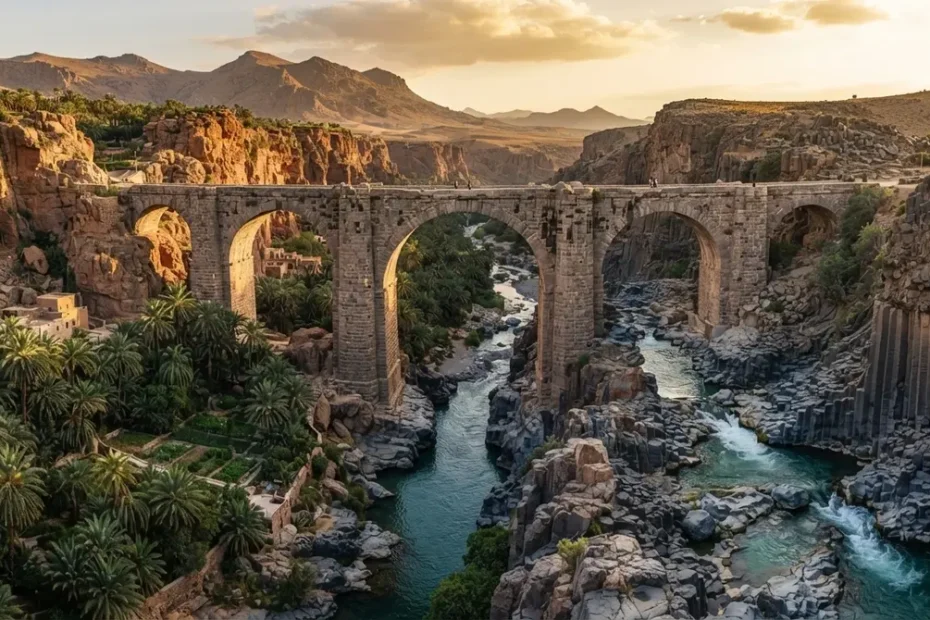
TL;DR: Derived from the classical Arabic word al-qanṭarah (“the bridge”), al-kântara connects over two thousand years of Roman engineering, North African geography, and Mediterranean trade. This comprehensive guide explores its linguistic origins, iconic stone monuments in Spain and Algeria, volcanic river canyons in Sicily, and its modern legacy in academic research and luxury industrial design.
Have you ever noticed how a single historic word can travel across continents and centuries without losing its core identity? Whether you are studying North African trade routes, admiring ancient Roman stonework in Spain, or checking the specification sheet on a high-performance sports car, the name al-kântara appears in surprisingly diverse places.
Most travelers and researchers encounter one version of the name and never realize how deeply it connects to other landmarks across the Mediterranean. In this guide, you’ll learn the Arabic etymology of the word, explore the ancient stone bridges and mountain gorges that share it, and see how this historical term evolved into a symbol of European scholarship and modern Italian design.
Quick Overview: Key Historical Facts
- Linguistic Origin: Derived from al-qanṭarah (القنطرة), the classical Arabic term for a vaulted stone bridge, arch, or aqueduct.
- North African Gateway: Refers to El Kantara in Algeria, a dramatic limestone mountain gorge known historically as the “Mouth of the Desert.”
- Roman Engineering Marvel: Shares its name with Trajan’s 2nd-century granite bridge across the Tagus River in Alcántara, Spain.
- Sicily’s Volcanic Canyon: Named after the Alcantara River in Italy, where ancient lava flows created columned basalt gorges.
- Modern Evolution: Inspired a premier Spanish academic journal (Al-Qanṭara) and a carbon-neutral synthetic suede material used in luxury vehicles.
What Does Al-Kântara Mean in Arabic Etymology?
Definition: In historical geography and linguistics, the term stems from the Arabic root q-n-ṭ-r, meaning to arch, vault, or span over a barrier. While the general Arabic word for a basic wooden footbridge or pontoon crossing is jisr, medieval Arab geographers reserved al-qanṭarah specifically for monumental, multi-arched stone masonry structures built to withstand severe river floods.
Why did ancient communities name entire towns after a single bridge? In antiquity and the Middle Ages, crossing a turbulent river or navigating a sheer mountain pass was a major logistical challenge. A permanent stone bridge transformed a treacherous crossing into a safe, reliable trade corridor. When early Arab travelers crossed North Africa and the Iberian Peninsula during the 7th and 8th centuries, Roman stone bridges stood out as monumental feats of civil engineering.
Over centuries of linguistic contact, local populations adopted the term into their regional dialects, producing several spelling variations across Europe and North Africa:
- Spanish Adaptation: Fused the Arabic article directly with the noun to create Alcántara.
- Portuguese Form: Evolved into Alcântara, famously designating a historic waterfront district in Lisbon.
- French / Colonial North African Transliteration: Written as Al-Kântara or El Kantara, using a circumflex (â) to represent the deep vowel sound spoken by local Maghrebi populations.
- Egyptian and Academic Spelling: Transliterated as El Qantara or Al-Qantara, preserving the classical qāf consonant.
Where Are the Most Famous Historical Locations Sharing This Name?
While the original term translates directly as “the bridge,” it designates four world-famous geographic landmarks across the Mediterranean basin. Each site played a critical role in military strategy, caravan trade, and regional transportation.
1. The Roman Bridge of Alcántara in Extremadura, Spain
Constructed between 104 and 106 CE under the orders of Roman Emperor Trajan, this granite masterpiece spans the Tagus River gorge near the Portuguese border. Its architect, Gaius Julius Lacer, carved a bold statement into the adjacent stone temple, declaring that he had built a monument destined to endure through the ages. Nearly two thousand years later, his dry-stone granite arches remain structurally sound.
When Moorish rulers established their presence in Al-Andalus, they marveled at the bridge’s immense size and named the surrounding settlement after it. As noted in The Art of the Umayyad Period in Spain (711–1031) published by The Metropolitan Museum of Art, the synthesis of Roman structural foundations and Islamic cultural heritage defined the architectural landscape of medieval Spain for nearly eight centuries. Later, in 1166 CE, Christian knights established the military Order of Alcántara right at this river crossing.
2. The El Kantara Gorge in Biskra, Algeria
Located in northeastern Algeria where the Aurès Mountains meet the northern Saharan plain, this limestone gorge cuts through a high mountain ridge. Local residents long called the canyon Foum es-Sahara (“The Mouth of the Desert”). Passing through the narrow passage reveals a dramatic environmental shift, transitioning from cool mountain slopes to warm desert winds over an oasis containing over 100,000 date palms.
Soldiers of the Roman Third Augustan Legion carved a highway through the gorge in the 3rd century CE, building a single-arch stone bridge over the Wadi El Hai. French military engineers widened the bridge deck in 1862, but the original Roman stone foundations still support the crossing today.
3. El Qantara on the Suez Canal in Egypt
Situated along the northeastern edge of the Nile Delta, El Qantara historically controlled the narrow overland land bridge connecting Africa to Asia along the ancient “Way of Horus.” Today, the city spans both banks of the Suez Canal, linked by the high-clearance Mubarak Peace Bridge.
4. The Alcantara River and Gorges in Sicily, Italy
Flowing along the northern base of Mount Etna, this Sicilian river carved a deep channel through ancient lava flows. Arab settlers during the Emirate of Sicily (831–1091 CE) named the river after an ancient stone bridge crossing its waters. Today, the location is preserved as a geological park famous for its hexagonal volcanic basalt columns.
How Do Different Uses of the Name Compare Across the World?
Because this historic name appears across geography, architecture, academic publishing, and industrial manufacturing, comparing the variations directly helps clear up common misunderstandings.
| Name / Spelling Variation | Category & Region | Origin Period | Key Architectural or Geological Feature | Primary Significance Today |
| Al-Kântara / El Kantara | Geography & Heritage (Biskra, Algeria) | 3rd Century CE (Roman) / Islamic Era | Sheer limestone canyon, date palm oasis, and ancient Dachra Dhahraouia village | Cultural heritage landmark and Saharan eco-tourism destination |
| Alcántara Bridge | Architecture & History (Cáceres, Spain) | 104–106 CE (Roman Empire) | Six mortarless granite arches reaching a total structural height of 233 feet (71 m) | Active road bridge and protected European historic monument |
| El Qantara | Geopolitics & Trade (Suez Canal, Egypt) | Ancient Egyptian / Medieval Islamic | Overland transit corridor across the Sinai peninsula | Strategic canal crossing linking Africa and Asia |
| Gole dell’Alcantara | Geology & Tourism (Sicily, Italy) | 9th–11th Century CE (Arab-Norman) | Columned volcanic basalt canyon walls up to 160 feet (50 m) high | Italian regional park and geological reserve |
| Al-Qanṭara Journal | Academic Publishing (Madrid, Spain) | Founded 1980 | Peer-reviewed academic research review published by Spain’s CSIC | Premier scholarly journal for Islamic and Andalusian studies |
| Alcantara® Material | Industrial Design (Milan, Italy) | Invented 1970 | High-performance synthetic suede microfiber engineered from polyester and polyurethane | Luxury interior trim for automobiles, aviation, and consumer electronics |
How Did Ancient Engineers Build Stone Bridges That Lasted 2,000 Years?
How were ancient masons able to construct massive arch bridges that survived thousands of years of floods, earthquakes, and military campaigns without using modern concrete or steel rebar? The secret lies in compressive geometry and precise stone cutting.
Clarifying the Scale of the Alcántara Bridge in Spain
Historical measurements of the Alcántara Bridge in Spain can sometimes seem contradictory if you don’t account for the structure’s distinct components:
- Bridge Deck Height: The road surface sits approximately 148 feet (45 meters) above the average level of the Tagus River.
- Total Monument Height: Measured from the riverbed piers to the apex of the central honorary Arch of Trajan, the monument reaches a total height of 233 feet (71 meters).
- Span Length: The bridge stretches 194 meters (636 feet) across the canyon using six dry-fitted granite arches.
The Five Steps of Keystone Construction
- Bedrock Foundations: Builders constructed wooden cofferdams to divert river currents, excavating down to solid bedrock to build stone piers that water could not wash away.
- Precision-Cut Voussoirs: Masons cut heavy granite blocks into precise wedge shapes called voussoirs, stacking them over wooden scaffolding frameworks known as falsework.
- Locking the Keystone: Workers drove a wedge-shaped central stone—the keystone—into the top of the arch. Once the keystone was set, the wooden scaffolding was removed.
- Compression Physics: The weight of the stone blocks pushes inward and downward, converting gravitational pull into lateral compression forces that press the arches tighter against the canyon walls.
- Mortarless Flexibility: Because builders didn’t use brittle mortar between the granite blocks at Alcántara, the structure can absorb minor seismic vibrations and thermal expansion during hot summer months without cracking.
What Is the Role of El Kantara in North African Geography and History?
In North Africa, the Algerian mountain gorge of al-kântara served as an irreplaceable trade bottleneck. Caravans transporting grain, dates, olive oil, and woven goods between northern coastal towns and Saharan settlements depended on the pass for safe transit through the Atlas Mountains.
Directly adjacent to the canyon lies Dachra Dhahraouia (historically referred to as the Red Village), a traditional settlement built from local earthen clay and stone. This historic village demonstrates how desert communities adapted their homes to natural canyon topography, using thick mud-brick walls to regulate interior temperatures against intense desert heat.
During seasonal mountain storms, violent flash floods swept through local riverbeds (wadis). Without the elevated Roman stone bridge anchored into the limestone canyon walls, seasonal trade across the region would have ground to a complete halt for weeks at a time.
Why Do Historians Value the Academic Journal Sharing This Name?
If you conduct research on medieval Mediterranean history or Islamic architecture, you will encounter this name in university library databases. Since 1980, the Spanish National Research Council (CSIC) in Madrid has published a peer-reviewed academic journal titled Al-Qanṭara.
Why did Spain’s leading research institute choose this title? The publication succeeded an earlier journal called Al-Andalus (founded in 1933) and sought a name that reflected two-way intellectual exchange between European and Middle Eastern scholars. Naming the journal “The Bridge” symbolized academic collaboration across cultural and national borders.
The journal publishes original research on medieval Islamic history, Judeo-Arabic literature, architectural restoration, and Mediterranean trade dynamics. These studies frequently rely on primary visual records, cartographic surveys, and historical photographs archived by global institutions to trace how historic bridges and fortifications changed over time.
How Did the Historical Name Connect to the Luxury Synthetic Suede Material?
One of the most frequent questions modern readers ask is how an ancient Arabic term for a stone bridge became a trademarked textile brand. If you drive a sports car or use premium consumer electronics, you are likely familiar with Alcantara® as a soft, durable, velvety material used on steering wheels, interior dashboards, and seat trim.
In 1970, Dr. Miyoshi Okamoto, a researcher working for the Japanese chemical firm Toray Industries, patented a breakthrough process for spinning ultra-fine synthetic microfibers. In 1972, Toray partnered with the Italian energy company ENI to produce the fabric in Umbria, Italy.
When choosing a brand name, company executives looked to Italian geography for inspiration. They selected the name of Sicily’s Alcantara River. The name sounded elegant across multiple languages and symbolized a connection between Japanese chemical engineering and Italian luxury manufacturing.
According to Alcantara’s official material specifications, the engineered composite fabric consists of approximately 68% polyester and 32% polyurethane. It delivers distinct advantages over traditional animal hides:
- Significant Weight Savings: It is roughly 50% lighter than natural leather of equal thickness, making it ideal for performance-focused sports cars.
- Enhanced Driving Grip: Its textured surface offers a non-slip grip on steering wheels and racing seats.
- All-Weather Temperature Neutrality: Unlike leather, which becomes hot in summer sun and cold in winter, the synthetic material maintains a comfortable surface temperature.
- Environmental Certification: The manufacturing process has maintained certified carbon-neutral status since 2009.
Practical Guide for Travelers and Heritage Researchers
Planning a visit to these historic sites or conducting architectural research? Use these five practical steps to ensure an accurate and enjoyable experience:
- Match Your Terminology to the Country: Use Alcántara (with an accent) when searching for the Spanish town in Cáceres province; El Kantara or al-kântara for the Algerian mountain gorge in Biskra; Gole dell’Alcantara for the basalt canyons in Sicily; and El Qantara for the Suez Canal crossing in Egypt.
- Schedule Spring Travel to Extremadura: If you are visiting Spain’s Tagus River region, plan your tour for April, May, or October. Summer temperatures in Extremadura regularly exceed 100°F (38°C), making daytime walking tours across the granite bridge exhausting.
- Hire a Local Guide in Biskra Province: To explore the Dachra Dhahraouia village and date palm groves in Algeria, travel with a licensed local guide. They can share verified historical details about local mud-brick preservation efforts and Roman inscriptions.
- Rent Waterproof Gear in Sicily: If you plan to wade through the Alcantara Gorges near Mount Etna, rent chest waders at the park entrance. Water running down from Mount Etna stays at roughly 50°F (10°C) even during peak summer months.
- Double-Check Academic Citations: When writing history papers, note that academic indexes list the Spanish research journal as Al-Qanṭara (with a dot under the ‘t’), while older French colonial maps catalog the Algerian gorge as El-Kantara.
Common Misconceptions to Avoid
- Misconception 1: “The Roman bridge in Spain was built by Moorish engineers.”
- Fact: Trajan’s Bridge was designed by Roman architect Gaius Julius Lacer between 104 and 106 CE. Islamic rulers who controlled the region centuries later named the nearby settlement Alcántara because of the bridge’s massive scale.
- Misconception 2: “The luxury interior fabric is made from genuine animal suede.”
- Fact: It is a 100% synthetic composite fabric engineered from polyester and polyurethane, designed to deliver higher durability and lighter weight than natural hides.
- Misconception 3: “El Kantara in Algeria and Alcántara in Spain are the same place.”
- Fact: They are separate geographical locations on different continents, connected only by their shared Arabic linguistic origin.
Key Takeaways
- Core Meaning: The name derives from al-qanṭarah, the classical Arabic term for a vaulted stone arch bridge or aqueduct.
- Two Master Crossings: Refers to Trajan’s 2nd-century granite bridge in Spain (standing 233 feet tall including its arch) and the historic Saharan mountain pass in Algeria.
- Engineering Principles: Roman stone arches used wedge-shaped voussoirs and keystone compression to survive nearly two millennia without mortar.
- Academic Leadership: Al-Qanṭara remains Spain’s premier scholarly journal for medieval Islamic and Mediterranean studies.
- Modern Design Brand: The trademarked microfiber fabric Alcantara® took its name from Sicily’s Alcantara River, bridging Japanese chemistry with Italian craftsmanship.
Frequently Asked Questions (FAQ)
What does al-kântara mean in Arabic?
Al-kântara is derived from the Arabic word al-qanṭarah (القنطرة), which translates to “the bridge.” It specifically denotes a large, vaulted stone masonry bridge or aqueduct, as opposed to a simple wooden footbridge.
How tall is the Roman Bridge of Alcántara in Spain?
The bridge road deck stands approximately 148 feet (45 meters) above the Tagus Riverbed. When measured to the top of the central honorary Arch of Trajan, the entire stone monument reaches a total height of 233 feet (71 meters).
What is El Kantara in Algeria famous for?
El Kantara is famous for its dramatic limestone gorge that serves as a natural pass between the Tell Atlas mountains and the Sahara Desert. The site features Roman bridge foundations, date palm groves, and the historic mud-brick village of Dachra Dhahraouia.
Is Alcantara fabric made from natural animal hides?
No. Alcantara® is a proprietary synthetic microfiber material invented in 1970. Composed of polyester and polyurethane, it offers the soft feel of suede with superior durability, lighter weight, and carbon-neutral manufacturing.
Why are there so many different spellings of this name?
The variations exist because different languages transliterated the Arabic letter qāf (ق) and definite article al-. This produced Alcántara in Spanish, Alcântara in Portuguese, El Kantara or al-kântara in French North Africa, and El Qantara in English.
Where is the Alcantara River located?
The Alcantara River is located in eastern Sicily, Italy. It flows past the base of Mount Etna through deep volcanic gorges made of columned basalt rock before emptying into the Ionian Sea.
Final Thoughts
It is extraordinary how a single Arabic noun—al-qanṭarah—traveled across centuries to shape global geography, military strategy, academic scholarship, and modern luxury design. From Trajan’s mortarless granite arches in Spain to the red limestone gorges of Algeria and the volcanic canyons of Sicily, this name has always stood for structural strength and enduring utility.
Understanding the history behind al-kântara reminds us that language and architecture function as living connections. They link ancient civilizations with our modern world, proving that true engineering mastery stands the test of time.
Keep Reading

What Is Mangogo (Mangago)? Platform Safety, Database Issues, and Legal Alternatives

Neworldsmagazine.com: What It Actually Publishes and How to Read It Safely

What Would Be an Appropriate Task for Using Generative AI?

What Is Tbg95? Unblocked Browser Games, Safety & Performance Guide

SparkPressFusion com: A Real-World Guide to the Media Site, Digital Tools, and Content Strategy