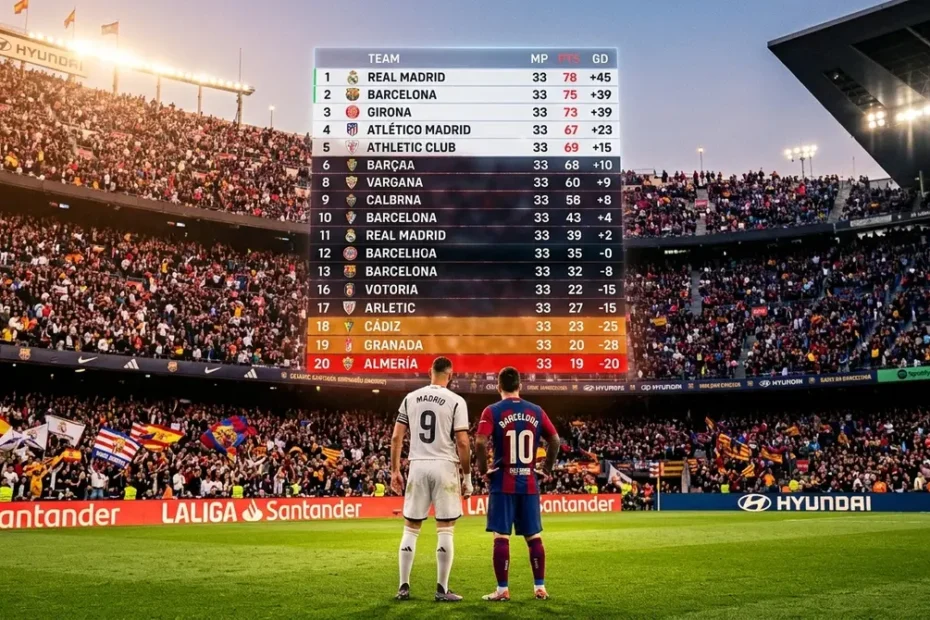
TL;DR: The Spanish La Liga standings rank 20 clubs by points over 38 matches, but head-to-head results — not goal difference — are the primary tiebreaker. This guide explains the full rules, European qualification, relegation, and the stats that actually drive the table.
You pull up the table on a Sunday night and notice two teams sitting on 54 points. One is in third, the other in fifth. That doesn’t make sense — until you realize La Liga’s tiebreaker rules are different from the Premier League’s, and overall goal difference isn’t the first thing they look at.
Understanding how the Spanish La Liga standings actually work will change the way you watch every matchday. In this guide, we’ll break down the points system, the tiebreaker hierarchy most fans get wrong, what each table position means for European football, and the underlying stats that separate genuine contenders from lucky streaks.
Quick Overview
- 20 teams, 38 matches each (home and away round-robin)
- 3 points for a win, 1 for a draw, 0 for a loss
- Head-to-head results are the primary tiebreaker — not overall goal difference
- Top 4 qualify for the UEFA Champions League
- Bottom 3 are relegated to La Liga 2
- The season runs from mid-August to late May
How the La Liga Points System Works
The foundation is simple. Every team plays 38 matches — one home and one away against each of the other 19 clubs. Win, and you pocket three points. Draw, and you take one. Lose, and you walk away with nothing.
At the end of the season, the team with the most points lifts the trophy. The team with the fewest packs its bags for the second division.
But the real complexity — and the part that confuses most casual fans — sits in the middle of the table, where teams frequently finish level on points. That’s where the tiebreaker rules come in, and they’re not what you probably think.
The Tiebreaker Rules Most Fans Get Wrong
If you’re used to the Premier League, you probably assume goal difference is the first tiebreaker. It’s not. La Liga handles ties differently, and this distinction matters more than you’d expect.
Here’s the official hierarchy, per the competition regulations:
- Head-to-head points between the tied teams (once both matches have been played)
- Head-to-head goal difference between the tied teams
- Overall goal difference across all 38 matches
- Overall goals scored across all 38 matches
- Fair play points (fewer yellow and red cards rank higher)
So if Real Betis and Villarreal both finish on 58 points, the first thing the league checks is how they fared against each other. If Betis won both meetings, they finish above Villarreal — even if Villarreal has a better overall goal difference by a wide margin.
Why does this matter mid-season?
During the first half of the campaign, before both head-to-head matches have been played, the La Liga table uses overall goal difference as a provisional tiebreaker. Once the second meeting happens, the head-to-head rule kicks in and can reshuffle positions overnight. This is why you’ll sometimes see standings swap without either team playing that weekend.
For the most accurate and up-to-date standings with these rules applied correctly, LaLiga’s official standings page is the definitive source — updated in real time on matchdays.
What About Three-Team Ties?
When three or more teams are level on points, La Liga creates a mini-table using only the matches played among the tied clubs. The same hierarchy applies within that mini-table: head-to-head points first, then head-to-head goal difference among the group, then overall goal difference, and so on. This makes multi-team ties significantly more complex — and far more dramatic in the final weeks of the season.
European Qualification: What Each Position Earns
The La Liga standings aren’t just about the title. Every position from 1st to roughly 7th carries tangible consequences for the following season’s European campaign.
| Final Position | European Competition |
| 1st–4th | UEFA Champions League (league phase) |
| 5th | UEFA Europa League (league phase) |
| 6th | UEFA Conference League (playoff round)* |
| 7th | Possible Conference League spot** |
*Exact allocation can shift depending on Copa del Rey results. If the cup winner has already qualified for Europe through league position, the spot cascades down the table.
**In some seasons, a 7th-place finish earns a Conference League berth if cup results create an extra opening.
The financial gap between Champions League and Europa League participation is enormous — often €30–50 million in direct revenue when you factor in broadcast money, matchday income, and sponsorship bonuses. That’s why the battle for 4th place is sometimes more fiercely contested than the title race itself. A single position on the table can determine a club’s transfer budget for the next two years.
For the latest on how European qualification slots are allocated across all leagues, UEFA’s official Champions League page details the current format and access list.
Relegation and the La Liga 2 Promotion Battle
The bottom of the table tells a very different story. The three lowest-placed teams at the end of the season are automatically relegated to La Liga 2, Spain’s second division.
There are no relegation playoffs to save you. If you finish 18th, you’re down. This creates an intense survival battle from roughly March onward, where clubs in 15th through 18th position are often separated by just three or four points.
What happens in La Liga 2?
The second tier features 22 teams playing a grueling 42-match season. The top two earn automatic promotion back to the top flight. Teams finishing 3rd through 6th enter a two-round playoff, with the winner claiming the third and final promotion spot.
The financial stakes are brutal. Relegation can cut a club’s revenue by 40–60% overnight due to lost TV rights money. Some clubs bounce back immediately. Others spend a decade trying to return. Girona FC’s remarkable rise — from the second division to Champions League qualification in just a few years — is the exception, not the rule.
The Stats That Actually Drive the Standings
Points tell you what happened. The underlying La Liga stats tell you why — and more importantly, whether a team’s position is sustainable over the remaining fixtures.
Expected Goals (xG)
This is the single most useful metric for reading the table critically. xG measures the quality of chances a team creates, assigning a probability to each shot based on location, angle, and type of play. A team consistently outperforming its xG is likely benefiting from exceptional finishing or short-term luck — both of which tend to regress over a full season.
If a club sitting in 6th place has an xG profile that suggests they should be 10th, don’t be surprised when they slide down the standings in the second half of the campaign.
Home vs. Away Splits
Spanish football has one of the strongest home advantages in Europe. Clubs like Athletic Club at San Mamés or Real Betis at the Benito Villamarín are dramatically harder to beat on their own turf. When you’re evaluating a team’s La Liga table position, always check whether their points are evenly distributed or heavily skewed toward home matches. A team that can’t win on the road will struggle to maintain a top-four push over 38 games.
Defensive Solidity Over Flashy Attack
Historically, La Liga champions tend to have the best defensive record in the league, not necessarily the highest goal tally. Atlético Madrid’s 2020–21 title win is a textbook example — they scored fewer goals than Barcelona but conceded significantly less. When you’re scanning the standings, pay as much attention to the “Goals Against” column as the “Goals For.”
How Elite Players Swing the Table
Standings are team achievements, but individual players can shift the entire trajectory of a season. Two archetypes consistently move the needle in Spanish football.
The Goal-Scoring Midfielder: Jude Bellingham
| Detail | Info |
| Full Name | Jude Victor William Bellingham |
| Born | June 29, 2003 (Stourbridge, England) |
| Position | Attacking Midfielder |
| Current Club | Real Madrid |
| La Liga Debut | 2023 (from Borussia Dortmund, €103M) |
| Playing Style | Late box arrivals, progressive carries, high pressing |
| Signature Impact | Scored 19 league goals in his debut La Liga season |
Bellingham’s arrival at Real Madrid illustrated something the data has shown for years: midfielders who contribute 15+ goals per season provide a points boost that’s disproportionate to their transfer fee. His ability to arrive in the penalty area at the exact right moment turns draws into wins — and those two-point swings accumulate over 38 matches to create championship-winning margins.
The Clinical Finisher: Robert Lewandowski
| Detail | Info |
| Full Name | Robert Lewandowski |
| Born | August 21, 1988 (Warsaw, Poland) |
| Position | Striker |
| Current Club | FC Barcelona |
| La Liga Debut | 2022 (from Bayern Munich) |
| Playing Style | One-touch finishing, positioning, aerial duels |
| Signature Impact | Won the Pichichi Trophy (top scorer) in his first La Liga season |
Lewandowski represents the other side of the equation. A striker who converts chances at a rate above his xG provides a consistent floor of goals that keeps a team competitive even during stretches of poor overall play. When Barcelona’s midfield struggled in his debut campaign, his individual output kept them in the title race far longer than the underlying team stats suggested they deserved.
The takeaway? When you’re reading the standings, look at which teams have players capable of producing moments that defy the underlying numbers. Those are the clubs that tend to overperform in the final weeks.
Following the La Liga Schedule Throughout the Season
The season runs from mid-August to late May, with matches spread across Friday through Monday. Midweek rounds pop up periodically, usually around Copa del Rey fixtures or European competition weeks.
A few practical tips if you’re tracking the standings week by week:
- Spanish kick-off times are late. Weekend matches frequently start at 9:00 PM or 10:00 PM CET. Plan accordingly if you’re watching from the Americas or Asia.
- The winter break is short. Unlike the Bundesliga’s lengthy pause, La Liga typically takes only about two weeks off around late December. The table can shift significantly during this compressed period.
- The final 10 matchdays are where the real drama happens. Many of the biggest relegation escapes and title-deciding swings happen in the final stretch of the season. If you’re new to following the league, that’s the period to pay closest attention to.
The official LaLiga app and website provide live updates, while platforms like FotMob and ESPN offer clean, quick-glance tables if you just want to check positions on a Monday morning.
Key Takeaways
- La Liga awards 3 points for a win, 1 for a draw, across 38 matches per team.
- Head-to-head results are the primary tiebreaker, not overall goal difference — a key difference from the Premier League.
- Top 4 earn Champions League football; the bottom 3 face automatic relegation to La Liga 2.
- Underlying stats like xG and home/away splits reveal whether a team’s table position is sustainable.
- Individual players who outperform expected metrics can swing 5–10 points over a season — the difference between Europe and mid-table.
Frequently Asked Questions
How are Spanish La Liga standings calculated?
Teams earn 3 points per win, 1 per draw, and 0 per loss across 38 matches. When teams are level on points, head-to-head results between those teams are the first tiebreaker, followed by head-to-head goal difference, then overall goal difference, overall goals scored, and fair play points.
What is the La Liga tiebreaker rule?
Unlike the Premier League, La Liga uses head-to-head results as the primary tiebreaker. Once two teams have played each other twice, their direct results determine who ranks higher — even if the other team has a better overall goal difference. Goal difference is only used provisionally before both meetings are played.
How many teams qualify for the Champions League from La Liga?
The top four teams in the final standings qualify for the UEFA Champions League league phase. This allocation is based on Spain’s UEFA coefficient ranking, which has consistently placed La Liga among Europe’s top four leagues.
How many teams get relegated from La Liga?
Three teams are automatically relegated to La Liga 2 at the end of each season. There are no relegation playoffs in Spain — if you finish 18th or lower, you’re down. They are replaced by two automatic promotees and one playoff winner from the second division.
When does the La Liga season start and end?
The season typically begins in mid-August and concludes in late May. There is a brief winter break of roughly two weeks around late December and early January, shorter than most other major European leagues.
What does the Pichichi Trophy mean?
The Pichichi Trophy is awarded to La Liga’s top goal scorer each season. It’s named after Rafael “Pichichi” Moreno, a legendary Athletic Club striker from the 1910s and 1920s. Winning it is considered one of the highest individual honors in Spanish football.
Conclusion
The Spanish La Liga standings are more nuanced than a simple points tally. The head-to-head tiebreaker rule, the financial chasm between European qualification spots, and the underlying stats that predict future movement all add layers that reward fans who look beyond the surface.
Whether you’re tracking a title race, a battle for fourth, or a desperate relegation scrap, understanding these mechanics makes every matchday richer. The table doesn’t lie — but it has a lot more to say than most people realize.
Keep Reading

What Is a Webtoon and Why Are Millions Reading Vertical Comics?

Who Is Erika Tureaud? Inside Mr. T’s Comedian Daughter

What Are the Best Delinquent’s First Love Manga & Anime?

Novelbin Platform Review: Is It Safe, Legal, and Worth Your Time?
Gajgry: The Complete Guide to Downpipe Debris Traps, Rainwater Gullies, and Roof Drainage Protection